Author’s note: This article refers to 29 degrees Capricorn (29 Capricorn through 0 Aquarius), not the 29th degree of Capricorn (28-29 Capricorn).
Sign: Capricorn (Internalized external expectations. Status, order, and hierarchy. Fear of failure. Scarcity mentality. Authority, sovereignty and dignity. Large corporation and institutions.)
Decanate: Virgo (Skills, functions, work ethic, the search for truth, noble goals, technocrats and bureaucrats.)
Duad: 12th duad Sagittarius (Courage and search for freedom in the face of grave danger. Secrets and uncertainty.)
Degree number: 29 (Acceptance and resignation. Adopt or die.)
Numerology: 11 (Personal relation with the Oneness)
Working Symbols:
(1) In the aftermath of a disaster, an underground political party swiftly overthrew the dictator in power and established a new regime.
(2) A skilled pilot overcame fear to complete a monumental test flight during an unexpectedly severe storm.
(3) After a closed-door meeting, authorities provided fabricated and ambiguous answers in a news conference.
The last degree of a zodiac sign is commonly known as the anaretic degree. Its energy is dominated by the conflict between three neighboring signs: the dominant sign (in this case, Capricorn) is undermined by its predecessor (12th-duad Sagittarius) while being challenged by the incoming sign (Aquarius), which aims to make incumbent irrelevant and obsolete. The tension among conflicting qualities makes this degree cagey and crisis-prone.
The degrees 20 through 29 in the 30-degree cycle are related to people and matters at the outer reaches of our influence. At 29 Capricorn, the dominant energy is past its prime and in decline. There is a prevailing now-or-never, even do-or-die urgency.
People with a natal planet or crucial point straddling between two signs are acutely aware of the impermanence and transient nature of their worldly existence. There is a constant, nagging anxiety about time running out and opportunities slipping away. The internal countdowns force them to ponder on their achievement and legacy at an early age. As their own perspectives and priorities shift, life becomes a series of last-ditch efforts as they grasp at the shifting sands, constantly falling behind.
The tension and urgency drown out the subtler influences, but they are nonetheless parts of the whole. The decanate energy (Virgo) is still in play, directing attention to ethics, standards, and truths (or the lack thereof). This degree suggests resignation and acceptance of a trajectory beyond one’s control; number 11 brings the spiritual dimension to the degree – it could be “let go and let God” as well as god-like arrogance. The 12th duad resonate a 12th house vibe, adding secrecy and uncertainty (sometimes intentionally), while Sagittarius brings faith and freedom into to the mix.
In the case of 29 Capricorn, the threshold between Capricorn and Aquarius holds the potential for great insights and the opportunities for breakthrough – if one can muster courage, faith, and cool detachment. That being said, it comes with a lot of caveats. Kozminsky Degrees observed the influence of 12th duad Sagittarius and noted those under its influence “is cautious and generally fortunate, … may gain a position of importance, but will not be able to hold it, … The higher he aims the more he renders himself vulnerable to shafts of those above him.”
Carelli Degrees warned: “inability to alter the direction of one’s inborn impulses. … Lofty ambitions, huge hopes; an extraordinary energy, often foreign to the native himself, but anyhow likely to boost him very high; but he may dash along like a fiery meteor, whereas the results of his actions will disappoint everyone as the power propelling him toward the goal may lot [sic] him overreach himself and go astray.” Sepharial similarly cautioned that “with the decline of his natural forces there will be a falling off of ambition and purpose.”
The arc of a hero’s meteoric rise and fall is aptly illustrated by the life of Charles Lindbergh, who has Jupiter at this epic degree. Ill-prepared for the publicity following his historic solo trans-Atlantic flight, Lindbergh and his family self-exiled to Europe.
Lindbergh considered communism as a greater threat to Western civilization than fascism. He learned firsthand about Germany’s advanced technology through numerous official visits, and hoped that Germany, if left unchallenged, would expand eastward and defeat the Soviet Union. This would allow the United Kingdom and France time to build up their militaries and, should Germany be weakened in the process, avert the devastating war in Western Europe which, in his opinion, would either results in Germany’s victory or devastation of entire western civilization.
At the onset of World War II, Lindbergh strongly advocated the preservation of American independence and democracy through impenetrable defense and staying out of the European war. In public speeches, Lindbergh called out the British, the Jewish and the Roosevelt administration as “war agitators” and accused the Roosevelt administration of dictatorship and deceit in its rush to war. President Roosevelt, infuriated and threatened, was convinced that Lindbergh was a Nazi, despite his secret inquiry had failed to produce any evidence. Three days after Roosevelt publicly labeled Lindbergh as a “Copperhead”, comparing him to Northern traitors and saboteurs during the Civil War, Lindbergh resigned his military commission in protest. He was publicly opposed by families and associates, denounced as an anti-Semite, a racist, a Nazi-sympathizer and an appeaser.
After Japan’s attack on Pearl Harbor, Lindbergh devoted wholeheartedly to the U.S. war effort, flying 50 combat missions as a civilian aviator while President Roosevelt refused to reinstate him. It was not until 1954 that President Dwight Eisenhower restored Lindbergh’s commission and promoted him to brigadier general. But the damage to his reputation was irreversible.
Witnessing the destruction of nature and civilization by his beloved science, Lindbergh grew disillusioned with human intelligence and technological progress. He became a crusader for conservation cause, racing to save indigenous tribes and endangered species of animals from extinction.
This complicity of this degree is beautifully distilled by Lindbergh’s reflection on his existence in the continuum in space and time, between the material and the mystical:
I grow aware of various forms of man and of myself. I am form and I am formless, I am life and I am matter, mortal and immortal. I am one and many — myself and humanity in flux. I extend a multiple of ways in experience in space. I am myself now, lying on my back in the jungle grass, passing through the ether between satellites and stars. My aging body transmits an ageless life stream. Molecular and atomic replacement change life’s composition. Molecules take part in structure and in training, countless trillions of them. After my death, the molecules of my being will return to the earth and sky. They came from the stars. I am of the stars.
Charles Lindbergh, Autobiography of Values
Despite their apparent conflict, Capricorn and Aquarius in mundane astrology share a preoccupation with authority and order. While Capricorn rules through individuals at the top of the social hierarchy, Aquarius rules through the groups and committees. From competing egos to competing ideologies, both camps attempt to claim orthodoxy and maintain superiority by excluding and oppressing those who refuse to fall in line. Despite Aquarius’ contrarian tendency and its upending of the existing framework, it shares with Capricorn dictatorial tendencies and a disregard for individual freedom.
As the Capricornian (ego-based) order breaks down, an Aquarian new order is shaping up at neck-breaking speed. Truth, common sense, and conventions are stretched to the breaking point by various interest groups. Pluto in Capricorn era brought immense power to large corporations; Pluto in Aquarius will be the era of weaponized ideologies, warring factions, breakthroughs in experimental technologies, some of which will be destructive. We can expect large technology corporations to continue dominating our world, and drastic upheavals in the pecking order of power players.
This new regime is revolutionary, technocratic, and group-centric, where the individuals merge into the group identity and relieve themselves of personal accountability. Without self-determination and self-awareness, a transition to transpersonal consciousness is no guarantee of humanity’s ascent up the evolutionary ladder.
At degree 29 of Capricorn, we find difficult transitions and uncertainties that call for faith, adoption and acceptance. Recurring themes include: breakdown and degradation of structure, paradigm, standards and objective truth; crowd control through censorship, secrecy and misinformation; and drastic rise and fall of prestige and status.
Courage and leap of faith during crises
Charles Lindbergh (Jupiter), American aviator who piloted first solo trans-Atlantic flight.
What pilot has not been in positions where he was in danger and where perfect judgment would have advised against going? … If one took no chances, one would not fly at all. … What kind of man would live where there is no daring? And is life so dear that we should blame men for dying in adventure? Is there a better way to die?
Charles Lindbergh, The Wartime Journals
Subjective facts, relative truths, and the changing science
Jules Verne (Uranus), French novelist who is considered as one of the founders of the science fiction genre. Verne argued that his scientific novels were not based on science and should not be treated as such. He was merely attempting a “very high ideal of beauty of style” and giving romanticized descriptions of the world.
William James (North Node), American psychologist and philosopher who established Pragmatism.
Hands off: neither the whole of truth nor the whole of good is revealed to any single observer, although each observer gains a partial superiority of insight from the peculiar position in which he stands.
William James, Talks to Teachers on Psychology: And to Students on Some of Life’s Ideals
The “facts” themselves meanwhile are not true. They simply are. Truth is the function of the beliefs that start and terminate among them.
William James, What Pragmatism Means
The critic’s trouble … seems to come from his taking the word “true” irrelatively, whereas the pragmatist always means “true for him who experiences the workings.”
William James, The Meaning of Truth
Joseph Campbell (Chiron), American writer and mythologist.
You must remember: all of the great traditions, and little traditions, in their own time were scientifically correct. That is to say, they were correct in terms of the scientific image of that age.
Joseph Campbell, Mythology and the Individual
Werner Heisenberg (Venus), German physicist who discovered the Uncertainty Principle.
Every experiment destroys some of the knowledge of the system which was obtained by previous experiments.
Werner Heisenberg, The Physical Principles of the Quantum Theory
Of course, we all know that our own reality depends on the structure of our consciousness; we can objectify no more than a small part of our world. But even when we try to probe into the subjective realm, we cannot ignore the central order…In the final analysis, the central order, or ‘the one’ as it used to be called and with which we commune in the language of religion, must win out.
Werner Heisenberg as quoted in Quirks of the Quantum Mind
Kellyanne Conway (Sun). President Trump’s 2020 campaign manager and first woman to run a successful presidential campaign. During her term as the Senior Counselor of the President, she coined the term “alternative facts” and repeatedly referred to the fictitious “Bowling Green massacre” as facts.
Dec 7-16, 2020 (Saturn), U.S. Food and Drug Administration confirm that Pfizer’s vaccine candidate is 95% effective. The first emergency use authorization for the Pfizer-BioNTech COVID-19 Vaccine was issued and the vaccine campaign began.
February 16, 2023 (Pluto). Chinese president Xi declared “decisive victory” over COVID after uncontrollable spread and lockdown protests.
March 14, 2023 (Pluto), OpenAI released GPT-4. Despite of capable of passing standardized tests (some with flying colors), it is also known for hallucinating, internal inconsistency, deception, erratic behavior, and strong bias.
Structural damage; breakdown or breakthrough of boundary, order, or paradigm. Drastic changes in social, economic, or political principles. Meteoric rise and fall.
Titanic maiden voyage (Moon). Titanic struck an iceberg and broke in half on its maiden voyage.
Halle Berry (MC), first African-American to win the Academy Award for best actress.
Bitcoin (Jupiter). A cryptocurrency regarded by its proponents as the tool against government surveillance and central banks’ currency manipulation.
March 9-20, 2020 (Saturn). Stock market “Black Monday I” (Marcy 9, 2020) “Black Thursday” (March 12, 2020) and “Black Monday II” (March 16, 2020). Italy, Norway, and Spain started nationwide lockdown. Federal Reserve announced that it would cut the federal funds rate target to 0%–0.25%, lower bank reserve requirements to zero, and begin a $700 billion asset purchasing program. BlackRock, the world’s largest asset management firm and the leader in exchange-traded funds, managed the purchasing program on Federal Reserve’s behalf and was allowed to purchase its own funds.
December 14-19, 2020 (Jupiter) Germany, The Netherlands, Turkey, Poland entered nationwide lockdown. In the U.S., the Electoral College meets in the state capitals to officially elect the next President. Joe Biden. Outgoing President Donald Trump continues to dispute the results of the election, citing widespread electoral fraud.
December 16, 2020 (Jupiter-Saturn super conjunction) Twitter says that it will ban false and misleading claims about COVID-19 vaccines on its platform. The Federal Reserve vowed to keep funneling cash into financial markets until the U.S. economic recovery is secure, Nasdaq Composite closed at a record high.
Reference
Campbell, Joseph. Mythology and the Individual. Audio. Joseph Campbell Foundation, 1997.
Carelli, Adriano. The 360 Degrees of the Zodiac. American Federation of Astrologers, 2000.
Charubel, and Sepharial. Degrees of the Zodiac Symbolized. Astrology Center of America, 2005.
Cole, Wayne S. Charles A. Lindbergh and the Battle Against American Intervention in World War II. Houghton Mifflin Harcourt P, 1974.
Part 3 is a survey of the crucial points of the U.S. Pluto cycle. These dates are determined by aspects formed between the transiting Pluto and the U.S. Pluto. Only major aspects – 60, 90, 120, and 180 degree – are included. As mentioned in part 2, for the sake of precision, I use an 1-degree orb, i.e. only events that took place when the transiting and natal Pluto are within 1-degree of forming an exact aspect are included. –Author
Dubbed “America’s first great depression,” the financial crisis in 1819 was a result of contraction of demand and money supply at the end of Anglo-French war in 1815.
The Panic was precipitated by the need for the Bank of the United States to save itself by reversing its credit expansion and contracting its loan sharply. This sudden contraction, precipitated in the summer and fall of 1818, forced the state banks to contract their loans as well. It brought an unpleasant day of reckoning to those over-inflated banks, which were now called upon to meet their unfulfillable promise to redeem their banknotes in specie. The result was a run of bank failures, and a severe contraction of banknotes throughout the country.
Murray N. Rothbard, “The Frankfort Resolutions And The Panic Of 1819.”
U.S. prospered during the European conflict as the neutral exporter to the warring countries. Owing to the disruption in European agriculture production, American agriculture imports were in high demand. U.S. domestic inflation further elevated the price of produce such cotton, tobacco, and wheat. Farmers and investors, anticipating sustained price increase, rushed to expand their land holding, creating the “land boom.”
The land rush was also promoted by the U.S. government, who incurred massive national debt during the Louisiana Purchase and The War of 1812. In anticipation of a revenue boost, millions of acres of western land were released to the public with generous purchasing terms. Buyers with insufficient funds were allowed to purchase with credit.
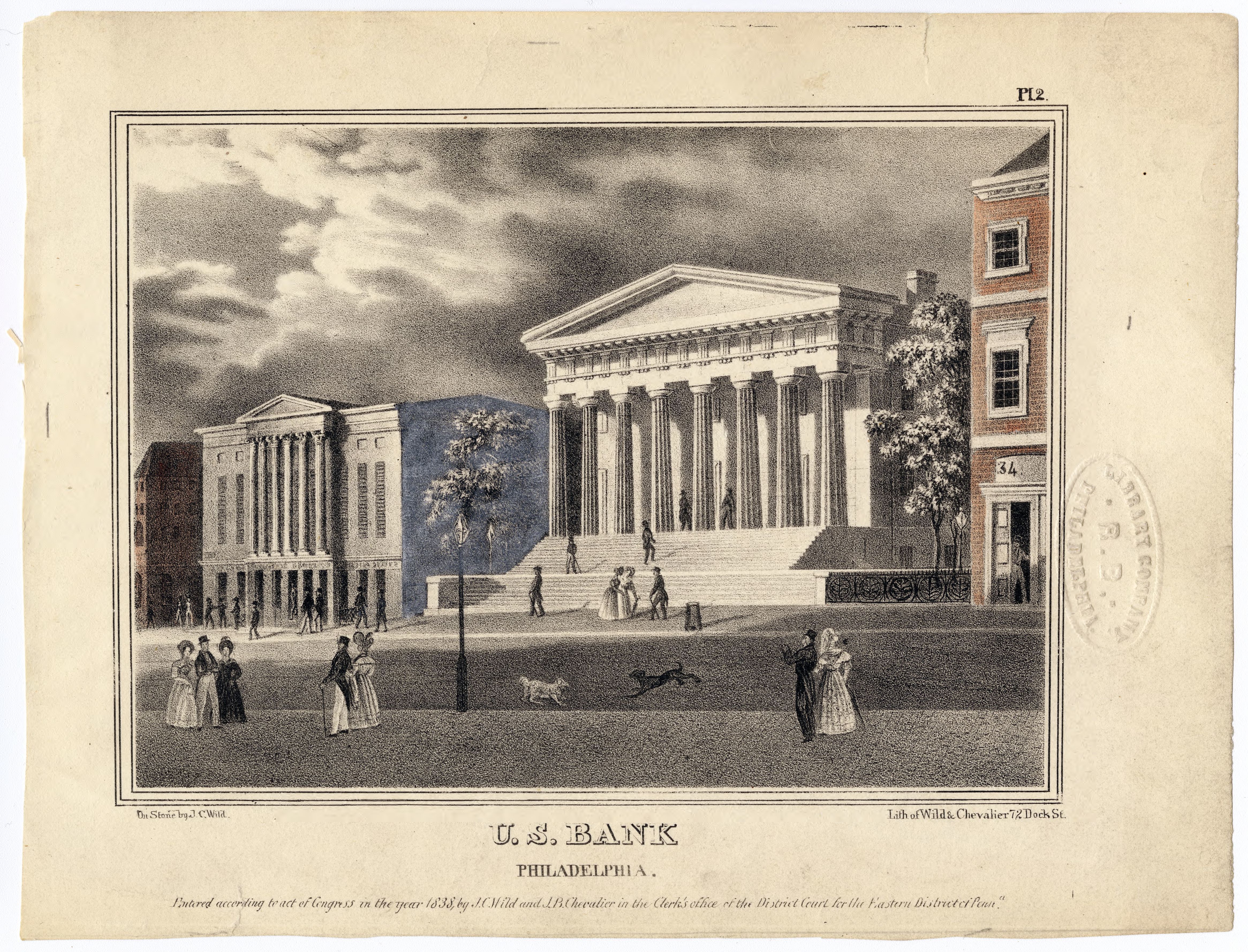
After the termination of First Bank of the United States in 1811, U.S. government, citizens and enterprises had relied on unregulated and under-capitalized “wildcat” state banks for funding. The suspension of specie (gold and silver coins) conversion in 1814 allowed these banks to freely issue banknotes with minimal reserve, subsequently greatly expanded the money supply. Between 1811 and 1815, the number of state banks in the U.S. rose from 88 to 208 while the national money supply doubled (Rothbard, 2007).
Money, or what passed for money, was the only cheap thing to be had…. The State banks were issuing their bills by the sheet, like a patent steam printing press its issues; and no other showing was asked of the applicant for the loan than an authentication of his great distress for money. …They generously loaned all the directors could not use themselves, and were not choice whether Bardolph was the endorser for Falstaff, or Falstaff borrowed on his own proper credit, or the funds advanced him by Shallow.
Joseph G. Baldwin. The Flush Times of Alabama and Mississippi.
The money supply exploded, wildly variable discount rates among banks began to cause chaos in the financial system. Premiums for redeeming specie were common place. Some banks even resorted to intimidation and lawsuits when customers attempted to convert their banknotes for specie. (Rothbard, 2002). The Second Bank of the United States was chartered in 1816 to establish uniformed convertibility among banknotes and restore trust in banks.
The largest corporation in its time, the national bank was owned by the federal government as well as foreign and domestic shareholders. The bank was entrusted with conducting all fiscal transactions for the U.S. Government, and paradoxically, according to secretary of the treasury William Crawford (1816-1825): “The first duty of the Board is to the stockholders; the second is to the nation.” (Browning, 2019).
With this conflict of interests in mind, perhaps it was not astonishing that the bank not only caved in to the financial and political interests of its shareholders, drastically amplifying the money supply and inflation, it was also derelict in reinforcement of the specie conversion, “outright fraud abounded” (Rothbard, 2002).
On the eve of the crisis, the explosion of money and credit spilled into infrastructure construction and international trade. Inflation was rampant. An outflow of specie drained the bank reserves across the country. Vicious dumping of cheap British imports devastated the once-burgeoning domestic manufacturing, an urban depression was underway. Since Britain’s conditional ban on imported grain in 1815, Europe has recovered from previous crop failure and resumed post-war agriculture production, which lead to reduced demand and production of American agriculture imports. The sudden collapse in price was precipitated by Britain’s switch to cheap Indian cotton in 1818. Farmers’ and investors’ profit plummeted, defaulted on their loans, setting off bank failures.
It was not until mid-1818, when U.S. must repay foreign debtor in gold or silver, did the national bank abruptly restricted loans and demanded immediate specie redemption from state banks. These high-flying banks, unable to meet the requirement, in turn recalled loans and demand immediate payment from their stressed borrowers. Mass default and bankruptcy ensued, triggering a banking crisis and the Panic of 1819. The money supply contracted 50% between the spring of 1818 and summer of 1819. The price of staples fell by 51% between November 1818 and June 1819 (Rothbard, 1963). Farmers and investors saw the price of their land dropped as much as 75%. In once thriving urban manufacturing centers, employment and income plummeted. Unemployment reached 50% in Pittsburgh and Philadelphia (Browning, 2019). Poverty was widespread and middle class crowded the debtors’ prison.
All the flourishing cities of the West are mortgaged to this money power. They may be devoured by it at any moment. They are in the jaws of the monster! A lump of butter in the mouth of a dog! One gulp, one swallow, and all is gone.
Missouri Senator Thomas Hart Benton (1821-1851)
The banking crisis lasted from 1818 to 1819. The depression was lifted in 1821, but its impact persisted into mid-1820s. The national bank, through increasing reserve requirement, quickly brought the financial crisis under control — at the cost of exacerbating and prolonging the depression. Distressed assets from borrowers were seized by the national bank and sold cheaply to those with means. State governments were powerless to restrain the federal bank.
In 1820, congress reduced the size and price of public land and banned the purchase of public land on credit installments. Subsequent relief programs for earlier buyers (1821) included interest forgiveness, price reduction, extended loan terms and return options. These relief measures set the precedent for controversial government interventions during future crisis.
This crisis was regarded as the start of modern boom-bust economic cycle. The corruption of banks and government were on full display throughout the first nationwide crisis. It became apparent that banks served their shareholders at the expense of their customers, and the wealthy and well-connected was able to ride out, even profited from the financial devastation. Predictably, the distressed asset price paved way for future consolidation. It also deepened the riff between states and federal government, the industrialized North and export-dependent South, the conservative East and expansionist West. The nationwide hatred toward the banks would last for decades and the bitterness toward the federal government would feed Southern sectionalism and sow the seed of civil war. The heated debate between sound money vs. debasement persisted to this day.
Reference
Browning, Andrew H. The Panic of 1819 the First Great Depression. Columbia: University of Missouri Press, 2019.
Rothbard, Murray N. “The Frankfort Resolutions And The Panic Of 1819.” The Register of the Kentucky Historical Society 61, no. 3 (1963): 214–19. http://www.jstor.org/stable/23375967.
Rothbard, Murray N. 2002. A History of Money and Banking in the United States. Ludwig Von Mises Institute.
Evidently, a narrative that negates all traces of a matter as massive as slavery must inevitably distort the rest of the story as well. From the meaning of freedom to the understanding of human nature, to the perception of God’s Providence, all elements of Americans’ understanding of their great national experiment were warped and reshaped to conform to the demands of a version of the tale in which the enslavement and dehumanization of millions of their fellow creatures could be deemed compatible with the values of the republic.
Robert Pierce Forbes. The Missouri Compromise and Its Aftermath.
Founders’ Compromise
Reason, justice, equity never had weight enough on the face of the earth to govern the councils of men; it is interest alone which does it, and it is interest alone which can be trusted.
Thomas Jefferson, “12 July, 1776” in Jefferson Autobiography
Coincided with the Panic of 1819, unprecedented threats of disunion and civil war erupted over the future of slavery.
The anti-slavery language was left out in the Declaration of Independence for the sake of unanimity. At Constitutional Convention of 1778, the delegates again faced the same quandary: a union with slavery vs. no slavery, no union.
Great as the evil is, a dismemberment of the Union would be worse. If those states should disunite from the other states for not indulging them in the temporary continuance of this (slave) traffic, they might solicit and obtain aid from foreign powers.
James Madison, Debate in Virginia Ratifying Convention, June 15, 1788
The political evil was inherent in the constitution itself, which brought States slaveholding and non-slaveholding into indissoluble bonds, providing no radical means for assimilating their condition. The anti-slavery spirit of 1776 had died out, or rather had exhausted its power of persuading States to emancipate…
James Schouler, History of the United States, Volume IV
Northern delegates conceded again, acquiescent in the belief that slavery will eventually become economically unsustainable and die out. With no foreseeable increase in demand of slave labor, the delegates prohibit the restriction of –thus continuing – Atlantic slave trade for the next twenty years, and left the thorny issue to individual states in the Tenth Amendment (1791): “The powers not delegated to the United States by the Constitution, nor prohibited by it to the States, are reserved to the States respectively, or to the people.”
After the “Act Prohibiting the Importation of Slaves” took effect in 1808, the nation settled on the future decline of slavery, yet domestic slave trade remained. The entire U.S. population continued to participate in trading and consuming goods produced by domestic and oversea slave labor. The invention of cotton gin in 1793 had revolutionized cotton processing, vastly increased the productivity and profit of cotton production, which almost entirely the product of slave labor. The “cotton boom” after the War of 1812 sent the production and worldwide demand for American cotton soaring. U.S. cotton export grew from $5,700,000 to $20,000,000 between 1800 and 1820, and the value of slaves was said to have increased three-fold in the same period. (Woodburn, 1894) Slavery became profitable and vital to the national economy once more.
The Tallmadge Amendment
In 1812, Louisiana territory –the first from the Louisiana Purchase – entered the union as a slave state. Missouri territory was expected to follow suit in 1818. In the course of debate, New York Representative James Tallmadge Jr. and Charles Baumgardner submitted two amendments to Missouri’s admission to the union:
“… that the further introduction of slavery or involuntary servitude be prohibited, except for the punishment of crimes, whereof the party shall have been fully convicted; and that all children born within the said State, after the admission thereof into the Union, shall be free at the age of twenty-five years.”
The Tallmadge Amendment was the first serious challenge to the southern status quo, an uneasy balance of power based on the joint evasion of morality of human bondage and servitude. The debate largely focused on the interpretation of the constitution. The discourse on morals was considered offensive by the southerners as it violates the state sovereignty and the long-standing understanding between the two sides of the slavery issue.
The debate on Tallmadge’s amendment was inconceivably intense and hostile, and involved open threats of disunion and civil war:
“If a dissolution of the Union must take place, let it be so! If civil war, which gentlemen so much threaten, must come, I can only say, let it come!”
Representative James Tallmadge Jr. of New York
The measure passed the house but failed in the Senate. Missouri’s statehood was in limbo at the close the 15th session of Congress. Over the recess, bitter resentment, and indignation raged across the country in town hall meetings, pamphlets, petitions, and newspaper essays. Northern antislavery force demanded that Missouri abandons slavery and the prohibition extended to all future territories. Missourians and their southern supporters decried the unwarranted delay and unfair restriction.
Political Distrust
…we have the wolf by the ear, and we can neither hold him, nor safely let him go. justice is in one scale, and self-preservation in the other.
Letter from Thomas Jefferson to John Holmes (April 22, 1820)
Self-Preservation
Southerners did not trust the North’s humanitarian anti-slavery argument. Rather, they viewed Northern restrictionists’ effort as a plot to revive the Federalist party and return to an era of a strong national government. The call for Revolutionary ideal of liberty and equality was perceived as encroachment on state sovereignty and dreaded incitement to slave riots.
The crux of the pro-slavery argument was the Southern slave holders’ prosperity and political dominance. Virginian planter class, and by extension, Southern slaveholders, have served almost consecutively in the White House and held high offices since the founding of the nation. The nation’s capital, border on Virginia and Maryland, was the center of domestic slave trade. Virginia held almost 1/3 of the nation’s slave population and was eager to push the surplus to the new territories.
Southern Founding Fathers, James Madison and Charles Pinckney stressed that the Constitutional Convention had not authorized any extraordinary congressional control over slavery. Thomas Jefferson, likewise, recoiled against all the northern constitutional innovations spawned by the Missouri crisis. Jefferson adopted the argument that “diffusion” of the institution in the West would not increase the total number of slaves and “would make them individually happier and facilitate their eventual emancipation.”
Don E. Fehrenbacher. The Slaveholding Republic.
Since the industrialization of cotton production and the upsurge of cotton export, slavery not only became enormously profitable but made its westward expansion. Up against the enormous economic incentive, Southern antislavery sentiment wavered, and the Revolutionary philosophy became irrelevant and inconvenient history.
Most southern representatives in the Congress continued to denounce slavery, but their words had become increasingly hollow. Apathy and resignation gradually set in. It was accepted that nothing –nonthreatening to the slaveholding class, at least –could be done. Many simply set the date of eventual abolition to the infinite future.
Charles Pinckney – founding father, signer of the Constitution, three-term South Carolina governor, ambassador, and two-term congressman –defended slavery. Citing historical precedents in ancient civilization and indigenous slavery in Africa, he asserted that slavery was human nature, and implied that the institution was common good of slaves and slaveholders:
A free black can only be happy where he has some share of education and has been bred to a trade or some kind of business. The great body of slaves are happier in their present situation than they could be in any other, and the man or men who would attempt to give them freedom, would be their greatest enemies.
Charles Pinckney’s Speech to Congress, 1820.
The South also extended their legal argument against the Tallmadge amendment on the sovereignty and equality of the of the state (Woodburn, 1894). Quoting the second half Article, 4 Section 3, Clause 2 of the U.S. Constitution: “…nothing in this Constitution shall be so construed as to Prejudice any Claims of the United States, or of any particular State”, along with the Tenth Amendment, they argued that the Constitution, by intentional omitting the slavery issue, has relinquished its claim to restriction. Slavery is an issue to be decided by individual states. Tallmadge amendment was unconstitutional because it placed the constraint on the admission of Missouri alone. Besides, since slaves were treated as property, banning slavery would amount to illegal seizure of personal property, prohibited by the Fifth Amendment.
Morals and Principles
I was aware of the delicacy of the subject and that I had learned from Southern gentlemen the difficulties and the dangers of having free blacks intermingling with slaves;… While we deprecate and mourn over the evil of slavery, humanity and good morals require us to wish its abolition, under circumstances consistent with the safety of the white population. Willingly, therefore, will I submit to an evil which we cannot safely remedy… But, sir, all these reasons cease when we cross the banks of the Mississippi, a newly acquired territory, never contemplated in the formation of our Government, not included within the compromise or mutual pledge in the adoption of our Constitution, a new territory acquired by our common fund, and ought justly to be subject to our common legislation.
Tallmadge’s Speech to Congress, 1819
The North did not see any attempt to end the slavery on the South’s part. Instead, they saw a revival and the intention to extend and expand. For the Northern restrictionists, the future of slavery was at stake –not only in Missouri, but in all new states and territories. They sought to implement the Northern Ordinance to the regions west of Mississippi River and Florida, and put an end to the expansion of slavery for good.
They argued on humanitarian ground and maintained that the Declaration of Independence and the Constitution provided the ground for abolition. While some claimed that Article I Section 8 would suffice to restrict all slave trades, the most eloquent proponent of Tallmadge Amendment, New York Senator Rufus King, cites first part of Article, 4 Section 3, Clause 2: “The Congress shall have Power to dispose of and make all needful Rules and Regulations respecting the Territory or other Property belonging to the United States” and contend that the Congress was granted the power to dictate the condition of admission of each state. Slavery was an evil disgrace forced upon the colonies. This wickedness was only tolerated for the sake of the Union and should be restricted at the earliest expediency.
Almost all debates surrounding Missouri Crisis could be boiled down to the balance of powder, however. Despite dominating the House, North’s demographic lead did not translate into their political sway. Equal number of Senators from each state gave the less populated South an unfair advantage. Maintaining the power balance depends on equal number of free and slave states.
The North had been pained by the three-fifth clause, which adds 60% of the slave population to the slave states’ free population for calculating taxation and assigning House representative seats. Originally meant as a compromise to discourage the growth of slavery, the three-fifth clause gave southern states more congressional representatives and more electoral votes for president than their white population entitled.
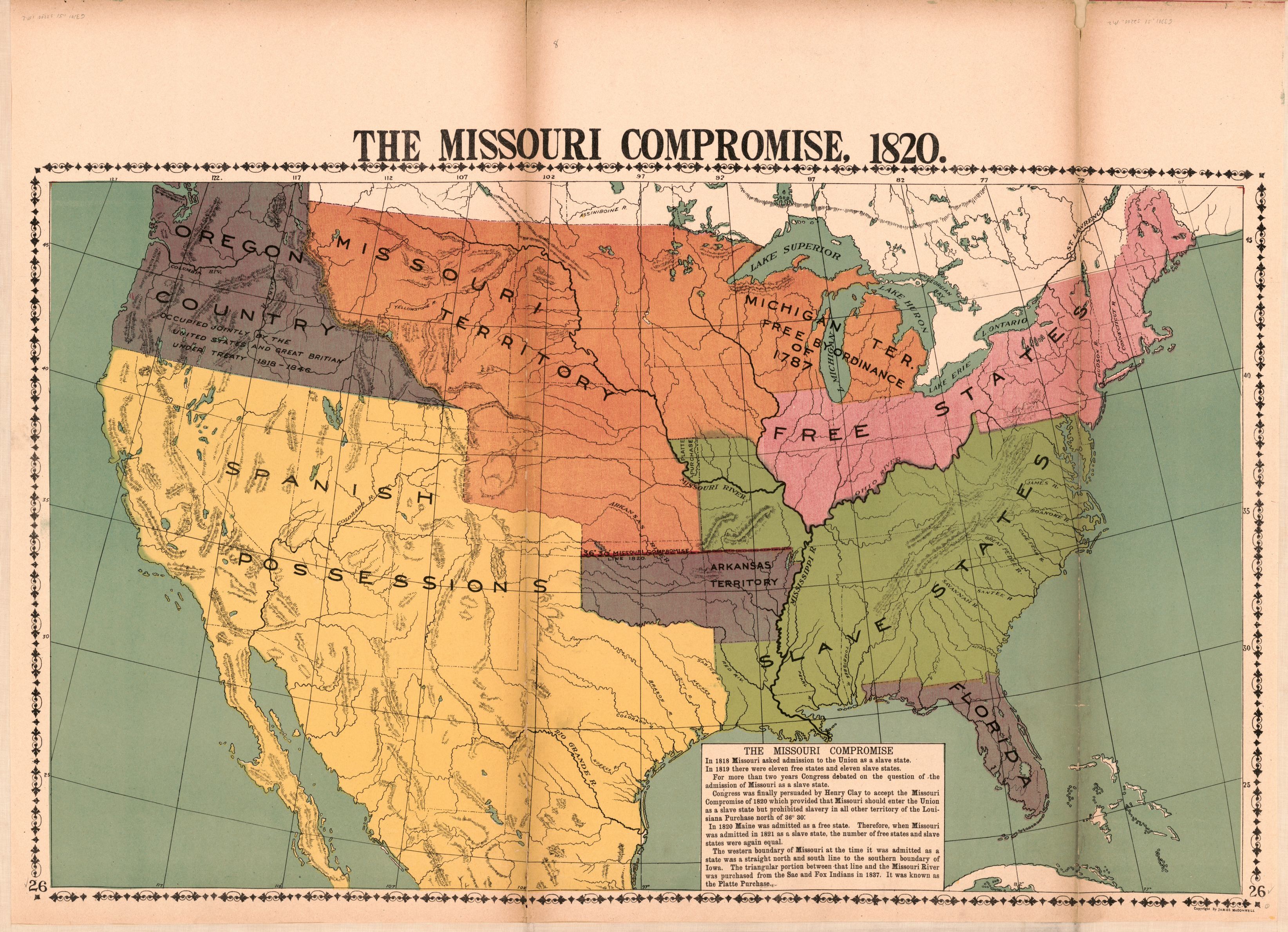
At the time of Missouri’s request of statehood, the nation contained 11 free states and 11 slave states at the time. Missouri’s entry as a slave state would have tipped balance of power in South’s favor; with the Tallmadge Amendment approved the antislavery stance would gain strength going forward. Aggravated by the dominance of “Slave Power,” North feared that if Missouri’s slave state status would solidify South’s dominance. Worse still, it could lead to more slave states and perpetuate their reign in national politics.
Congressional Wrangling
Missouri renewed its request after the Congress reconvened; Maine also applied to join the union. The Senate amended the Maine admission with the unconditional acceptance of a slaveholding Missouri but the coercion was called out by Northern House representatives. Seeking incentivize the bill passage, Senator Jesse Thomas of Illinois added a proviso that allows slavery in Missouri, but “forever prohibits” slavery in all remaining areas of the Louisiana Purchase north of the 36° 30′ parallel, an area mostly uninhabited at the time. The bill passed the Senate and again rejected by the House.
In respond to the Senate’s strong-arming, the House passed its own bill admitting Missouri with the antislavery Tallmadge Amendment. The bill was rejected by the Senate and the Congress came to a deadlock.
A sullen gloom hung over the nation. All felt that the rejection of Missouri, was equivalent to a dissolution of the Union: because those states which already had, what Missouri was rejected for refusing to relinquish, would go with Missouri.
Abraham Lincoln, Eulogy of Henry Clay
The Senate called for a committee of conference thenext day. Kentucky Senator Henry Clay, then Speaker of the House, also known as “The Great Compromiser,” spearheaded the compromise effort. A slave owner himself, Clay had argued for “the inviolability of this species of property” granted by the Constitution and advocated “diffusion” and “colonization” as the ultimate and humane solution to slavery. He, along with Thomas Jefferson, James Madison and then-President James Monroe claimed that it was only humane to disperse South’s surplus slave population westward, and expatriate them when free labor is plenty and slave-holding becomes unaffordable in time. This would defuse the tension among the dense and restless southern slave population and lessen the threat and stress of the slaveholders –while profiting through the domestic slave trade.
Clay’s optimism about the compromise was soon threatened by the building momentum of the antislavery force. Fearing an impending all-out restriction on slavery, Clay rushed to forge a compromising majority by instilling the fear of disunion and accusing the Federalists of instigating and exploiting the Missouri issue to divide the nation.
We have been told by the Speaker that the people of Missouri are ready to shoulder their muskets, to march en masse, and force their way into this hall, Sir, if this be indeed so, it is time to barricade the doors. If it be an enemy that is advancing, let us bar our gates, and prepare for our defence;…
… But not only will Missouri revolt from our authority: the slave-holding states will join with her, and, if this restriction passes, the Union will be dissolved. Such, sir, is the language which I have heard, with infinite regret, upon this floor, not from two or three members merely, but from all those who have spoken against this amendment…
…respecting the motives of the friends of this restriction; and an appeal has been made to vulgar prejudices, by calling it a Federal measure; …it is well known that it originated with Republicans; that it is supported by the Republicans throughout the free states; and that the Federalists of the south are its warm opponents: The question then is not between Federalists and Republicans, but between slave-holders and those who hold no slaves. It is a knowledge of this fact, which has induced the free states, usually so much divided among themselves, to advance on this occasion with so much ardor and unanimity to the attainment of their object.
Speech of Mr. Plumer, of New-Hampshire, on the Missouri question, delivered in the House of Representatives of the United States, February 21, 1820
Clay successfully convinced some Southern pro-slavery House representatives to accept the Thomas proviso and wrangled several Northern representatives to absent or support Missouri as a slave state. By dividing the Compromise into three bills, Henry Clay prevented the North and Southern opponents to join force to defeat the Senate bill.
On the same day, March 2, 1820, the joint committee, carefully chosen by Clay, returned with an endorsement of the original Senate compromise bill, now in three separate parts. Missouri was admitted as a slave state by a margin of three votes, Maine entered as a free state the day before its application expires, and slavery was prohibited north of 36° 30´ parallel, the so-called “Compromise Line. The Missouri Compromise was thus achieved. Clay sneaked the bill to the Senate while blocking the House’s reconsideration. President Monroe signed the bill on March 6, 1820.
He did not confine himself to speeches addressed to the House, but he went from man to man, expostulating, beseeching, persuading, in his most winning way… What helped in him gaining over the number of votes necessary to form a majority was the growing fear that this quarrel would break up the ruling party, and lead to the forming of new divisions.
Carl Schurz, Life of Henry Clay
President Monroe’s Role
President James Monroe was instrumental in fostering the compromise. “Monroe’s endorsement of the Missouri Compromise was a last-ditch effort to defeat a budding antislavery movement that stood a few congressional votes shy of enacting the most meaningful national restrictions on slavery in a generation.” (Hammand, 2019)
A Virginia slaveholder himself, he regarded the nation’s interests aligned with the prosperity of the South, and concerned himself with maintaining the privilege and security of Virginia’s planter class. Monroe deemed Virginia’s former anti-slavery stance as idealistic and naïve, as the planter class previously had not faced the menacing danger of an ever-increasing and rebellious slave population. Anti-slavery sentiment had become a luxury the Planter Class could no longer afford. He helped promote the idea that the Northerners are ignorant of the South’s peculiar condition and that the expansion of slavery was not only necessary but humane. He and other Republicans, along with Thomas Jefferson, worked to detract and re-frame the antislavery argument by claiming the Federalists and their alleged sympathizers of plotting the Missouri crisis to consolidate the antislavery front, spoil his reelection, and dictate the future of the union.
The Second Missouri Compromise
Missouri adopted a constitution for the new state on July 19, 1820. Bitter and defiant about the delay and insults, Missouri delegates inserted a provision that not only prohibited free blacks from migrating to the state, but also forbade the legislative emancipation of slaves without the slave owners’ consent. This clause was considered in direct violation of the Article IV, Section 2, of the US Constitution: “The Citizens of each State shall be entitled to all Privileges and Immunities of Citizens in the several States.”
The Missouri crisis was revived. Northern representative who unwillingly compromised were disgusted by the clause and withdrew their support. The antislavery faction, seeing their hope renewed, seized the last chance to keep a slave-holding Missouri out of the union while the representatives from Missouri waited for their admission at the Congress door.
The debate centered around the citizenship of free blacks and by extension, their rights under the Constitution. A compromise Proviso by Tennessee Senator John Eaton passed the Senate: “That nothing herein contained shall be so construed as to give the assent of Congress to any provision in the Constitution of Missouri, if any such there be, which contravenes the clause in the Constitution of the United States that ‘the citizen of each state shall be entitled to all the privileges and immunities of citizens in the several states.’”
The House rejected this and several subsequent proposals for Missouri’s admission, leaving the Congress in deadlock and Missouri without a legal status. On February 2, 1821, a joint committee was formed, focusing solely on forming an amendment to guard “against the violation of the privileges and immunities of citizens of other states in Missouri.” The House rejected the bill by a vote of 88 to 82.
South Carolina senator and Constitution’s framer Charles Pinckney proclaimed that the oppositions’ rejection was trivial, and accused them of breaching of faith and deception:
The article of the Constitution on which now so much stress is laid—‘the citizens in each State shall be entitled to all the privileges and immunities in every State.’—having been made by me, it is supposed that I must know, or perfectly recollect, what I meant by it. In answer, I say that, at the time I drew that article, I perfectly knew that there did not then exist such a thing as a black or color citizen of the United States, and knowing that all the Southern and Western States had for many years passed laws to the same effect, which laws are well known to Congress, being at this moment in their library and within the walls of the Capitol, and which were never before objected to by them or their courts, they (the people of Missouri) were no doubt warranted in supposing they had the same right…
On February 21, 1821, Kentucky Senator William Brown demanded the Missouri enabling act repealed, claiming that “The plighted path of Congress for the admission of Missouri has been violated… the course of the majority can be justified by no principle of reason or sound policy, but must rest for its support on pious fraud”. On the next day, Clay assembled a congressional committee with his chosen candidates. The elected committee members agreed that Missouri to be admitted with the original condition and the controversial clause (fourth clause of the twenty-sixth section of the third article of the constitution) “shall never be construed to authorize the passage of any laws, and that no law should ever be passed, by which any citizen, of either of the states in Union, shall be excluded from the enjoyment of any of the privileges and immunities to which such citizen is entitled under the constitution of the United States; that the legislature of said State, by a solemn public act, shall declare the assent of said State to the said fundamental condition.” The Senate passed the measure by a four-vote margin.
By applying circular logic, the provision suggested that the Missouri’s constitution was in fact unconstitutional, and deftly circumvented the question of whether free blacks were U.S. citizens and equally protected by the constitution. This purposely obstruse provision is known as the Second Missouri Compromise.
President Monroe proceeded to proclaim Missouri’s contingent statehood on March 2, 1821. Missouri subsequently denied the Congress’s right to demand such a statement and openly declared “A Solemn Public Act” a farce:
…this general assembly are of opinion that the congress of the United States have no constitutional power to annex any condition to the admission of this state into the federal Union, and that this general assembly have no power to change the operation of the constitution of this state…
the Solemn Pubic Act passed the Missouri by overwhelming margin, possibly owing to the fact that the incorrect clause was cited in the congressional resolution. The clause the Congress objected to, “free negroes and mulattoes were to be prevented from coming to and settling in the State” was actually the first clause –not the fourth – of the controversial passage. Therefore “the assent given to it by the Legislature of Missouri was without binding force, moral or legal, upon any human being whatsoever.” (Carr, 1900)
President Monroe received a copy of the Act and on August 30, 1821, declared that the condition had been complied and the Missouri’s admission to the Union was complete. The Solemn Public Act was overturned on March 14, 1835, when free Blacks must meet onerous conditions to obtain a “freedom license” to legally remain in Missouri.
National Suicide and the Prelude to Civil War
I have favored this Missouri compromise, believing it to be all that could be effected under the present Constitution, and from extreme unwillingness to put the Union at hazard. But perhaps it would have been wiser as well as a bolder course, to have persisted in a restriction upon Missouri, till it should have terminated in a convention of the States to revise and amend the Constitution. This would have produced a new Union of thirteen or fourteen States unpolluted with slavery, with a great and glorious object to effect, namely, that of rallying to their standard the other States by the universal emancipation of their slaves. If the Union must be dissolved, slavery is precisely thequestion upon which it ought to break. For the present, however, this contest is laid asleep.
The Memoirs of John Quincy Adams
The compromise had another sinister feature. The anti-slavery sentiment in the North, invoked by the Missouri controversy, was no doubt strong and sincere. The South threatened the dissolution of the Union; and, frightened by that threat a sufficient number of Northern men were found willing to acquiesce, substantially in the demands of the South. Thus the slave power learned the weak spot in the anti-slavery armor. It was likely to avail itself of that knowledge, to carry further point by similar threats, and to familiarize itself more and more with the idea that the dissolution of the Union would really be a royal remedy for all its complaints.
Carl Schurz, Life of Henry Clay
To this day, the Missouri Compromise is still seen as a brilliant effort to preserve the balance of power in the U.S. congress, as if the moral dimension of the compromise was beyond the scope of discussion. From http://www.senate.gov:
(the Missouri Compromise) maintained a delicate balance between free and slave states…. Ironically, it was the astute maneuvering of Speaker Henry Clay that helped bring about this new era of Senate debate, creating a legislative forum in which Senator Henry Clay would soon forge other Union-saving compromises.
The confounding inconsistency of the founding fathers and congressional leaders during the Missouri crisis baffled historians. E.g., Thomas Jefferson’s characterization of emancipation as “an abstract principle” and asserted that the abolitionist zeal was destructive, suicidal, and treasonous:
I regret that I am now to die in the belief that the useless sacrifice of themselves, by the generation of ’76. to acquire self government and happiness to their country, is to be thrown away by the unwise and unworthy passions of their sons, and that my only consolation is to be that I live not to weep over it. if they would but dispassionately weigh the blessings they will throw away against an abstract principle more likely to be effected by union than by scission, they would pause before they would perpetrate this act of suicide on themselves and of treason against the hopes of the world.
Jefferson, Letter to John Holmes, 1820
Some historians have concluded that our founders were self-deluding hypocrites and liars, while others rationalized their comments and actions. In any case, it appeared that the revolutionary spirit had all but dissipated within one generation and the pursuit of equal rights and liberty was only intended for the white men all along. “Americans subscribed in a new understanding that ‘the Declaration of Independence did not in fact proclaim universal human rights, but rather applied to whites alone.’” (Fehrenbacher, 2002)
An uneasy silence dawned in the aftermath of the Missouri Compromise, for discussion on such dedicate subject had been deemed inherently dangerous for the Planter class. The frightened slaveholders were convinced that these prolonged and intense debates incited slave riots, the Demark Vesey uprising of 1822 was a case in point.
Another certain casualty was the “Era of Good Feelings.” The post-war nationalistic sentiment and aligned national interests under one-party rule with was no longer. The crisis precipitously fractured the Democratic Republican Party along the sectional line and caused irreparable damage without warning. “Disunion” and “civil war” were repeated nonchalantly during congressional sessions and presidential meetings. The animosity sown would ultimately lead to the devastating Civil War.
Despite some anti-slavery representatives mourned the intolerable defeat, both sides proclaimed victory Initially. The heated debates forged a unified Southern identity, geographically separated, and forever identified with slavery. Over time, the Compromise Line evolved into both the unbreachable boundary and confinement of slavery expansion. When the Southern interest was cornered a few decades later, their repeal of the Compromise Line led to a full-blown Civil War.
Then Secretary of State John Quincy Adams prophesied the beginning of Southern decline in his personal diary:
(Missouri Compromise was) terrible to the whole Union, but portentously terrible to the South – threatening in its progress the emancipation of all their slaves, threatening in its immediate effect that Southern domination which has swayed the Union for the last twenty years, and threatening that political ascendancy of Virginia, upon which Clay and Crawford had fastened their principal hope of personal aggrandizement.
The two-year congressional battle had exhausted the antislavery movement, re-legitimized slavery, reversed the emancipation momentum, adding insult and injury to free black people nationwide.
In late 1821, Attorney General William Wirt, in response to Secretary of the Treasure William H. Crawford’s inquiry whether free blacks are citizens of the United States, replies: “No person is included in the description of citizen of the United States who has not the full rights of a citizen in the United States.” This statement effective excludes all free black persons living in any states that does not grant full rights to them, which was at least 95% of the free black population of the country at the time (Fehrenbacher, 2002). In the same year, New Jersey Supreme Court rules that all Black men were prima facie slaves. The citizenship and rights of free black people hang in balance and suffered further degradation in the coming decades.
The forced political deal satisfied neither the anti-slavery advocates nor the pro-slavery force. South opposed the bill because it cordoned off too much of the West; North objected to it because it opened the gate for slavery expansion. The uneasy truce was sustained until 1850 by alternating the admission of slave and free states.
U.S. political leadership had hoped the Missouri Compromise would settle the slavery debate once and for all, yet the peace was not to last. The Missouri Compromise was repealed in 1854 and ruled unconstitutional by the Supreme Court three years later in a move that lead the nation closer to the Civil War.
THE ASTROLOGY PERSPECTIVE
Astrologers consider sextile (60-degree) is one of the “easy” or “soft” transits that offers a window of opportunity to prepare for the challenging square transit. In retrospective, the Missouri Compromise was a missed opportunity to right the ship before the union head into the abyss.
By default, the U.S. Sagittarius ascendant will always seek and rationalize easy-and-quick fixes. It is effortless to imagine the Congressional representatives being persuaded to “look at the big picture” and vote for union-saving measures, while overlooking the grander scheme –our founding principles. A judicious study of the U.S. history reveals that time and again, the decision to defuse crises with temporary solutions –from the Declaration of Independence, the Constitution, the earliest major point of the U.S.’s Pluto cycle, to all the economic and political crises we face today –were the cause of future destruction. The answer to our past and present oppressive burden would have been, and still is to break away from the consensus of compromisers. It is apparent that our political class do not solve problems; they delay and evade, while simultaneously create disabling, contradictory complexities that entrench us into such a gridlock that we either compromise once more or beg for draconian interventions.
A Capricorn Pluto is desperately fearful of chaos and disgrace, and would pay any price to maintain its status and respectability. Its antiscion places its secret shadow deep in the shapeless zone of the twelfth house, subjects itself to self-delusion and secretive, underhanded ploys. We as individuals, therefore, are tasked with the mission of acute awareness, to work ourselves out of this collective illusion and paralysis while our nation transforms for better or worse.
During the Pluto return, we could expect that our national founding principles challenged again by commercial interest and matters of national survival. If history is our guide, more compromises could be expected to delay our day of reckoning and the extract a still greater price when the differences of our most fundamental values and principles become irreconcilable.
Dixon, Archibald, and Susan Bullitt Dixon. 1899. The True History of the Missouri Compromise and Its Repeal. Cincinnati: The Robert Clarke company.
Forbes, Robert Pierce. 2009. The Missouri Compromise and Its Aftermath. Chapel Hill: Univ of North Carolina Press.
Fehrenbacher, Don E. 2002. The Slaveholding Republic. Oxford University Press.
Hammond, John Craig. “President, Planter, Politician: James Monroe, the Missouri Crisis, and the Politics of Slavery.” Journal of American History 105, no. 4 (March 1, 2019).
Jefferson, Thomas. 1820. “Thomas Jefferson to John Holmes .” Library of Congress | Exhibitions – Thomas Jefferson: The West. Library of Congress. https://www.loc.gov/exhibits/jefferson/159.html.
Schouler, James. 1889. History of the United States of America Under the Constitution: 1831-1847.
Wilentz, Sean. 2004. “Jeffersonian Democracy and the Origins of Political Antislavery in the United States: The Missouri Crisis Revisited.” The Journal of the Historical Society, no. 3 (September): 375–401.
Wilentz, Sean. 2016. The Politicians & the Egalitarians: The Hidden History of American Politics, New York: W.W. Norton & Company.
Woodburn, James Albert. 1894. The Historical Significance of the Missouri Compromise.
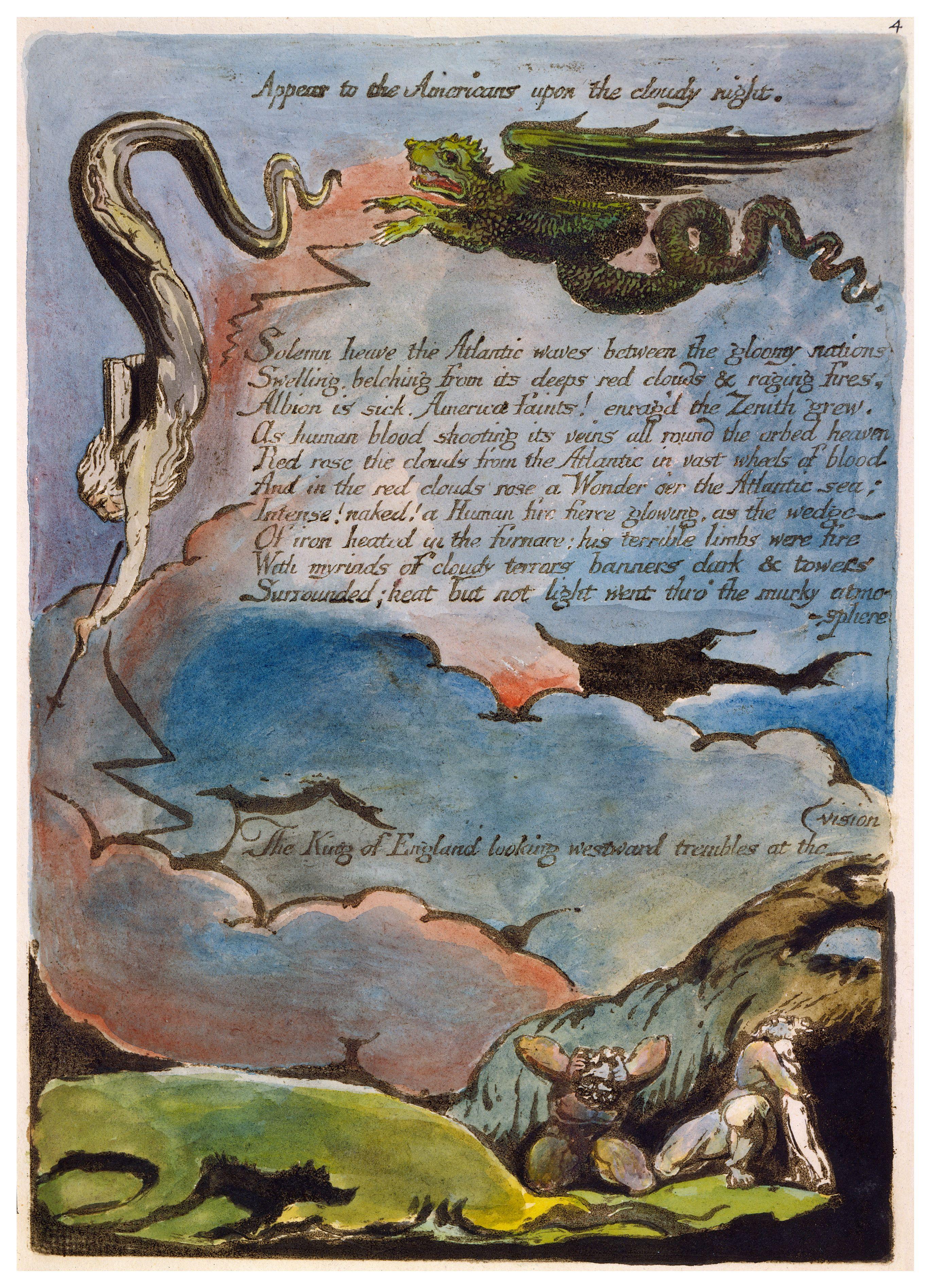
William Blake. America. A Prophecy [Public Domain].
In this article, I will explain the astrology of the U.S. Pluto and the significance of the U.S. Pluto return. We will dive into the 27th degree of Capricorn, explore its hidden meanings through its antiscion degree, and discover possible solutions provided by the 27th degree of Cancer.
–Author
The long-awaited U.S. Pluto return is upon us. This is the period when Pluto completes a revolution around the sun and returns to the same zodiac degree in the nation’s birth chart. Based on the most commonly-used U.S. national birth chart, the exact U.S. Pluto return dates are February 19, 2022; July 12, 2022; and December 27, 2022. Using a narrow one-degree orb, the active period of this transit started in March 2021 and will stretch well into the end of 2023.
It is monumental because beside its rare occurrences (approximately once every 248 years), both participants of this event are equally powerful and unyielding. Natal Pluto symbolizes the entity’s survival instinct and nucleus of strength. Transiting Pluto, manifesting as external events, transforms everything it touches, destroying the frivolous and folly, mercilessly cutting down wastes and excess, and unifying the false dichotomy. Pluto transits force us to define and defend the crux of our existence, the spark of our souls. Failing that, we are zombies, lobotomized. We are a shell of our former selves. Our lights go out.
At the founding of the nation, the colonists presented the Declaration of Independence, stating:
“We hold these truths to be self-evident, that all men are created equal, that they are endowed by their Creator with certain unalienable Rights, that among these are Life, Liberty and the pursuit of Happiness.”
In reality, this credo has not held true. In this series, I will attempt to unpack the U.S. Pluto through astrology and history. Once we define our core strengths and our survival strategy, we have a better chance to find a clear path forward.
The astrology of U.S. Pluto
U.S. Birth Chart by Ebenezer Sibly
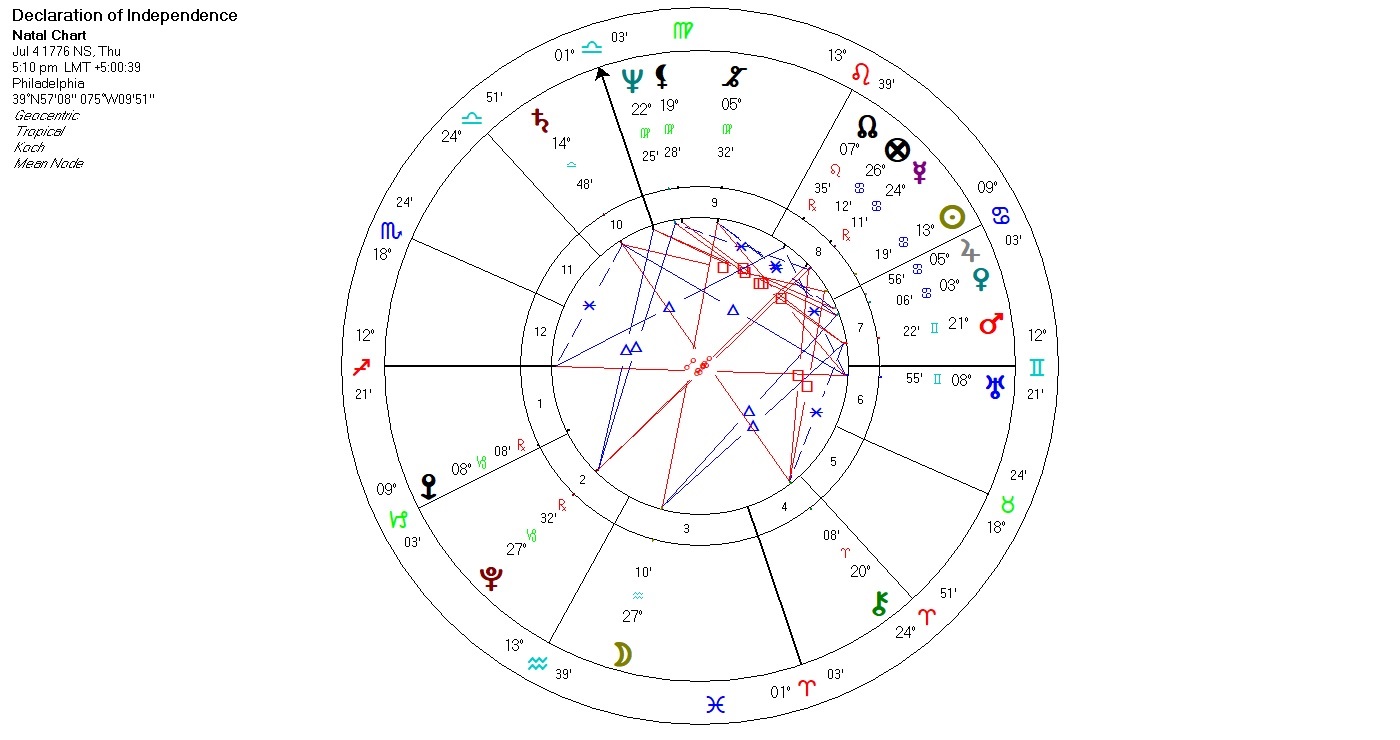
The most widely used U.S. Birth Chart was elected by British physician, astrologer, and occultist Ebenezer Sibly (1751-1799). Sibly’s chart placed the U.S. Pluto in the second house at Capricorn 27 degrees and 32 minutes. It is not the scope of this series to cover the U.S. birth chart in its entirety. Instead, I will focus on the astrology of U.S. Pluto and its cycle manifested in past and current events.
Meaning of the Second House
The second house of an astrology chart points to the resource at one’s disposal. Most commonly referred to as the house of money, it actually refers to value and resource in the broadest terms: judgment of worth, weighing of priorities (for deploying resources), money, time, energy, efforts, talents, personal properties, faculties, and freedom. Simply put, it is what we deem valuable and dedicate our resources to as a nation.
Meaning of U.S.’ Capricorn-Aquarius Second House
The second house in the U.S. birth chart spans from the 9th degree of Capricorn to the 13th degree of Aquarius. The Capricorn house cusp and the Pluto placement in Capricorn warrants heavy emphasis on Capricorn quality regarding the nation’s value and priorities.
The archetypal Capricorn is conscientious, responsible, insecure, and status-seeking. Driven by the underlining inferiority complex, Capricorn appeals to the authority and desires to present itself as the arbiter of reality. Predictably, Capricorn strives for stability and respectability, i.e. money and social status, and by extension, demands others to honor and conform to the social order it helps build, for it abhors the unpredictable and the deviant.
In short, Capricorn aspires to project success and order. Contrary to popular belief, Capricorn in the U.S. second house indicates that we as a nation value status and stability above all. Our collective pursue has always been wealth, power, and control.
The second part of the U.S. second house is in Aquarius. Innovation, revolutions, freedom, and Egalitarianism are also at our disposal. Pluto’s placement near the cusp of Aquarius hints at solutions that contain contradicting maneuvers, which I will discuss further.
Meaning of Pluto
Pluto in our natal chart represents the nucleus of our psychological and physical survival. It is what we cling to in our most perilous moments. It’s the part of us that digs deep and plays dirty for self-preservation.
Pluto is the fear of annihilation petrified into obsession, and the obsession eating its own tail. In the case of U.S. Pluto, our obsession with staying safe has turned a pent-up citizenry explosive. The interventions to stabilize domestic and international crises have destabilized the intended target in most cases. The need to control and manipulate our environment and relationships is sometimes so great that an off-the-rails Pluto will seek to alter the status quo by self-destruction. Despite its many negative manifestations, losing our Pluto, we lose the will to live and become frail facades.
Transiting Pluto shares the same quality and manifests through dramatic external events. During a Pluto return, the entity’s will to survive encounters the universal force to transform. Surviving and thriving during Pluto transits requires letting go of the status quo, –no exceptions. The more we try to stay the same, the more drastic the demolition. The only way through it is shedding all non-essential and pretense in every aspect of our lives. When we do, we’re indestructible.
Pluto in Capricorn
As these once-sacred institutions will simultaneously face the Plutonian purging and reform, seeking shelter from these establishment will be futile. Frauds exposed, credibility plummeted, the dismantling is unfolding right in front of our eyes. We share our fates with our nation, but that does not mean we face the same limited options as an overreaching and overstretched behemoth. It is worth mentioning that the U.S. Pluto placement also entails that the government and institutions will try the tools of control and oppression, even blatantly violate the social contract during their breakdown and transformation.
Pluto in the Second House, Ruling the Twelfth House
Pluto in the second house puts tremendous wealth and resources at U.S.’ disposal; it also clearly points to Plutocracy and Plutonomy. Destructive and weaponized Pluto signals dramatic rise and fall of fortune and unscrupulous policies that could rip the social fabric and undermine U.S.’ global standings. Pluto’s will to power and its manipulative, meddlesome approaches, in combination with misguided foreign entanglement and systemic corruption, could spell U.S.’ self-undoing.
Meaning of Capricorn 27th degree
The 27th degree of the zodiac is a degree of discontent and defiance; it is also a degree of exceptionalism. People under the influence of this degree acknowledge the deterioration of the institution and absurdity of the status quo. They also regard their peers as ineffectual when it comes to support and insights. To serve a higher calling, they depart from the social perimeter and blaze new trails.
The Sabian symbol for Capricorn 27th degree is “a large aviary”. We get the colorful image of chattering birds in confinement, but this hardly provides enough clues to flesh out our current predicament. My interpretation for this degree is twofold:
“Technocrats conspire with foreign agents to manage a discontent populace and disappointed international allies.”
“Disappointed truth seekers confront their peers who have resorted to underhanded maneuvers, and decide to remove themselves to take a higher ground.”
Lonsdale’s reading of this degree reminds us to rein in our follies:
“You need to drop the vast bulk of your voluminous self-indulgences in order to, after all, start to wake up and really remember purpose and the whole story.”
Capricorn 27 people are workaholics and truth-seekers who separate themselves from their peers to rise above groupthink and mediocrity. This degree reveals that the system has been corrupted and is breaking down. No help is coming from the establishment; they must break away from the consensus and convention to craft their exit plans. A small group of visionaries will propose solutions that seem impossible and unpopular, but soon will become the only viable option. At the founding moment, the energy of this degree was imprinted as the nation’s core strength and survival mechanism. We have come a long way and strayed far from the trailblazing business in many ways.
Another way to read a zodiac degree is to look for the hidden meaning derived from its shadow degree (antiscion). Antiscion is the zodiac degree that shares the same distance from solstice points as the degree in question, like a reflection in a mirror that stretches from the 0 degree of Cancer to the 0 degree of Capricorn. The Sabian symbol for Capricorn 27’s antiscion, Sagittarius 2, is “two men playing chess.” In uncanny synchronicity, Martin Goldsmith expanded the imagery and described:
“A young prince and his tutor concentrate on a game of chess. Around the board, an inlaid design depicts black and white dragons biting each other’s tails.”
The image brings in sharp focus inter-generational conflicts and geopolitical competition with China, frequently symbolized as dragons. Goldsmith further elaborates:
“Playing to win, no holds bars, vs. playing like a gentleman (dangerous opponents); making calculated moves; waiting for the right time to act, vs. rashly forging ahead; … bluffing by acting weak or bluffing by acting strong.”
This degree foretells coming geopolitical conflicts and inter-general competition for resources. Sagittarius 2 also hints at difficulty with international diplomacy, disagreements on beliefs and principles, and trusted elders turning on their young.
In the zodiac wheel, the opposite degrees are considered two sides of the same theme. Looking to Cancer 27 could propose a solution to our Capricorn 27th degree problems. The Sabian symbol for Cancer 27 is “a modern Pocahontas.” Later interpretations depict a Native American girl introducing her white boyfriend to the tribe. This degree points to breaking away from emotional dependency on one’s family, tribe, and race, and forging new connections outside one’s heritage and cultural identity.
Ellias Lonsdale, in is book “Inside Degrees” promised innate guidance to those involved with the 27th degree of Cancer:
“Inwardly knowing where to go, what to do, how to do it, and where it all leads. You have a special faculty for karmic clairvoyance or sensing the individual and collective destiny-territory that must be navigated through. Placed strategically in the molten core of world dilemma to remember how to get it right. Driven by a force of will that is overwhelming. You are guided to be in the right place at the right time for catching the drift of the tide we all are swimming toward. Unconsciously and superconsciously in touch and in tune with what is happening. Consciously, walking a tightrope between the heights and the depths, and never sure while being sure. Given an engraved destiny invitation to participate to the utmost in collective cycles of renewal and to stay within your place of power throughout. For you have gathered considerable awareness toward this time of decision, and this vertical attunement is a welcome ingredient–one vitally needed.”
ACall to Awareness
Throughout U.S. history, national crises unfolded around Pluto themes, and the same themes will be the focus again during the Pluto return. Regrettably, second-house matters such as national prosperity and personal freedom do not mix well with Pluto energies. Moreover, a Scorpio twelfth house subjects our national psyche to subversive and deceitful stratagems, as well as a predisposition to misuse the transformative and weaponized energy. Pluto principle underpins our national priorities and permeates our collective unconscious. Call it the original sin or collective karma, this is a burden we have to bear as a nation. The Pluto return is a period when we must take our own medicine and ride out this once-in-a-Plutonian-year storm. Think of it as a storm that flushes out the stale and the stifled, the outdated and the unsound. Whatever remains will be consolidated and stronger than before, like a newly acquired superpower. I speculate that by the time this transit is over, the current system and our endless, divisive bickering will reach a conclusion, and the opposing positions and their hotly contested issues will be irrelevant. (To be continued)



 Brave New Real