27 Degrees Pisces: Into the Deep End, Part 2

The Starry Night by Vincent Van Gogh (Detail), (CC BY-SA 4.0)

Author’s note: This article refers to 27 degrees Pisces (27-28 Pisces), not the 27th degree of Pisces (26-27 Pisces). Read about the zodiac and numerical components and a case study of 27 Pisces in Part 1.

Unpacking the symbology of this degree, here are the major themes:

MISADVENTURE AT SEA

The Pisces-Scorpio influence is predictably present in charts of maritime disaster and their unfortunate victims. The influence not only correspond to real-life shipwrecks, but also correlated to cruel fate and difficult personality of fictional characters created and brought to life by the artists under the degree’s influence. The Capricorn-Aquarius duad manifested as the failure of leadership or physical structure.

“Under pouring rain, a man who is drowning in a lake calls for help. From the bank, another man tries to help.”

… But the most serious threats also come from the sea, and all precautions must be taken in order to face them, for instance by subscribing a comprehensive professional and family insurance policy.

Janduz interpretation, rewritten by Astrotheme

Titan submersible implosion, Jun 18, 2023 (Neptune). The experimental submersible Titan imploded during its expedition to the Titanic wreckage, killing all five passengers on board. The submersible suffered a “catastrophic loss of the pressure chamber,” according to the U.S. Coast Guard.

Warnings and concerns about the Titan’s design and safety from industry experts were repeatedly dismissed by the CEO Stockton Rush, who was also onboard the fatal excursion. In a 2021 interview, Rush said I think it was General MacArthur who said, ‘You’re remembered for the rules you break.’ And I’ve broken some rules to make [Titan]. I think I’ve broken them with logic and good engineering behind me. The carbon fiber and titanium, there’s a rule you don’t do that. Well, I did.”

Titanic maiden voyage (Venus). Not surprisingly, the world’s most famous shipwreck also involved 27 degree Pisces. In mundane astrology, Venus represents lives and property. More than half of the Titanic’s passengers perished at sea when it sank on its maiden voyage. Her cargo spilled into the ocean. The wreck proved to be too fragile to be raised.

Jack London (Mars). The stormy and oppressive Pisces-Scorpio energy comes to life in Jack London’s Sea-Wolf. Van Weyden, a wealthy literary critic, is adrift at sea after a shipwreck. He is rescued and held captive by Wolf Larsen, the handsome and brilliant captain who enjoys entertaining philosophical debates yet has no regard for life. Wolf is bitterly jealous of those who can enjoy the brighter side of life, for he only derives pleasure from brutality and extreme danger to which he subjects himself and his crew.

After Van Weyden escaped with his companion to a deserted island, Wolf was abandoned by his crew and set adrift at sea by his brother. When his ship wrecked on Van Weyden’s island, he was blind, his life hanging by a thread. Despite this, he attempted to murder Van Weyden, his caretaker, before dying in a raging storm. Van Weyden and his companion are rescued and share their first sweet kiss.

Spencer Tracy (Mars). Another story of an aristocrat/intellectual held captive at sea is Kipling’s Captain Courageous. In the film adaptation, Spencer Tracy played the fisherman Manuel, who fell into the sea while racing a rival and became entangled in the rigging. Unable to free himself, Manuel asked the captain to cut him free before sinking into the sea.  Tracy garnered an Academy Award for this dramatic role, and again for his performance in Boys Town (see below).

Herman Melville (Pluto). Speaking of literary captains, who can forget the maniacal Captain Ahab in Moby Dick? Hellbent on revenge, Captain Aha hijacked the whaling operation and forced the crew to join his to mission to kill Moby Dick, who sinks the ship and drags Ahab away with the fishing line around his neck.

Power Struggles, Secrets and Scandals related to oppression and corruption (sexual, racial, financial, political)

Cast into an abyss. Dumped out of status and specialness and made to be hyper-receptive to whatever is moving here—an abandoned center, karmically sacrificed to learn both humility and the lessons of the street. … A regressive loop with powerful emanations.

Ellias Lonsdale, Inside Degrees

When manifested as power struggles between the oppressor (Scorpio) and the oppressed (Pisces), 27 Pisces energy typically manifests as dereliction, corruption, or abuse of power (Capricorn-Aquarius). A tug-of-war or seesaw action (2 Libra) involving laws and contracts is usually at play. During the current Neptune transit (May 10, 2023 through August 22, 2023), there are ongoing major developments involving corruptions of power, secret surveillance programs, race/class/gender struggles, and border insecurity related to illegal drug and human trafficking. Here is a partial list:

Panic of 1819 and The Missouri Compromise (Pluto). Chartered in 1816, the Second Bank of the United States was charged with stabilizing the U.S. banking system during the frontier land boom and unregulated banking. Its branches, beholden to political and financial interests, not only failed to enforce regulations, but further fueled land speculation by expanding the money supply. As demand for U.S. exports fell, prices plummeted, triggering a wave of defaults by farmers and investors. The result was widespread bank failures and economic depression. The corruption of the banks and the government was on full display during the first nationwide financial crisis.

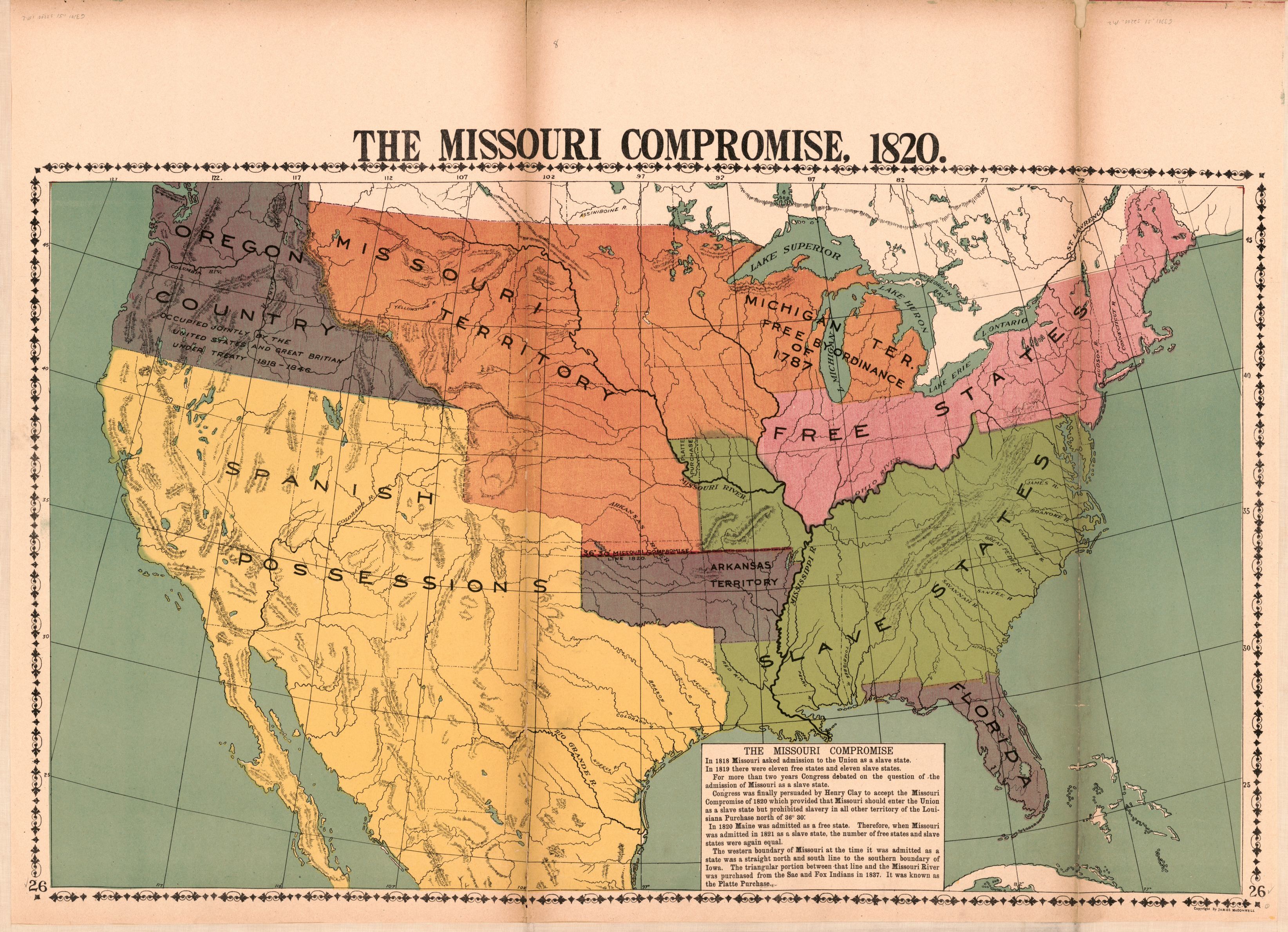
At the same time, the U.S. Congress was engaged in a bitter and protracted debate over the future of slavery, with both sides threatened to dissolve the Union. Kentucky Senator Henry Clay, known as the “Great Compromiser,” played legislative trickery to sneak through the pro-slavery bill that prohibited slavery north of Missouri’s southern border while admitting Missouri as a slave state. 

Harassed and embittered, Missouri violated the US constitution and prohibited free blacks from entering the state. Once again, Henry Clay came to the rescue. By adding a non-binding provision to circumvent the controversial section, Missouri was admitted to the Union. This crisis had exhausted the antislavery movement, re-legitimized slavery, reversed the momentum of emancipation, and added insult to injury for black people across the country. The acrimony would eventually lead to the Civil War.

(For a detailed account of these two crises, see my article here.)

Vanessa Williams (Sun). First African-American Miss America. She was forced to relinquish her Miss America title when Penthouse magazine acquired and published unauthorized nude photographs of her. Williams overcame the public shaming and went on to became a successful singer and actress. 

Fabrice Morvan (Saturn). Member of the duo Milli Vanilli, Grammy Award for Best New Artist of 1990. Milli Vanilli endured worldwide public humiliation from the lip-synching scandal when their producer, who hired studio musicians to sing on their hit album, ousted them for demanding to sing on the new album. In an interview with the Los Angeles Times, Morvan said:

“Our producer tricked us. We signed contracts as singers but were never allowed to contribute. It was a nightmare. We were living a lie. The psychological pressure was very hard. It was like we were trapped in some golden prison.”

May 31, 2023 (Neptune). A former staffer of Taiwan’s ruling party posted her experience of workplace sexual harassment on Facebook. Her essay, echoing a popular Netflix political drama “Wave Makers”, encouraged other victims to “not just let this go,” which led to an explosion of more than 200 allegations of sexual misconducts by public figures and celebrities. Many of them have resigned in disgrace or had their titles stripped. The president and the leader of the ruling party issued multiple apologies. Under tremendous pressure and expectations, legal amendments were quickly introduced to combat sexism and seniority in the society.

June 7, 2023 (Neptune). An attorney for the U.S. Virgin Islands in its federal lawsuit against JPMorgan Chase released the bank’s internal emails, showing that the bank paid for Jeffrey Epstein’s consultation and referral service, and continued the client relationship after his conviction. On July 24, 2023 (Neptune), the Attorney General of the U.S. Virgin Islands filed new documents alleging that JPMorgan Chase facilitated Jeffrey Epstein’s sex trafficking operation and helped him evade Suspicious Activity Reports during 2006 and 2019.

US Supreme Court strikes down President Biden’s student loan debt forgiveness program. (June 30, 2023. Neptune). On the same day, the Department of Education announces new rules to lower monthly payments and cut the loan forgiveness period in half. On July 25, 2023, White House announces that the Biden administration has cancelled additional $130 million in debt for 7,400 students, bringing the total approved student debt relief under his administration to $14.6 billion for 1.1 million borrowers.  

US Supreme Court rejects affirmative action program at colleges, declaring that race cannot be factored in admission process. (June 29, 2023, Neptune). President Biden strongly disagrees with the ruling and urges schools to continue their commitment to racial diversity. A new standard is in the works at the Department of Education to counter hardship or discrimination in college admissions. Several top-ranked schools have ended legacy admissions in response. 

Missouri vs Biden (July 4, 2023. Neptune). Citing the Free Speech Clause of the U.S. Constitution, Attorneys General of Missouri and Louisiana ordered to temporarily block federal agencies and specific individual government officials from influencing and interfering social-media companies, with a few exceptions. On July 14, 2023, a federal appeals court temporarily blocked the order until further notice.

In addition, newly released evidence and corroborated whistleblower accounts implicated Hunter Biden, and by extension President Biden, in influence peddling and foreign bribery schemes, as well as interfering with the IRS (Scorpio) investigation into Hunter Biden’s tax crimes (Pisces).

Mass Atrocities

World War I (Eris). Anti-Serb sentiment and persecution in the Austro-Hungarian Empire had steadily increased in the decades leading up to World War I. The volunteer militia Schutzkorps was tasked with suppressing Serbian uprisings. The governor of Bosnia and Herzegovina, Oskar Potiorek, (Sedna in 27 Pisces, also in charge of the royal couple’s travel during the fateful visit) was particularly hostile, leading oppressive anti-Serb measures and inciting racial hatred.

After the Habsburg monarchy’s annexation of Bosnia-Herzegovina in 1908, Serbian nationalists worked in secret to unite all Serbs and liberate Serbs under the Austro-Hungarian occupation. The Black Hand, a Serbian military-intelligence secret society, organized the assassination of Archduke Franz Ferdinand of Austria and his wife.

After the assassination, riots broke out in Sarajevo and throughout Bosnia-Herzegovina and Croatia; military and civilians both took part in the destruction of Serbian properties. Using the assassination as a  pretext, and with Germany’s “blank cheque” support, Austria delivered an ultimatum to Serbia that was impossible to accept. When Serbia returned with partial agreement, Austria declared war on Serbia on July 28, 1914. Allies of Serbia (Russia, France, Belgium, Britain) and Austria-Hungary (Germany) mobilized in turn thus began the WWI.

After the declaration of war, the Austria-Hungarian authority carried out ethnic cleansing through massacres, mass executions, kidnappings, looting and destruction of property. World War I lasted until November 11, 1918. The death toll is estimated at between 15 and 19 million.

Adolf Eichmann (Sun). Nazi war criminal. During World War II, Eichmann first oversaw the deportation of Jews. Later, he facilitated the confiscation of Jewish property and arranged for the transportation of Jews to concentration camps. He was captured in 1960, trailed in public and sentenced to death. Days before his execution, Eichmann plead for clemency, arguing that “[there] is a need to draw a line between the leaders responsible and the people like me forced to serve as mere instruments in the hands of the leaders”. Since he was only following orders, he concluded, “I was not a responsible leader, and as such do not feel myself guilty”.

Jiang Qing (Sun). Actress and First Lady of the People’s Republic of China. During the Cultural Revolution, Jiang presided over the systematic destruction of China’s cultural and religious heritage and led a violent student rebellion that escalated into atrocious political persecution and nationwide massacres. She also unleashed political smear campaigns against her opponents and ordered the torture and murder of the children of Zhou Enlai, whom she considered her chief rival.

Jiang showed no remorse during her televised trial. She discredited the special court and argued that she obeyed the party’s orders and committed no crime. She defended Mao and the Cultural Revolution to the end, and was proud to die for her cause.

UNPARALLELED ARTISTIC PURSUITS

When it comes to artists under the influence of 27 Pisces, it’s nearly impossible to separate their lives from their art. These towering figures push the boundaries of social tolerance and individual sanity, never satisfied, perfectly content with their obsession and endless pursuits.

“For myself, I quite often worry that my life hasn’t been calm enough, all these disappointments, annoyances, changes mean that I don’t develop naturally and in full in my artistic career. … I can’t precisely describe what the thing I have is like, there are terrible fits of anxiety sometimes – without any apparent cause – or then again a feeling of emptiness and fatigue in the mind.”

Vincent van Gogh “764 (768, W11): To Willemien van Gogh. Arles, between about Sunday, 28 April and Thursday, 2 May 1889.”

Vincent van Gogh (Sedna and Mars/Venus midpoint). Dutch painter and one of the most famous artist in the world. Due to his volatile personality, van Gogh suffered a long series of rejections and lived in loneliness and poverty for most of his life. He neglected his health for the sake of his art, painting feverishly against his anguish and deteriorating mental health.

After his artistic breakthrough, Van Gogh’s paintings burst with vibrant color and restless energy. Some pieces capture the spiraling, mystical force that connects and responds to all the objects in the painting. He struggled to remain productive and optimistic, eager to improve his art and repay his brother, while dreading the eventual loss of his mental faculties. Having sold only one painting in his entire life, he saw himself as a failure and a burden. Despite eventual recognition, the sense of futility won out. He died of a self-inflicted gunshot wound. In his last moments, he said to his brother: “The sadness will last forever.”

John Coltrane (Uranus). Jazz saxophonist, composer, and canonized saint by American Orthodox Church.

… there’s often a suggestion that Coltrane’s practice was obsession, that it was not a simple matter of working to improve, that there was an emotional desperation and drive in it that was somehow beyond the norm.

Lewis Porter, John Coltrane

Ever direct and intense, Coltrane’s playing became more emotionally overwhelming as he evolved musically. His signature “sheet of sound” is a barrage of rapid, fervent, trance-inducing sonic storms.

Coltrane’s masterpiece “A Love Supreme” was an offering to God and marked the watershed in his style and aesthetic. His later works abandoned steady tempos, chord progressions, and key centers and embraced ethnic music from around the world. Some of his music devotional bordered on chaos.

Throughout his career, he was uncertain of his artistic direction and never found what he was searching for. Two years before his passing, he told Melody Maker magazine:

“Everybody wants to hear what I’ve done. Nobody wants to hear what I’m doing… I’ve had a strange career. I haven’t yet quite found out how I want to play music. Most of what’s happened these past few years has been questions. Someday we’ll find the answers.” 

OCCULT AND RELIGIOUS POWERS AND SALVATION

Boys Town (Eris). Founded in 1917 by Father Edward J. Flanagan (played by Spencer Tracy in his second Oscar-winning role), Boys Town started as a home for homeless boys and in time grew over time into a model institution for at-risk boys.

After years of service in impoverished dioceses, Father Flanagan concluded that the solution to destitution and criminality began with helping at-risk youth. A firm believer in “there is no such thing as a bad boy,” he endeavored to end to the abusive treatment in juvenile detention centers.

Boys Town accepted and cared for the most vulnerable and helpless –regardless of race, religion, or criminal record –and provided a caring environment to meet their developmental needs. Today, Boys Town continues to provide youth care and health services, educational and parental training, and advocacy for juvenile justice reform.

Sydney Portier (Uranus). First black actor to win the Academy Award for Best Actor. In his award-winning film Lilly of the Field, Portier played a roaming GI (Smith) who offers to repair a fence for a group of nuns, only to find out that the impoverished nuns have no money to pay for his labor. Mysteriously, Smith can’t help but continue to oblige the Mother Superior’s requests, eventually volunteered to build the chapel by himself. The townspeople, at first incredulous, are compelled to contribute labor and materials. Under Smith’s supervision, the chapel is completed. The Mother Superior thanks God for fulfilling her vision. Smith, unrewarded, drives off into the dark night.

Manly P. Hall (Sun). One of the greatest occult philosophers of the 20th century, Hall’s encyclopedic masterpiece, The Secret Teaching of All Ages, was published around the age of 27 and continues to influence and inspire the seekers of esoterica.

Details on Hall’s personal life are sparse. Abandoned by both parents, Hall was raised by his grandmother. “As a result of a confused and insecure childhood, it was necessary for me to formulate a personal philosophy with which to handle immediate situations.” His lifelong study of ancient mystery traditions resulted in an enormous body of work: nearly 7,000 lectures (some sources cite 8,000), more than 200 books, hundreds of essays, and a massive library on occult science.

Contrary to his own teachings on self-discipline and health, Hall had an insatiable appetite for sweets. He encouraged the idolatry of his admirers and at times used their affection for his own benefit. Hall and his wife might have misplaced their trust on Hall’s healer/personal assistance, who gained access to Hall’s bank accounts, and was granted power of attorney a few days before Hall’s suspicious death.

Arthur Conan Doyle (Neptune). British author and physician. Doyle was dissatisfied with the detective stories of his day, in which the cases were solved “either by some lucky chance, or a fluke, … Nobody ever gives an explanation how.” He sought to apply his scientific training to the writing of detective stories and created Sherlock Holmes, the most famous literary detective.

Less well known is Doyle’s dedication to the science and philosophy of spiritualism. Doyle considered psychic knowledge of great importance to humanity. He read voraciously on the subject, experimented and met with psychics and investigators from all over the world.

Bibliography

鳳凰網. “ 江青咆哮法庭:我是主席的一条狗 不怕你们打. ,” August 9, 2012. http://news.ifeng.com/history/zhongguoxiandaishi/detail_2012_08/09/16668737_1.shtml.
Archived https://web.archive.org/web/20190219061353/http://news.ifeng.com/history/zhongguoxiandaishi/detail_2012_08/09/16668737_1.shtml

Andrew Bailey, Missouri Attorney General. “MO.Gov,” July 4, 2023. https://ago.mo.gov/docs/default-source/press-releases/missouri-v-biden-ruling.pdf?sfvrsn=dd807c2_2.

Astrotheme. “The 360 Symbolic Degrees and Their Interpretation | You Have Selected: 27° Pisces | Janduz Interpretation, Rewritten by Astrotheme.” Accessed July 27, 2023. https://www.astrotheme.com/the_360_symbolic_degrees.php.

Arthur Conan Doyle Interviewed on Sherlock Holmes and Spirituality , n.d.
https://www.youtube.com/watch?v=XWjgt9PzYEM, archived https://web.archive.org/web/20141229192253/https://www.youtube.com/watch?v=XWjgt9PzYEM

Boys Town. “Boys Town Services.” https://www.boystown.org/OneBoysTown/Pages/Services.aspx.

Cesarani, David. Eichmann. Random House, 2005.

U.S. Department of Education. “FACT SHEET: President Biden Announces New Actions to Provide Debt Relief and Support for Student Loan Borrowers | U.S. Department of Education,” June 30, 2023. https://www.ed.gov/news/press-releases/fact-sheet-president-biden-announces-new-actions-provide-debt-relief-and-support-student-loan-borrowers.

BBC News. “Titan Sub Implosion: What We Know about Catastrophic Event,” June 19, 2023. https://www.bbc.com/news/world-us-canada-65934887.

Boys Town. “Father Edward J. Flanagan.” https://www.boystown.org/about/father-flanagan/Pages/default.aspx.

Home | Senator Chuck Grassley. “Grassley Obtains & Releases FBI Record Alleging VP Biden Foreign Bribery Scheme,” July 20, 2023. https://www.grassley.senate.gov/news/news-releases/grassley-obtains-and-releases-fbi-record-alleging-vp-biden-foreign-bribery-scheme.

Hioe, Brian. “Taiwan Rocked by Wave of Sexual Harassment, Assault Allegations.” The Diplomat, June 14, 2023. https://thediplomat.com/2023/06/taiwan-rocked-by-wave-of-sexual-harassment-assault-allegations/.

I24news. “Holocaust Organizer Sought Clemency, Saying He Was ‘Mere Instrument’ ,” January 27, 2016. https://www.i24news.tv/en/news/israel/society/100660-160127-eichmann-asked-israel-s-then-president-yitzhak-ben-zvi-for-clemency.

Horowitz, Mitch. “Secret Teachings Reborn: The Mysterious Life of Manly P. Hall.  New Dawn: The World’s Most Unusual Magazine, January 15, 2014. https://www.newdawnmagazine.com/articles/secret-teachings-reborn-the-mysterious-life-of-manly-p-hall.

Kahn, Ashley. “John Coltrane Biography.” JOHN COLTRANE. https://www.johncoltrane.com/biography.

Kröll, Herbert. Austrian-Greek Encounters Over the Centuries. Studien Verlag, Austria, 2007.

Lonsdale, Ellias. Inside Degrees. North Atlantic Books, 1997.

Lyon, James. Serbia and the Balkan Front, 1914. Bloomsbury Publishing, 2015.

Manly P. Hall: Resources and Inspirations. “About Manly P. Hall.” https://manlyphall.info/about-mph.htm.

Martens, Pam, and Russ Martens. “JPMorgan Had a Secret Project That Is Now Spreading Its Scandalous Internal Emails with Sex Trafficker Jeffrey Epstein to News Outlets Worldwide.” Wall Street On Parade. https://wallstreetonparade.com/2023/06/jpmorgan-had-a-secret-project-that-is-now-spreading-its-scandalous-internal-emails-with-sex-trafficker-jeffrey-epstein-to-news-outlets-worldwide/.

———. “JPMorgan Had a Secret Project That Is Now Spreading Its Scandalous Internal Emails with Sex Trafficker Jeffrey Epstein to News Outlets Worldwide.” Wall Street On Parade. https://wallstreetonparade.com/2023/06/jpmorgan-had-a-secret-project-that-is-now-spreading-its-scandalous-internal-emails-with-sex-trafficker-jeffrey-epstein-to-news-outlets-worldwide/.

Morelle, Rebecca, Alison Francis, and Gareth Evans. “Titan Sub CEO Dismissed Safety Warnings as ‘Baseless Cries’, Emails Show.” BBC News, June 23, 2023. https://www.bbc.com/news/world-us-canada-65998914.

Myers, Marc. “Jazz News: John Coltrane: Sheets of Sound.” All About Jazz, January 1, 1970. https://www.allaboutjazz.com/news/john-coltrane-sheets-of-sound/.

Philips, Chuck. “’We Sold Our Souls to the Devil’ : In a Wide-Ranging Interview, the Duo Tell the Whole Story About What It Was Like to Live a Lie.” Los Angeles Times. Los Angeles Times, November 21, 1990. https://www.latimes.com/archives/la-xpm-1990-11-21-ca-4670-story.html.

Pierson, Brendan. “Court Blocks Curbs on US Government Contact with Social Media Companies for Now | Reuters.” Reuters. Reuters, July 14, 2023. https://www.reuters.com/legal/court-blocks-curbs-us-government-contact-with-social-media-companies-now-2023-07-14/.

Porter, Lewis. John Coltrane. University of Michigan Press, 1999.

Sahagun, Louis. Master of the Mysteries. Process Media, 2008.

Shear, Michael D. “‘This Is Not a Normal Court’: Biden Denounces Affirmative-Action Ruling.” The New York Times, June 29, 2023. https://www.nytimes.com/2023/06/29/us/politics/biden-supreme-court-affirmative-action.html/.

Sherman, Mark. “Live Updates: Supreme Court Rejects Biden’s Student Loan Plan.” AP News. AP News, June 30, 2023. https://apnews.com/article/student-loan-forgiveness-supreme-court-653c2e9c085863bdbf81f125f87669fa.

———. “Supreme Court Live Updates: Court Ends Affirmative Action in Colleges.” AP News, June 29, 2023. https://apnews.com/article/supreme-court-affirmative-action-college-race-f83d6318017ec9b9029b12ee2256e744.

Stein, Chris, and Joanna Walters. “‘This Is Not a Normal Court’: Joe Biden Condemns Affirmative Action Ruling.” The Guardian, June 29, 2023. https://www.theguardian.com/us-news/2023/jun/29/joe-biden-affirmative-action-supreme-court-reaction.

Taub, Ben. “The Titan Submersible Implosion Was ‘an Accident Waiting to Happen’ | The New Yorker.” The New Yorker. The New Yorker, July 1, 2023. https://www.newyorker.com/news/a-reporter-at-large/the-titan-submersible-was-an-accident-waiting-to-happen?utm.

The White House. “Statement from President Joe Biden on Student Debt Relief Action in Colorado,” July 25, 2023. https://www.whitehouse.gov/briefing-room/statements-releases/2023/07/25/statement-from-president-joe-biden-on-student-debt-relief-action-in-colorado/.

Van Gogh Museum. “The Last Days of Vincent van Gogh.” https://www.vangoghmuseum.nl/en/art-and-stories/stories/the-last-days-of-vincent-van-gogh.

Vincent van Gogh | The Letters. “764 (768, W11): To Willemien van Gogh. Arles, between about Sunday, 28 April and Thursday, 2 May 1889.” https://vangoghletters.org/vg/letters/let764/letter.html.

Velikonja, Mitja. Religious Separation and Political Intolerance in Bosnia-Herzegovina. Texas A&M University Press, 2003.

Zibang, Xiao, and Betty Hou. “Taiwan Proposes Tougher Penalties for Sexual Harassers Amid #MeToo Wave.” Time. Time, July 13, 2023. https://time.com/6294319/taiwan-equality-laws-me-too/.

© Brave New Real 2023. All rights reserved.

27 Degrees Pisces: Into the Deep End, Part 1

Author’s note: This article refers to 27 degrees Pisces (27-28 Pisces), not the 27th degree of Pisces (26-27 Pisces).

Degree components

Sign: Pisces

  • Vast bodies of water
  • Dissolution of identity, boundaries, and definition
  • Personal and collective unconscious –the liminal state, dreams, art, music, literature, mythology, and imagery.
  • Escapism via spirituality, religion, worshiping of individuals and groups, altered state of consciousness, and oblivion. Evasiveness and indeterminacy.
  • Distress, oppressed, victimized and powerless states caused by physical, emotional, or social conditions. The need and desire to rescue other or be rescued .

Decanate: Scorpio (20-29 Degrees Pisces)

  • Depth and shadow
  • Complications, power struggles, and entanglement
  • Objectification, oppression, manipulation, damage, and destructiveness
  • Intense emotions, obsession, and brutality
  • Occult power and knowledge

Duad: Capricorn/Aquarius (Structural failure, breakdown of a framework, distortion of truth, population control.) For a detailed discussion on the boundary between Capricorn and Aquarius please see this blog article .

Degree number: 27 (Discontent. Carrying out one’s religious and philosophical beliefs. Seeking a higher ground –in social status, ethics, and/or philosophy. Withdraw from the public. Deviation from the mainstream.)

Numerology: 9 (Retreat, observe and comment. A phase coming to an end.)

Antiscion: 2 Libra (Balancing act, contract, and counterpart)

Working symbol: On a sinking ship, water gushes through shattered windows. A passenger struggles to untangle from the rigging that’s dragging him down.

…there is a quality about Vanessa that makes me feel as if she resides in a netherworld of mystery that eludes the rest of us mortals. Her voice seems to come from some deep place that knows all suffering and all secrets. Watching her work is like seeing through layers of glass, each layer painted in mythic watercolour images, layer after layer, until it becomes dark, but even then you know you haven’t come to the bottom of it …

 Jane Fonda on Vanessa Redgrave (Venus at 27 Pisces)

The last decanate of Pisces (degrees 20-29) lies in the murky depths of Scorpio decanate. Under the influence of Pisces, we long to return to the primordial state and merge with the subconscious, in hope of escaping the harsh reality and bypass natural and man-made barrier and limitations.

While these maneuvers are supposed to free us from the humdrum of human conditions, Scorpio energy tends to seduce us into the vortex of complications. Instead of bliss and ecstasy, we are thrown into the deep end, mistaking the asylum as the safe harbor, and entrenched in power struggle and destructiveness.

The third decan of each sign is public-facing, thus its expressions is related to one’s attitude and response to the faceless crowd as a whole. Natal and mundane astrology alike, in this decan we find people falling into hard times and encountering insurmountable obstacles due to society’s collective shadow and failure of reason, restrain, and decency. Victims and perpetrators of racism, ethnic cleansing, destitution, sexual exploitation, crimes, political corruption, decadence, and secret surveillance abound in this section of the zodiac. Authors and artists under this influence invariably dedicate bodies of work –and their lives – dealing with the powerful Pisces-Scorpio energy.

The numerology of 9 expressed in zodiac degrees (9, 18, and 27) indicates the retreating from physical action –detached, observing, or directing from a distance, most likely a moral high ground. Specifically, degree 27 in each zodiac sign alludes to dissatisfaction and aversion of social convention. It can be personified as someone who, consciously or unconsciously, is consumed by a belief system, or some abstract idea that sets them apart from the mainstream.

…Less highly evolved individuals… tend to repeat themselves endlessly and get stuck in patterns that do not allow them to advance and to grow.  … [they] run the risk of sinking into a torpor in which they are ultimately incapable of moving forward …

Goldschneider, The Secret Language of Birthdays

In essence, 27 degrees Pisces starts off as the escapist being seduced into the murky, often destructive, depth of human psyche. Their obsessive and intense discontent, the byproduct of a strong belief system, calls for a deviation from the social norm. Under the Capricorn/Aquarius duad, the preoccupation has to do with the society’s failures or the unbecoming conducts of superiors and authorities. The struggle also involves breaking free from the consensus reality, rigid structure and restrictions.

Once connected to this oppressive and irrational vortex, both the perpetrators and victims of this energy will find it extremely difficult to extract themselves. Voluntarily or involuntarily, this dark and downward pressure leads them away from the reality and into an obsessive and self-perpetuating endless pursuit.

Reemergence usually involves the power of art, the occult, or religion. Superhuman strength is required to break (instead of reinforce) the self-fulfilling cycle and tunnel through further depth and darkness. Redemption occurs through miraculous divine intervention that works through a powerful and patient counterpart. In the best scenario, the wholehearted embrace and skillful maneuver of these powers is directed and materialized for a higher cause.

In natal and mundane astrology, this degree unfolds under the sweeping Pisces-Scorpio themes: brutal crimes, maritime misadventure, social-economic struggles (related to race, sex and economic status), occult power, religious salvation, and unparalleled artistic pursue. During current Neptune’s long stay in 27 Pisces, many suppressed secrets are coming to light in the form of public power-struggles and scandals.   

A Cinematic Case Study: Luc Besson (Sun)

Luc Besson’s most memorable films aptly illustrate these themes, metaphorically and figuratively, through masterfully crafted plots. The main characters in these movies are placed in the perilous, murky depth (ocean, crime [Pisces]), and due to oppression or obsession (Scorpio), unable to break away (27) from the downward spiral. They face tremendous struggles as they attempt to reemerge, leaning heavily on a significant counterpart (2 Libra) for redemption (Pisces). In the end, only those embracing mystical and paranormal power (Pisces-Scorpio-27) can rise above. Here are a few notable examples:

Le Grand Bleu (English title: The Big Blue) fictionalized the rivalry between two real-life record-breaking freedivers (Pisces-Scorpio) Jacques Mayol (who contributed to the screenplay and has Varuna at 27 Pisces) and Enzo Maiorca. During their childhood, the two witnessed the horrific death of Jacque’s father, who drowned when his air hose got caught on the reef and punctured (27 Pieces). Enzo later rescued (2 Libra) a trapped diver from a shipwreck (27 Pisces). Now a world champion freediver, he seeks out Jacque to prove once and for all that he is the better diver. The two become obsessed (Scorpio) with breaking each other’s records (Capricorn-Aquarius), competing against the doctor’s advice and their physical limits. During their last face-off, Enzo is fatally injured (Scorpio) and begs Jacque, who rescues him (Pisces, 2 Libra), to send his body to the bottom of the ocean (Pisces-Scorpio). Overwhelmed by grief (Pisces), Jacque suffers cardiac arrest (Scorpio) and is saved (Pisces) by fellow divers (2 Libra). Despite the emotional pleas (Pisces) of his pregnant girlfriend (2 Libra), Jacque makes one last dive (Pisces-Scorpio). Greeted by a dolphin, he drops his line and follows the dolphin into the watery oblivion. (27 Pisces). 

Le Femme Nikita and Leon: The Professional depict the struggles and attempted redemption of assassins (Pisces-Scorpio). Both Nikita and Leon hope that love can save them (Pisces, 2 Libra), or at least alleviate them from their miserable circumstances (Capricorn-Aquarius) to some resemblance of a normal life. In both cases their strive for deliverance from the life of crime failed (Pisces 27).

Lucy. Kidnapped (Scorpio) and turned into drug mule (Pisces), Lucy accidentally becomes superhuman when the package of drug (Pisces) inside her breaks open (Scorpio). As her body disintegrates and morphs (Capricorn-Aquarius), she gains mental power (27) and physical strength, unbound by space and time (Capricorn-Aquarius). Lucy devours cutting-edge neurology research papers (27) to understand her condition, and shares her experience with the leading scientist (Capricorn-Aquarius, 2 Libra). In the end, Lucy transcends her physical state into pure consciousness, immortalized by leaving behind her knowledge (27) in a portable hard drive.

(Continue to Part 2)

Reference

Fonda, Jane. My Life So Far. Random House Trade Paperbacks, 2006.

Goldschneider, Gary. The Secret Language of Birthdays. Penguin Studio, 1994.

© Brave New Real 2023. All rights reserved.

Revisiting 29 Degrees Capricorn

Image by Anja from Pixabay

Author’s note: This article refers to 29 degrees Capricorn (29 Capricorn through 0 Aquarius), not the 29th degree of Capricorn (28-29 Capricorn).

Sign: Capricorn (Internalized external expectations. Status, order, and hierarchy. Fear of failure. Scarcity mentality. Authority, sovereignty and dignity. Large corporation and institutions.) 

Decanate: Virgo (Skills, functions, work ethic, the search for truth, noble goals, technocrats and bureaucrats.)

Duad: 12th duad Sagittarius (Courage and search for freedom in the face of grave danger. Secrets and uncertainty.)

Degree number: 29 (Acceptance and resignation. Adopt or die.)

Numerology: 11 (Personal relation with the Oneness)

Working Symbols:

(1) In the aftermath of a disaster, an underground political party swiftly overthrew the dictator in power and established a new regime.

(2) A skilled pilot overcame fear to complete a monumental test flight during an unexpectedly severe storm.

(3) After a closed-door meeting, authorities provided fabricated and ambiguous answers in a news conference.

The last degree of a zodiac sign is commonly known as the anaretic degree. Its energy is dominated by the conflict between three neighboring signs: the dominant sign (in this case, Capricorn) is undermined by its predecessor (12th-duad Sagittarius) while being challenged by the incoming sign (Aquarius), which aims to make incumbent irrelevant and obsolete. The tension among conflicting qualities makes this degree cagey and crisis-prone.

The degrees 20 through 29 in the 30-degree cycle are related to people and matters at the outer reaches of our influence. At 29 Capricorn, the dominant energy is past its prime and in decline. There is a prevailing now-or-never, even do-or-die urgency.

People with a natal planet or crucial point straddling between two signs are acutely aware of the impermanence and transient nature of their worldly existence. There is a constant, nagging anxiety about time running out and opportunities slipping away. The internal countdowns force them to ponder on their achievement and legacy at an early age. As their own perspectives and priorities shift, life becomes a series of last-ditch efforts as they grasp at the shifting sands, constantly falling behind.

The tension and urgency drown out the subtler influences, but they are nonetheless parts of the whole. The decanate energy (Virgo) is still in play, directing attention to ethics, standards, and truths (or the lack thereof). This degree suggests resignation and acceptance of a trajectory beyond one’s control; number 11 brings the spiritual dimension to the degree – it could be “let go and let God” as well as god-like arrogance. The 12th duad resonate a 12th house vibe, adding secrecy and uncertainty (sometimes intentionally), while Sagittarius brings faith and freedom into to the mix.

In the case of 29 Capricorn, the threshold between Capricorn and Aquarius holds the potential for great insights and the opportunities for breakthrough – if one can muster courage, faith, and cool detachment. That being said, it comes with a lot of caveats. Kozminsky Degrees observed the influence of 12th duad Sagittarius and noted those under its influence “is cautious and generally fortunate, … may gain a position of importance, but will not be able to hold it, … The higher he aims the more he renders himself vulnerable to shafts of those above him.”

Carelli Degrees warned: “inability to alter the direction of one’s inborn impulses. … Lofty ambitions, huge hopes; an extraordinary energy, often foreign to the native himself, but anyhow likely to boost him very high; but he may dash along like a fiery meteor, whereas the results of his actions will disappoint everyone as the power propelling him toward the goal may lot [sic] him overreach himself and go astray.” Sepharial similarly cautioned that “with the decline of his natural forces there will be a falling off of ambition and purpose.”

The arc of a hero’s meteoric rise and fall is aptly illustrated by the life of Charles Lindbergh, who has Jupiter at this epic degree. Ill-prepared for the publicity following his historic solo trans-Atlantic flight, Lindbergh and his family self-exiled to Europe.

Lindbergh considered communism as a greater threat to Western civilization than fascism. He learned firsthand about Germany’s advanced technology through numerous official visits, and hoped that Germany, if left unchallenged, would expand eastward and defeat the Soviet Union. This would allow the United Kingdom and France time to build up their militaries and, should Germany be weakened in the process, avert the devastating war in Western Europe which, in his opinion, would either results in Germany’s victory or devastation of entire western civilization.

At the onset of World War II, Lindbergh strongly advocated the preservation of American independence and democracy through  impenetrable defense and staying out of the European war. In public speeches, Lindbergh called out the British, the Jewish and the Roosevelt administration as “war agitators” and accused the Roosevelt administration of dictatorship and deceit in its rush to war. President Roosevelt, infuriated and threatened, was convinced that Lindbergh was a Nazi, despite his secret inquiry had failed to produce any evidence. Three days after Roosevelt publicly labeled Lindbergh as a “Copperhead”, comparing him to Northern traitors and saboteurs during the Civil War, Lindbergh resigned his military commission in protest. He was publicly opposed by families and associates, denounced as an anti-Semite, a racist, a Nazi-sympathizer and an appeaser.

After Japan’s attack on Pearl Harbor, Lindbergh devoted wholeheartedly to the U.S. war effort, flying 50 combat missions as a civilian aviator while President Roosevelt refused to reinstate him. It was not until 1954 that President Dwight Eisenhower restored Lindbergh’s commission and promoted him to brigadier general. But the damage to his reputation was irreversible.

Witnessing the destruction of nature and civilization by his beloved science, Lindbergh grew disillusioned with human intelligence and technological progress. He became a crusader for conservation cause, racing to save indigenous tribes and endangered species of animals from extinction.

This complicity of this degree is beautifully distilled by Lindbergh’s reflection on his existence in the continuum in space and time, between the material and the mystical:

I grow aware of various forms of man and of myself. I am form and I am formless, I am life and I am matter, mortal and immortal. I am one and many — myself and humanity in flux. I extend a multiple of ways in experience in space. I am myself now, lying on my back in the jungle grass, passing through the ether between satellites and stars. My aging body transmits an ageless life stream. Molecular and atomic replacement change life’s composition. Molecules take part in structure and in training, countless trillions of them. After my death, the molecules of my being will return to the earth and sky. They came from the stars. I am of the stars.

Charles Lindbergh, Autobiography of Values

Despite their apparent conflict, Capricorn and Aquarius in mundane astrology share a preoccupation with authority and order. While Capricorn rules through individuals at the top of the social hierarchy, Aquarius rules through the groups and committees. From competing egos to competing ideologies, both camps attempt to claim orthodoxy and maintain superiority by excluding and oppressing those who refuse to fall in line. Despite Aquarius’ contrarian tendency and its upending of the existing framework, it shares with Capricorn dictatorial tendencies and a disregard for individual freedom.

As the Capricornian (ego-based) order breaks down, an Aquarian new order is shaping up at neck-breaking speed. Truth, common sense, and conventions are stretched to the breaking point by various interest groups. Pluto in Capricorn era brought immense power to large corporations; Pluto in Aquarius will be the era of weaponized ideologies, warring factions, breakthroughs in experimental technologies, some of which will be destructive. We can expect large technology corporations to continue dominating our world, and drastic upheavals in the pecking order of power players.

This new regime is revolutionary, technocratic, and group-centric, where the individuals merge into the group identity and relieve themselves of personal accountability. Without self-determination and self-awareness, a transition to transpersonal consciousness is no guarantee of humanity’s ascent up the evolutionary ladder.

At degree 29 of Capricorn, we find difficult transitions and uncertainties that call for faith, adoption and acceptance. Recurring themes include: breakdown and degradation of structure, paradigm, standards and objective truth; crowd control through censorship, secrecy and misinformation; and drastic rise and fall of prestige and status.

Courage and leap of faith during crises

  • Charles Lindbergh (Jupiter), American aviator who piloted first solo trans-Atlantic flight.

What pilot has not been in positions where he was in danger and where perfect judgment would have advised against going? …  If one took no chances, one would not fly at all. … What kind of man would live where there is no daring? And is life so dear that we should blame men for dying in adventure? Is there a better way to die?

Charles Lindbergh, The Wartime Journals

Subjective facts, relative truths, and the changing science

  • Jules Verne (Uranus), French novelist who is considered as one of the founders of the science fiction genre. Verne argued that his scientific novels were not based on science and should not be treated as such. He was merely attempting a “very high ideal of beauty of style” and giving romanticized descriptions of the world.
  • William James (North Node), American psychologist and philosopher who established Pragmatism.

Hands off: neither the whole of truth nor the whole of good is revealed to any single observer, although each observer gains a partial superiority of insight from the peculiar position in which he stands.

William James, Talks to Teachers on Psychology: And to Students on Some of Life’s Ideals

The “facts” themselves meanwhile are not true. They simply are. Truth is the function of the beliefs that start and terminate among them.

William James, What Pragmatism Means

The critic’s trouble … seems to come from his taking the word “true” irrelatively, whereas the pragmatist always means “true for him who experiences the workings.”

William James, The Meaning of Truth
  • Joseph Campbell (Chiron), American writer and mythologist.

You must remember: all of the great traditions, and little traditions, in their own time were scientifically correct. That is to say, they were correct in terms of the scientific image of that age.

Joseph Campbell, Mythology and the Individual
  • Werner Heisenberg (Venus), German physicist who discovered the Uncertainty Principle.

Every experiment destroys some of the knowledge of the system which was obtained by previous experiments.

Werner Heisenberg, The Physical Principles of the Quantum Theory

Of course, we all know that our own reality depends on the structure of our consciousness; we can objectify no more than a small part of our world. But even when we try to probe into the subjective realm, we cannot ignore the central order…In the final analysis, the central order, or ‘the one’ as it used to be called and with which we commune in the language of religion, must win out.

Werner Heisenberg as quoted in Quirks of the Quantum Mind
  • Kellyanne Conway (Sun). President Trump’s 2020 campaign manager and first woman to run a successful presidential campaign. During her term as the Senior Counselor of the President, she coined the term “alternative facts” and repeatedly referred to the fictitious “Bowling Green massacre” as facts.
  • Dec 7-16, 2020 (Saturn), U.S. Food and Drug Administration confirm that Pfizer’s vaccine candidate is 95% effective. The first emergency use authorization for the Pfizer-BioNTech COVID-19 Vaccine was issued and the vaccine campaign began.
  • February 16, 2023 (Pluto). Chinese president Xi declared “decisive victory” over COVID after uncontrollable spread and lockdown protests.
  • March 14, 2023 (Pluto), OpenAI released GPT-4. Despite of capable of passing standardized tests (some with flying colors), it is also known for hallucinating, internal inconsistency, deception, erratic behavior, and strong bias.

Structural damage; breakdown or breakthrough of boundary, order, or paradigm. Drastic changes in social, economic, or political principles. Meteoric rise and fall.

  • Titanic maiden voyage (Moon). Titanic struck an iceberg and broke in half on its maiden voyage.
  • Halle Berry (MC), first African-American to win the Academy Award for best actress.
  • Bitcoin (Jupiter). A cryptocurrency regarded by its proponents as the tool against government surveillance and central banks’ currency manipulation.
  • March 9-20, 2020 (Saturn). Stock market “Black Monday I” (Marcy 9, 2020)  “Black Thursday” (March 12, 2020) and “Black Monday II” (March 16, 2020).  Italy, Norway, and Spain started nationwide lockdown.  Federal Reserve announced that it would cut the federal funds rate target to 0%–0.25%, lower bank reserve requirements to zero, and begin a $700 billion asset purchasing program. BlackRock, the world’s largest asset management firm and the leader in exchange-traded funds, managed the purchasing program on Federal Reserve’s behalf and was allowed to purchase its own funds.
  • December 14-19, 2020 (Jupiter) Germany, The Netherlands, Turkey, Poland entered nationwide lockdown. In the U.S., the Electoral College meets in the state capitals to officially elect the next President. Joe Biden. Outgoing President Donald Trump continues to dispute the results of the election, citing widespread electoral fraud.
  • December 16, 2020 (Jupiter-Saturn super conjunction) Twitter says that it will ban false and misleading claims about COVID-19 vaccines on its platform. The Federal Reserve vowed to keep funneling cash into financial markets until the U.S. economic recovery is secure, Nasdaq Composite closed at a record high.

Reference

Campbell, Joseph. Mythology and the Individual. Audio. Joseph Campbell Foundation, 1997.

Carelli, Adriano. The 360 Degrees of the Zodiac. American Federation of Astrologers, 2000.

Charubel, and Sepharial. Degrees of the Zodiac Symbolized. Astrology Center of America, 2005.

Cole, Wayne S. Charles A. Lindbergh and the Battle Against American Intervention in World War II. Houghton Mifflin Harcourt P, 1974.

The New York Times Web Archive. “Daring Lindbergh Attained the Unattainable With Historic Flight Across Atlantic,” August 27, 1974. https://archive.nytimes.com/www.nytimes.com/books/98/09/27/specials/lindbergh-daring.html.

PBS: Public Broadcasting Service. “Fallen Hero | American Experience”. https://www.pbs.org/wgbh/americanexperience/features/lindbergh-fallen-hero/.

Heisenberg, Werner. The Physical Principles of the Quantum Theory. University of Chicago Press, 1930.

Jahn, Robert G., and Brenda J. Dunne. Quirks of the Quantum Mind. ICRL Press, 2012.

James, William. Talks to Teachers on Psychology, 1899.

———. What Pragmatism Means. Createspace Independent Publishing Platform, 2017.

Kozminsky, Isidore. Zodiacal Symbology and Its Planetary Power. American Federation of Astrologers, 1917.

Lindbergh, Charles Augustus. Autobiography of Values. Houghton Mifflin Harcourt P, 1978.

———. The Wartime Journals, 1970.

New York Times. “Lindbergh Is Named A Brigadier General; LINDBERGH NAMED RESERVE GENERAL,” February 16, 1954. https://www.nytimes.com/1954/02/16/archives/lindbergh-is-named-a-brigadier-general-lindbergh-named-reserve.html.

The New York Times. “LINDBERGH SEES TRICKERY ON WAR; Lists Roosevelt ‘Subterfuges’ at Garden Rally — Wheeler Charges Secret Pledges ,” October 31, 1941. https://www.nytimes.com/1941/10/31/archives/lindbergh-sees-trickery-on-war-lists-roosevelt-subterfuges-at.html.
Archived http://www.charleslindbergh.com/pdf/103141_lindy.pdf

Sherard, R.H. “Jules Verne at Home : His Own Account of His Life and Work.” McClure’s Magazine, January 1894.

Persico, Joseph E. Roosevelt’s Secret War. Random House Trade Paperbacks, 2002.

New York Times. “PRESIDENT DEFINES LINDBERGH’S NICHE; Puts Him With Vallandigham, Leader of Copperheads in ’63, and Valley Forge Quitters,” April 26, 1941. https://www.nytimes.com/1941/04/26/archives/president-defines-lindberghs-niche-puts-him-with-vallandigham.html.

©2023 Brave New Real. All rights reserved.

Current Mercury Retrograde Mood: The Commoditization of Us (15 Degrees Taurus)

Public domain Image From The Æsop for Children, by Æsop, illustrated by Milo Winter.

Author’s note: This article refers to 15 degrees Taurus (15-16 Taurus), not the 15th degree of Taurus (14-15 Taurus).

Sign: Taurus (One’s worth, values, and resources. Physical sensations.)

Decanate: Virgo (Earthy and materialistic bounties. Fruits of labor. Value of skills. Ethics.)

Duad: Scorpio (Creative destruction. Objectifying and acquisition. Break down of ownership, values and boundaries.)

Degree number: 15 (Contrast. Intensified personal relations. Possible change of alliance. Evaluation of others. Internal conflicts. Self as one’s worst enemy. Instability.)

Numerology: 6 (Harmony and discord. Evaluation and judgement.)

Working symbol: A farmer contemplating killing his golden-egg-laying goose to extract its remaining eggs.

The degree where Mercury stationed before turning retrograde dominates the agenda of the retrograde period. For the current retrograde, Mercury stays within 15 degrees Taurus for 6 days before changing degree.

The 15-16 degree of Taurus is closely related to the value of commoditized labor and skills, and whether we are selling ourselves short or overestimating our contribution in the workplace. Conversely, our superior, peers, or customers may also be thinking about how to maximize their benefit from us, and whether to retain our service after the metaphorical extraction. It is also possible that we’re at the position of evaluating someone else’s worthiness and value. In any case, the underlying tone is one of self-centeredness and stubbornness, as well a lack of generosity and good will.

This degree also has to do with how we value our labor and hard-earned skills. Do we package the fruits of our labor and sell them to the highest bidder? Or do we continue to refine and break things in the hope of discovering the magic formula? Are we preserving or destroying our health and well-being as we cope with endless demands and an impersonal workplace?

The degree 15 of a sign is where it the two opposing signs –in this case, Taurus and Scorpio, oscillates in a fragmented and conflicting manner. This behavior is not always apparent and sometimes can disguise as ambivalence and lead to an abrupt turning point of a relationship.

15 Taurus also happens to be the degree 45 of the 360-degree cycle, carrying the quality of eight-ness, which refers to the duality of strength and weakness, and can point to the excessive use of force that cause injury and damage.

In summary, it may be wise to pay attention to the themes related to this retrograde period and remind ourselves that during this period our perception and reasoning can be flawed. And if possible, withhold any irreversible decisions until after May 15, 2023, when Mercury resumes its forward motion.

©2023 Brave New Real. All rights reserved.

Turmoil in the Second House – The U.S. Pluto Return (2021-2023) Part 3: History Rhymes (2)

The Nixon Shock

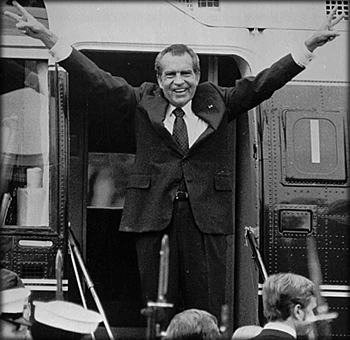
Few days in modern economic history are remembered as a day of infamy like August 15, 1971, when President Richard Nixon suspended U.S. dollar’s convertibility to gold.  The “Nixon Shock” permanently and fundamentally transformed U.S.’s economy and governance, its impact reshaped international trade and geopolitics.

Taking place during the Pluto trine (when transiting Pluto formed a 120° angle to the U.S. Pluto), this series of events played out along the path of political expediency and betrayal of principles, which were followed by pernicious effects. The result was the corruption of core values (Pluto in 2nd house): currency devaluation, economic recession, a tectonic shift of socioeconomic landscape, and the government’s increased control over personal freedom and prosperity – all signatures of U.S. Pluto transits.

The trine between two planets indicates both energies working in sync and in harmony. The influences materialize swiftly. Due to the lack of conflict, the natives can be careless and unaware. In the case of U.S. Pluto, the trine with transiting Pluto means the powerful, corruptive forces –both within and without—are working as one, unobstructed. What we observed was the compromise of core beliefs, broken promises, deceptions, and secrecy.

Policies made during U.S. Pluto transits often corresponded with the destruction of status quo and the expansion of federal government. The quick-and-dirty solution frequently leads to unintended consequences that work the opposite of the original intention, since Pluto’s pattern is also to ensnare and complicate. The impact of these policies does not fully materialize until years, even decades later. This episode is a cautionary tale of a politicized economy and its aftermath.

Consumer Price Index for all items for the United States (Blue)
Consumer Price Index: Food in U.S. City Average (Green)
Consumer Price Index: Energy in U.S. City Average (Red)
Median Sales Price of House in the U.S. (Purple)
Median family income (Gold)
1960 – 2022. Price in August (Q3) 1971 is indexed at 100

Transit Pluto trine U.S. Pluto (120-degree angle)

Effective periods:

November 4, 1969 – February 26, 1970

September 2, 1970 – October 27, 1970

March 12, 1971 – August 26, 1971

Exact dates: September 29, 1970; April 20, 1971; July 24, 1971

Themes:

  • Compromise of principle for political expediency
  • Financial crisis, inflation, and currency devaluation
  • Plutonomy (Wealth redistribution, disparity, and concentration)
  • Plutocracy (Expansion of government control. Government by the wealthy, of the wealthy, and for the wealthy.)
  • Trade wars and currency wars

THE BRETTON WOODS SYSTEM

In July 1944, near the end of World War II, delegates from 44 nations gathered at the Bretton Woods Conference to rebuild the international monetary system. United States dominated the post-war economy and its dollar emerged as the world’s reserve currency. The U.S. government agreed to back every dollar overseas with its gold reserve at $35 per ounce, and all other countries pegged their currencies to the dollar.

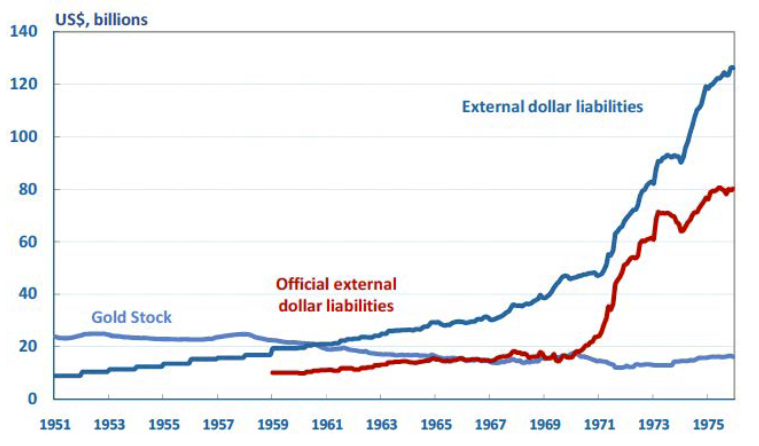
The Bretton Woods system became functional in 1958. Since U.S. owned over half of the world’s gold reserve, the system was stable for a time. Foreign countries continued to acquire dollars and spend on American industrial exports, and their U.S. dollars were saved in interest-bearing accounts rather than converted to gold (Lowenstein 2011).

U.S. Gold Stock and External Liabilities 1951-1975 (Bordo, Monnet and Naef 2018) https://economics.ucdavis.edu/events/papers/copy2_of_417Bordo.pdf

THE LONDON GOLD POOL

In order to provide dollars for international trade, U.S. ran a persistent balance of payment deficit (expenditure exceeding income) and redeemed overseas dollars in gold upon request. In 1961, the amount of outstanding dollar claims began to exceed the U.S. government’s gold reserve. The London Gold Pool was established to shoulder the burden of gold outflow with member nations and defend the $35 gold price.

The stabilization mechanism was not to last. The Federal Reserve shifted to an inflationary policy in 1965, violating the rules of the Bretton Woods System (Bordo, Monnet, and Naef 2017). In the same year, French president Charles De Gaulle led the charge to repatriate gold and subsequently withdrew from the London Gold Pool. Other countries followed suit and the gold run accelerated.

Unfazed, the U.S. government carried on its “benign neglect” policy, running ever-larger balance of payments deficits and increased spending on Great Society program and the Vietnam war. The Johnson administration (1963-1969) doubled the national deficit and flooded the world with dollars.

As the U.S. dollar became further overvalued and oversupplied, foreign central banks and traders accelerated their dollar-to-gold conversion. In 1966, foreign central banks and governments held over 14 billion U.S. dollars. The United States had $13.2 billion in its gold reserve, only $3.2 billion of which was available to cover foreign dollar holdings.

On March 14, 1968, the United States requested the London gold markets to halt trading amidst overwhelming demand; the two-week closure spelled the official collapse of the London Gold Pool. On March 18, the congress voted to eliminate the gold reserve requirement for Federal Reserve Notes –namely, the U. S. Dollar. The measure exacerbated the devaluation and damaged the U.S.’s credibility. (Bordo 2018)

A two-tiered gold system emerged in effort to shore up the U. S. dollar and contain gold’s surging price. Foreign central-banks pledged to stop trading gold on the open market and reaffirmed the $35 price among central banks. Gold price in the open market was left to float freely. Incidentally, American citizens had been barred from owning monetary gold since 1933. The U.S. Supreme Court ruled the gold confiscation was constitutional during U.S. Pluto and transiting Pluto opposition (forming a 180-degree angle) in 1935.

THE DOLLAR CRISIS OF 1971

What’s our immediate problem? We are meeting here today because we are in trouble overseas. The British came in today to ask us to cover $3 billion, all their dollar reserves. Anyone can topple us – anytime they want – we have left ourselves completely exposed.

—John Connally, Secretary of the Treasury (1971-1972), August 1971

The fiscal and monetary tightening in 1968 brought some relief to the gold outflow; it also caused the recession in 1970. Despite inflation nearing a two-decade high, Nixon was more worried about persistent high unemployment rates, fearing it would threaten his re-election victory.  He relentlessly harassed and pressured Burns –through whisper campaigns, blackmailing and mixed messages –to accelerate money supply “vigorously and aggressively”. Starting in early 1971, Burns forwent his cautious stance and repeatedly slashed the Fed discount rate. Inflation and the run on the dollar resumed. In June 1971, gold in the open market rose above $40 per ounce.

In early August of 1971, United States lost $850 million in gold reserves in just one week. The French had called in over $1 billion in reserves in the a few weeks prior (after an $191 million purchase); the Germans and the Dutch were looking to call in some $200 – 250 million more. (Ohlmacher 2009)

The last draw came on August 12, when the British ambassador appeared before the United States Treasury and asked that $3 billion be converted into gold. That amounted to one quarter of the remaining U. S. gold reserves.

With the run on the dollar at an all-time high and Nixon administration unwilling to tighten, the Bretton Woods framework reached a breaking point. Nixon had wanted to hold off a decision until after the 1972 election, but was advised that doing so would risk hemorrhaging billions more from the gold reserves. To put an immediate stop to market speculation, Nixon’s advisors impressed upon him that the announcement must be made before the markets’ open on the next Monday, which meant broadcasting during the Sunday prime time.

SECRET CAMP DAVID MEETING

On the afternoon of Friday, August 13, 1971, President Nixon holed up with fifteen advisers and staff members at Camp David to confront the economic crisis. The course of action was set: all that was needed was a united front within the administration. Nixon was preoccupied with the short-term economic outcomes and how it would impact of his re-election in 1972 (Ohlmacher 2009); more time was spent discussing the timing and the presentation of the speech than how the economic program would work (Yergin and Stanislaw 1997). Despite of the policy’s enormous impact on international relations and global trade, no foreign policy advisors were invited. Federal Reserve chair Arthur Burns vehemently opposed the closing of the gold window, but he was marginalized and overruled.

Secretary of Treasury John Connally played to the president’s insecurity and advocated dramatic display of leadership. Having infamously said “foreigners are out to screw us … our job is to screw them first,” Connally convinced the president to bypass the Congress and plan in secret ahead of the European finance ministers’ meeting, which would release a joint statement on the United States’ role in the international financial crisis (Ohlmacher 2009).

We can stop convertibility very easily – by just saying so…The next thing is that you probably ought to float this exchange rate with the other currencies of the world. …We have a floating currency… We can take these steps without revaluing gold.

—John Connally, Secretary of the Treasury, August 1971 (Ohlmacher 2009)

Connally assured Nixon that he did not have to be the president who devalued the dollar, and advised him to conflate the closing of the gold window with a domestic policy package: “Whatever we do in the international field – it seems to me – ought to be coupled with action on the domestic front so that they tend to shield each other”. “Posture it as being competitive,”  such action would have “no political downsides. At all. And a great deal of upsides”. (Ohlmacher 2009)

THE NIXON SHOCK (& LIES)

On the evening of August 15, 1971 president Nixon delivered a live, prime-time speech to outline his sweeping economic reform. In a broad stroke, Nixon proposed a 10 percent tax credit for business investment, repeal of the 7-percent excise on automobiles, and speeding up income tax exemption. He also ordered a cut in Federal spending and foreign aid, pay freeze, and downsizing government personnel.

By executive order, Nixon imposed a 90-day wage and price control to counteract inflation expectations. As his dramatic announcement seemingly drew to a close, Nixon segued into blaming international currency traders for unemployment and inflation, arguing for a strong dollar, trade competitiveness, decoupling from gold, and monetary stability in the same breath:

The third indispensable element in building the new prosperity is closely related to creating new jobs and halting inflation. We must protect the position of the American dollar as a pillar of monetary stability around the world.

In the past 7 years, there has been an average of one international monetary crisis every year. Now who gains from these crises? Not the workingman; not the investor; not the real producers of wealth. The gainers are the international money speculators. Because they thrive on crises, they help to create them.

In recent weeks, the speculators have been waging an all-out war on the American dollar. The strength of a nation’s currency is based on the strength of that nation’s economy, and the American economy is by far the strongest in the world. Accordingly, I have directed the Secretary of the Treasury to take the action necessary to defend the dollar against the speculators. I have directed Secretary Connally to suspend temporarily the convertibility of the dollar into gold or other reserve assets, except in amounts and conditions determined to be in the interest of monetary stability and in the best interest of the United States.

Now, what is this action which is very technical? What does it mean for you? Let me lay to rest the bugaboo of what is called devaluation. If you want to buy a foreign car or take a trip abroad, market conditions may cause your dollar to buy slightly less. But if you are among the overwhelming majority of Americans who buy American-made products in America, your dollar will be worth just as much tomorrow as it is today….

I am determined that the American dollar must never again be a hostage in the hands of international speculators.

I am taking one further step to protect the dollar, to improve our balance of payments, and to increase jobs for Americans. As a temporary measure, I am today imposing an additional tax of 10 percent on goods imported into the United States. …

As a result of these actions, the product of American labor will be more competitive, and the unfair edge that some of our foreign competition has will be removed. This is a major reason why our trade balance has eroded over the past 15 years.

–President Richard Nixon, August 15, 1971

With this announcement, U.S. unilaterally suspend the dollar’s convertibility into gold, effectively dissolved its international obligations and ended the Bretton Wood system. Nixon blamed “international speculators” for U.S. losing competitiveness and imposed a 10% tariff on all imported goods until a new international monetary agreement was made.

President Nixon has moved with startling decisiveness to stabilize the dollar and spur economic growth. (He) has now provided the leadership which is even more essential than any specific proposal for turning the economy around and starting it back on the road to full employment, price stability and competitiveness in an open world market.

The New York Times, August 16, 1971

The new policy was well-received by the media as well as Wall Street, with the S&P 500 booking the largest one-day gain of the year.

POLITICAL EXPEDIENCY

… between now and the election in November [1972], there must be one paramount consideration. And that paramount consideration is not the responsibility of the U.S. in the world, it isn’t outgoing policy, it isn’t the fact that in foreign [policy] we’ve done this, that, or the other thing, the main thing is that we have to create the impression that the president of the United States, finally, at long last, after 25 years with blood, sweat and tears, is […] looking after its interests.

 –President Richard Nixon, September 11, 1972

Back in 1968, Nixon campaigned on the promise to roll back President Johnson’s liberal agenda and expansionist policies. He presented himself as a free-market proponent in pursuit of gradual money contraction, inflation reduction, full employment, and balanced budgets. (Bordo 2018)

Believing that high unemployment rates had costed him his first presidential bid in 1960, Nixon’s mandate for the incoming Fed Chairman Arthur Burns was “no recessions”. (Bordo 2018) After the mild recession in 1970, Nixon declared “now I am a Keynesian,” abandoning his free-market stance and fiscal discipline. A loose monetary policy not only supported the domestic welfare programs and the Vietnam war, but also supported economic expansion resulting in an upward revision of economic indicators through the election season.

FALSE ENEMIES

Instead of correcting the monetary and fiscal policies, President Nixon successfully convinced the American people that the rest of the world was the problem: The surplus countries were blamed for devaluing their currencies and hurting the dollar’s competitiveness; currency speculators were blamed for the pressure to devalue the dollar. There was an unwillingness to recognize that the key source of the problem: U.S. inflation. (Bordo 2018)

By re-framing policy failure as a triumph and fresh start, Nixon succeeded in playing the role of a strong and decisive leader. He won the re-election in a landslide in 1972.

This is the shabby secret of the welfare statists’ tirades against gold. Deficit spending is simply a scheme for the “hidden” confiscation of wealth. Gold stands in the way of this insidious process. It stands as a protector of property rights. If one grasps this, one has no difficulty in understanding the statists’ antagonism toward the gold standard.

–Alan Greenspan (Federal Reserve Chairman, 1978-2006), 1967

ADDITIONAL READING

©2022 Brave New Real. All rights reserved.

Turmoil in the Second House – The U.S. Pluto Return (2021-2023) Part 3: History Rhymes (1)

Part 3 is a survey of the crucial points of the U.S. Pluto cycle. These dates are determined by aspects formed between the transiting Pluto and the U.S. Pluto. Only major aspects – 60, 90, 120, and 180 degree – are included. As mentioned in part 2, for the sake of precision, I use an 1-degree orb, i.e. only events that took place when the transiting and natal Pluto are within 1-degree of forming an exact aspect are included. –Author

Panic of 1819 and The Missouri Compromise (1819-1821)

Active period:

April 10, 1819 – September 19, 1819

February 25, 1820 – May 28, 1820

July 30, 1820 – April 1, 1821

October 4, 1821 – February 15 1822

Themes:

Panic of 1819

  • Free trade vs. embargo
  • Economic boom-and-bust
  • Monetary and credit expansion
  • Financial crisis and depression
  • Public–private entanglement and corruption
  • Business consolidation
  • Central bank and government intervention
  • Debt default and relief

Missouri Compromise

  • Political expediency that at the cost of moral principles and long-term peace
  • Maintaining status quo and social cohesion at all costs
  • Federal government vs. individual states
  • Political polarization and disunion threats
  • Legitimized oppression of minorities
  • Congressional power struggle
  • Infringement of property right and individual freedom
  • Fear mongering and conspiracies

Adams-Onis Treaty (Enacted on February 22, 1821): Territory expansion

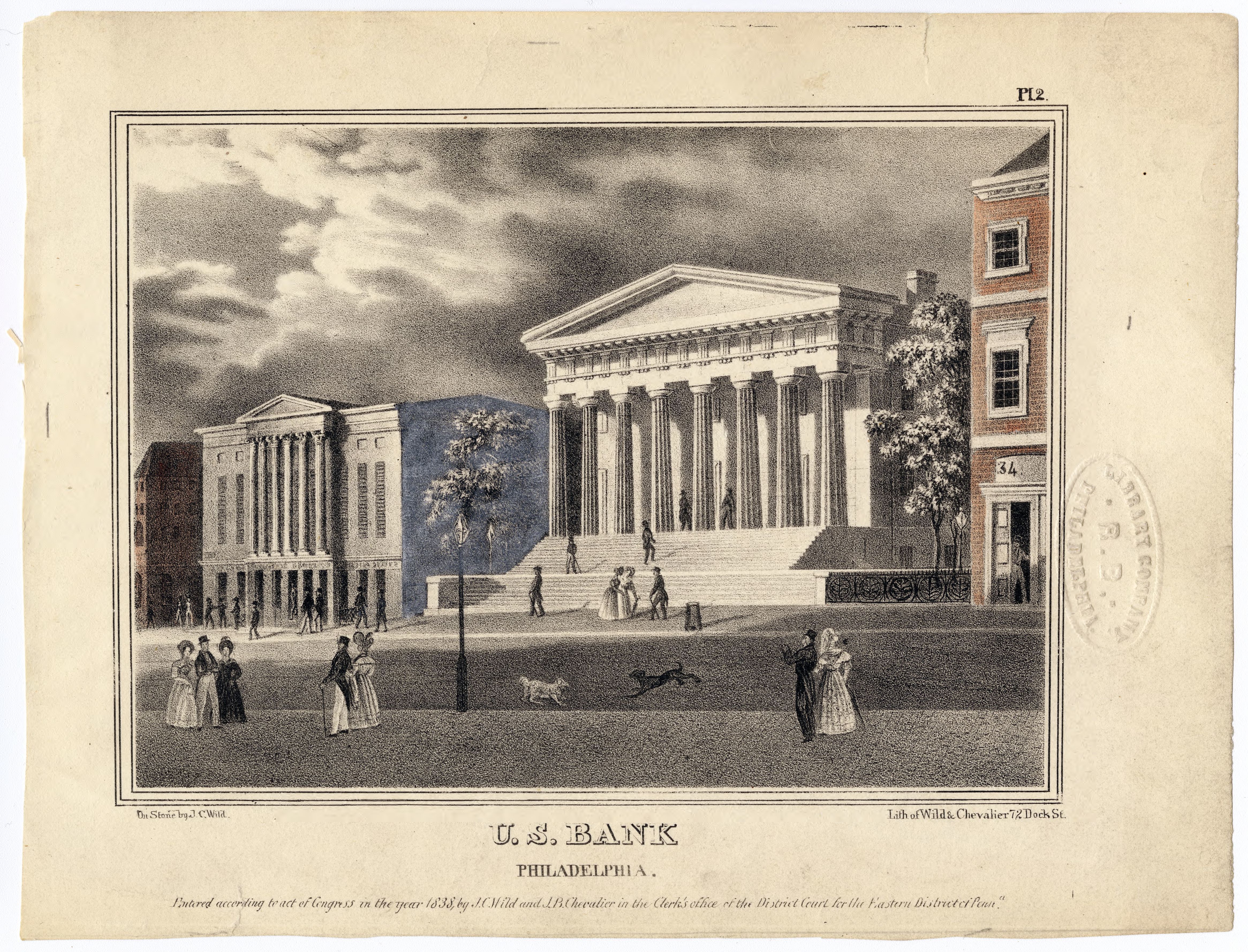
Wild, J. C. (John Caspar), United States Bank, Chestnut Street, Philadelphia. https://www.loc.gov/item/2021670221

Panic of 1819

Dubbed “America’s first great depression,” the financial crisis in 1819 was a result of contraction of demand and money supply at the end of Anglo-French war in 1815.

The Panic was precipitated by the need for the Bank of the United States to save itself by reversing its credit expansion and contracting its loan sharply. This sudden contraction, precipitated in the summer and fall of 1818, forced the state banks to contract their loans as well. It brought an unpleasant day of reckoning to those over-inflated banks, which were now called upon to meet their unfulfillable promise to redeem their banknotes in specie. The result was a run of bank failures, and a severe contraction of banknotes throughout the country.

Murray N. Rothbard, “The Frankfort Resolutions And The Panic Of 1819.”

U.S. prospered during the European conflict as the neutral exporter to the warring countries. Owing to the disruption in European agriculture production, American agriculture imports were in high demand. U.S. domestic inflation further elevated the price of produce such cotton, tobacco, and wheat. Farmers and investors, anticipating sustained price increase, rushed to expand their land holding, creating the “land boom.”

The land rush was also promoted by the U.S. government, who incurred massive national debt during the Louisiana Purchase and The War of 1812. In anticipation of a revenue boost, millions of acres of western land were released to the public with generous purchasing terms. Buyers with insufficient funds were allowed to purchase with credit.

After the termination of First Bank of the United States in 1811, U.S. government, citizens and enterprises had relied on unregulated and under-capitalized “wildcat” state banks for funding. The suspension of specie (gold and silver coins) conversion in 1814 allowed these banks to freely issue banknotes with minimal reserve, subsequently greatly expanded the money supply. Between 1811 and 1815, the number of state banks in the U.S. rose from 88 to 208 while the national money supply doubled (Rothbard, 2007).

Money, or what passed for money, was the only cheap thing to be had…. The State banks were issuing their bills by the sheet, like a patent steam printing press its issues; and no other showing was asked of the applicant for the loan than an authentication of his great distress for money. …They generously loaned all the directors could not use themselves, and were not choice whether Bardolph was the endorser for Falstaff, or Falstaff borrowed on his own proper credit, or the funds advanced him by Shallow.

Joseph G. Baldwin. The Flush Times of Alabama and Mississippi.

The money supply exploded, wildly variable discount rates among banks began to cause chaos in the financial system. Premiums for redeeming specie were common place. Some banks even resorted to intimidation and lawsuits when customers attempted to convert their banknotes for specie. (Rothbard, 2002). The Second Bank of the United States was chartered in 1816 to establish uniformed convertibility among banknotes and restore trust in banks.

The largest corporation in its time, the national bank was owned by the federal government as well as foreign and domestic shareholders. The bank was entrusted with conducting all fiscal transactions for the U.S. Government, and paradoxically, according to secretary of the treasury William Crawford (1816-1825): “The first duty of the Board is to the stockholders; the second is to the nation.” (Browning, 2019).

With this conflict of interests in mind, perhaps it was not astonishing that the bank not only caved in to the financial and political interests of its shareholders, drastically amplifying the money supply and inflation, it was also derelict in reinforcement of the specie conversion, “outright fraud abounded” (Rothbard, 2002).

On the eve of the crisis, the explosion of money and credit spilled into infrastructure construction and international trade. Inflation was rampant. An outflow of specie drained the bank reserves across the country. Vicious dumping of cheap British imports devastated the once-burgeoning domestic manufacturing, an urban depression was underway. Since Britain’s conditional ban on imported grain in 1815, Europe has recovered from previous crop failure and resumed post-war agriculture production, which lead to reduced demand and production of American agriculture imports. The sudden collapse in price was precipitated by Britain’s switch to cheap Indian cotton in 1818. Farmers’ and investors’ profit plummeted, defaulted on their loans, setting off bank failures.

It was not until mid-1818, when U.S. must repay foreign debtor in gold or silver, did the national bank abruptly restricted loans and demanded immediate specie redemption from state banks. These high-flying banks, unable to meet the requirement, in turn recalled loans and demand immediate payment from their stressed borrowers. Mass default and bankruptcy ensued, triggering a banking crisis and the Panic of 1819. The money supply contracted 50% between the spring of 1818 and summer of 1819. The price of staples fell by 51% between November 1818 and June 1819 (Rothbard, 1963). Farmers and investors saw the price of their land dropped as much as 75%. In once thriving urban manufacturing centers, employment and income plummeted. Unemployment reached 50% in Pittsburgh and Philadelphia (Browning, 2019). Poverty was widespread and middle class crowded the debtors’ prison.

All the flourishing cities of the West are mortgaged to this money power. They may be devoured by it at any moment. They are in the jaws of the monster! A lump of butter in the mouth of a dog! One gulp, one swallow, and all is gone.

Missouri Senator Thomas Hart Benton (1821-1851)

The banking crisis lasted from 1818 to 1819. The depression was lifted in 1821, but its impact persisted into mid-1820s. The national bank, through increasing reserve requirement, quickly brought the financial crisis under control — at the cost of exacerbating and prolonging the depression. Distressed assets from borrowers were seized by the national bank and sold cheaply to those with means. State governments were powerless to restrain the federal bank.

In 1820, congress reduced the size and price of public land and banned the purchase of public land on credit installments. Subsequent relief programs for earlier buyers (1821) included interest forgiveness, price reduction, extended loan terms and return options. These relief measures set the precedent for controversial government interventions during future crisis.

This crisis was regarded as the start of modern boom-bust economic cycle. The corruption of banks and government were on full display throughout the first nationwide crisis. It became apparent that banks served their shareholders at the expense of their customers, and the wealthy and well-connected was able to ride out, even profited from the financial devastation. Predictably, the distressed asset price paved way for future consolidation. It also deepened the riff between states and federal government, the industrialized North and export-dependent South, the conservative East and expansionist West. The nationwide hatred toward the banks would last for decades and the bitterness toward the federal government would feed Southern sectionalism and sow the seed of civil war. The heated debate between sound money vs. debasement persisted to this day.

Reference

Browning, Andrew H. The Panic of 1819 the First Great Depression. Columbia: University of Missouri Press, 2019.

Catherwood, Jamie. “Panic Series (Pt. II) – 1819.” Investor Amnesia, 12 Sept. 2021, https://investoramnesia.com/2021/09/12/the-panic-series-pt-ii-1819/.

Haulman, Clyde. “The Panic of 1819: America’s First Great Depression.” Financial History, Museum of American Finance, Winter 2010, https://www.moaf.org/exhibits/checks_balances/andrew-jackson/materials/Panic_of_1819.pdf.

Rothbard, Murray N. “The Frankfort Resolutions And The Panic Of 1819.” The Register of the Kentucky Historical Society 61, no. 3 (1963): 214–19. http://www.jstor.org/stable/23375967.

Rothbard, Murray N. 2002. A History of Money and Banking in the United States. Ludwig Von Mises Institute.

Rothbard, Murray Newton. The Panic of 1819: Reactions and Policies. Ludwig von Mises Institute, 2007. https://cdn.mises.org/The%20Panic%20of%201819%20Reactions%20and%20Policies_2.pdf.

Primm, James Neal. “A Foregone Conclusion: Chapter One – the Nineteenth Century Background: St. Louis Fed.” Saint Louis Fed. Federal Reserve Bank of St. Louis, June 25, 2021. https://www.stlouisfed.org/a-foregone-conclusion/chapter-one.

Ward, Michael. “Panic of 1819.” Encyclopedia of Alabama. Alabama Humanities Alliance, April 10, 2010. http://encyclopediaofalabama.org/article/h-2568.

The Missouri Compromise

Modern School Supply Company. Historical-geographical maps of the United States: The Missouri Compromise 1820. https://www.loc.gov/resource/g3701sm.gct00483/?sp=22&r=0.05,-0.093,1.279,0.801,0

Evidently, a narrative that negates all traces of a matter as massive as slavery must inevitably distort the rest of the story as well. From the meaning of freedom to the understanding of human nature, to the perception of God’s Providence, all elements of Americans’ understanding of their great national experiment were warped and reshaped to conform to the demands of a version of the tale in which the enslavement and dehumanization of millions of their fellow creatures could be deemed compatible with the values of the republic.

Robert Pierce Forbes. The Missouri Compromise and Its Aftermath.

Founders’ Compromise

Reason, justice, equity never had weight enough on the face of the earth to govern the councils of men; it is interest alone which does it, and it is interest alone which can be trusted.

Thomas Jefferson, “12 July, 1776” in Jefferson Autobiography

Coincided with the Panic of 1819, unprecedented threats of disunion and civil war erupted over the future of slavery. 

The anti-slavery language was left out in the Declaration of Independence for the sake of unanimity. At Constitutional Convention of 1778, the delegates again faced the same quandary: a union with slavery vs. no slavery, no union.

Great as the evil is, a dismemberment of the Union would be worse. If those states should disunite from the other states for not indulging them in the temporary continuance of this (slave) traffic, they might solicit and obtain aid from foreign powers.

James Madison, Debate in Virginia Ratifying Convention, June 15, 1788

The political evil was inherent in the constitution itself, which brought States slaveholding and non-slaveholding into indissoluble bonds, providing no radical means for assimilating their condition. The anti-slavery spirit of 1776 had died out, or rather had exhausted its power of persuading States to emancipate…

James Schouler, History of the United States, Volume IV

Northern delegates conceded again, acquiescent in the belief that slavery will eventually become economically unsustainable and die out. With no foreseeable increase in demand of slave labor, the delegates prohibit the restriction of –thus continuing – Atlantic slave trade for the next twenty years, and left the thorny issue to individual states in the Tenth Amendment (1791): “The powers not delegated to the United States by the Constitution, nor prohibited by it to the States, are reserved to the States respectively, or to the people.”

After the “Act Prohibiting the Importation of Slaves” took effect in 1808, the nation settled on the future decline of slavery, yet domestic slave trade remained. The entire U.S. population continued to participate in trading and consuming goods produced by domestic and oversea slave labor. The invention of cotton gin in 1793 had revolutionized cotton processing, vastly increased the productivity and profit of cotton production, which almost entirely the product of slave labor. The “cotton boom” after the War of 1812 sent the production and worldwide demand for American cotton soaring. U.S. cotton export grew from $5,700,000 to $20,000,000 between 1800 and 1820, and the value of slaves was said to have increased three-fold in the same period. (Woodburn, 1894) Slavery became profitable and vital to the national economy once more.

The Tallmadge Amendment

In 1812, Louisiana territory –the first from the Louisiana Purchase – entered the union as a slave state. Missouri territory was expected to follow suit in 1818. In the course of debate, New York Representative James Tallmadge Jr. and Charles Baumgardner submitted two amendments to Missouri’s admission to the union:

“… that the further introduction of slavery or involuntary servitude be prohibited, except for the punishment of crimes, whereof the party shall have been fully convicted; and that all children born within the said State, after the admission thereof into the Union, shall be free at the age of twenty-five years.”

The Tallmadge Amendment was the first serious challenge to the southern status quo, an uneasy balance of power based on the joint evasion of morality of human bondage and servitude. The debate largely focused on the interpretation of the constitution. The discourse on morals was considered offensive by the southerners as it violates the state sovereignty and the long-standing understanding between the two sides of the slavery issue.

The debate on Tallmadge’s amendment was inconceivably intense and hostile, and involved open threats of disunion and civil war:

“If a dissolution of the Union must take place, let it be so! If civil war, which gentlemen so much threaten, must come, I can only say, let it come!”

Representative James Tallmadge Jr. of New York

The measure passed the house but failed in the Senate. Missouri’s statehood was in limbo at the close the 15th session of Congress. Over the recess, bitter resentment, and indignation raged across the country in town hall meetings, pamphlets, petitions, and newspaper essays. Northern antislavery force demanded that Missouri abandons slavery and the prohibition extended to all future territories. Missourians and their southern supporters decried the unwarranted delay and unfair restriction.

Political Distrust

…we have the wolf by the ear, and we can neither hold him, nor safely let him go. justice is in one scale, and self-preservation in the other.

Letter from Thomas Jefferson to John Holmes (April 22, 1820)
Self-Preservation

Southerners did not trust the North’s humanitarian anti-slavery argument. Rather, they viewed Northern restrictionists’ effort as a plot to revive the Federalist party and return to an era of a strong national government. The call for Revolutionary ideal of liberty and equality was perceived as encroachment on state sovereignty and dreaded incitement to slave riots.

The crux of the pro-slavery argument was the Southern slave holders’ prosperity and political dominance. Virginian planter class, and by extension, Southern slaveholders, have served almost consecutively in the White House and held high offices since the founding of the nation. The nation’s capital, border on Virginia and Maryland, was the center of domestic slave trade. Virginia held almost 1/3 of the nation’s slave population and was eager to push the surplus to the new territories.

Southern Founding Fathers, James Madison and Charles Pinckney stressed that the Constitutional Convention had not authorized any extraordinary congressional control over slavery. Thomas Jefferson, likewise, recoiled against all the northern constitutional innovations spawned by the Missouri crisis. Jefferson adopted the argument that “diffusion” of the institution in the West would not increase the total number of slaves and “would make them individually happier and facilitate their eventual emancipation.”

Don E. Fehrenbacher. The Slaveholding Republic.

Since the industrialization of cotton production and the upsurge of cotton export, slavery not only became enormously profitable but made its westward expansion. Up against the enormous economic incentive, Southern antislavery sentiment wavered, and the Revolutionary philosophy became irrelevant and inconvenient history.

Most southern representatives in the Congress continued to denounce slavery, but their words had become increasingly hollow. Apathy and resignation gradually set in. It was accepted that nothing –nonthreatening to the slaveholding class, at least –could be done. Many simply set the date of eventual abolition to the infinite future.    

Charles Pinckney – founding father, signer of the Constitution, three-term South Carolina governor, ambassador, and two-term congressman –defended slavery. Citing historical precedents in ancient civilization and indigenous slavery in Africa, he asserted that slavery was human nature, and implied that the institution was common good of slaves and slaveholders:

A free black can only be happy where he has some share of education and has been bred to a trade or some kind of business. The great body of slaves are happier in their present situation than they could be in any other, and the man or men who would attempt to give them freedom, would be their greatest enemies.

Charles Pinckney’s Speech to Congress, 1820.

The South also extended their legal argument against the Tallmadge amendment on the sovereignty and equality of the of the state (Woodburn, 1894). Quoting the second half Article, 4 Section 3, Clause 2 of the U.S. Constitution: “…nothing in this Constitution shall be so construed as to Prejudice any Claims of the United States, or of any particular State”, along with the Tenth Amendment, they argued that the Constitution, by intentional omitting the slavery issue, has relinquished its claim to restriction. Slavery is an issue to be decided by individual states. Tallmadge amendment was unconstitutional because it placed the constraint on the admission of Missouri alone. Besides, since slaves were treated as property, banning slavery would amount to illegal seizure of personal property, prohibited by the Fifth Amendment.

Morals and Principles

I was aware of the delicacy of the subject and that I had learned from Southern gentlemen the difficulties and the dangers of having free blacks intermingling with slaves;… While we deprecate and mourn over the evil of slavery, humanity and good morals require us to wish its abolition, under circumstances consistent with the safety of the white population. Willingly, therefore, will I submit to an evil which we cannot safely remedy… But, sir, all these reasons cease when we cross the banks of the Mississippi, a newly acquired territory, never contemplated in the formation of our Government, not included within the compromise or mutual pledge in the adoption of our Constitution, a new territory acquired by our common fund, and ought justly to be subject to our common legislation.

Tallmadge’s Speech to Congress, 1819

The North did not see any attempt to end the slavery on the South’s part. Instead, they saw a revival and the intention to extend and expand. For the Northern restrictionists, the future of slavery was at stake –not only in Missouri, but in all new states and territories. They sought to implement the Northern Ordinance to the regions west of Mississippi River and Florida, and put an end to the expansion of slavery for good.

They argued on humanitarian ground and maintained that the Declaration of Independence and the Constitution provided the ground for abolition. While some claimed that Article I Section 8 would suffice to restrict all slave trades, the most eloquent proponent of Tallmadge Amendment, New York Senator Rufus King, cites first part of Article, 4 Section 3, Clause 2: “The Congress shall have Power to dispose of and make all needful Rules and Regulations respecting the Territory or other Property belonging to the United States” and contend that the Congress was granted the power to dictate the condition of admission of each state.  Slavery was an evil disgrace forced upon the colonies. This wickedness was only tolerated for the sake of the Union and should be restricted at the earliest expediency.

Almost all debates surrounding Missouri Crisis could be boiled down to the balance of powder, however. Despite dominating the House, North’s demographic lead did not translate into their political sway. Equal number of Senators from each state gave the less populated South an unfair advantage. Maintaining the power balance depends on equal number of free and slave states. 

The North had been pained by the three-fifth clause, which adds 60% of the slave population to the slave states’ free population for calculating taxation and assigning House representative seats. Originally meant as a compromise to discourage the growth of slavery, the three-fifth clause gave southern states more congressional representatives and more electoral votes for president than their white population entitled.

At the time of Missouri’s request of statehood, the nation contained 11 free states and 11 slave states at the time. Missouri’s entry as a slave state would have tipped balance of power in South’s favor; with the Tallmadge Amendment approved the antislavery stance would gain strength going forward. Aggravated by the dominance of “Slave Power,” North feared that if Missouri’s slave state status would solidify South’s dominance. Worse still, it could lead to more slave states and perpetuate their reign in national politics.

Congressional Wrangling

Missouri renewed its request after the Congress reconvened; Maine also applied to join the union. The Senate amended the Maine admission with the unconditional acceptance of a slaveholding Missouri but the coercion was called out by Northern House representatives. Seeking incentivize the bill passage, Senator Jesse Thomas of Illinois added a proviso that allows slavery in Missouri, but “forever prohibits” slavery in all remaining areas of the Louisiana Purchase north of the 36° 30′ parallel, an area mostly uninhabited at the time. The bill passed the Senate and again rejected by the House.

In respond to the Senate’s strong-arming, the House passed its own bill admitting Missouri with the antislavery Tallmadge Amendment. The bill was rejected by the Senate and the Congress came to a deadlock. 

A sullen gloom hung over the nation. All felt that the rejection of Missouri, was equivalent to a dissolution of the Union: because those states which already had, what Missouri was rejected for refusing to relinquish, would go with Missouri.

Abraham Lincoln, Eulogy of Henry Clay

The Senate called for a committee of conference the next day. Kentucky Senator Henry Clay, then Speaker of the House, also known as “The Great Compromiser,” spearheaded the compromise effort. A slave owner himself, Clay had argued for “the inviolability of this species of property” granted by the Constitution and advocated “diffusion” and “colonization” as the ultimate and humane solution to slavery. He, along with Thomas Jefferson, James Madison and then-President James Monroe claimed that it was only humane to disperse South’s surplus slave population westward, and expatriate them when free labor is plenty and slave-holding becomes unaffordable in time. This would defuse the tension among the dense and restless southern slave population and lessen the threat and stress of the slaveholders –while profiting through the domestic slave trade. 

Clay’s optimism about the compromise was soon threatened by the building momentum of the antislavery force. Fearing an impending all-out restriction on slavery, Clay rushed to forge a compromising majority by instilling the fear of disunion and accusing the Federalists of instigating and exploiting the Missouri issue to divide the nation.

We have been told by the Speaker that the people of Missouri are ready to shoulder their muskets, to march en masse, and force their way into this hall, Sir, if this be indeed so, it is time to barricade the doors. If it be an enemy that is advancing, let us bar our gates, and prepare for our defence;…

But not only will Missouri revolt from our authority: the slave-holding states will join with her, and, if this restriction passes, the Union will be dissolved. Such, sir, is the language which I have heard, with infinite regret, upon this floor, not from two or three members merely, but from all those who have spoken against this amendment…

…respecting the motives of the friends of this restriction; and an appeal has been made to vulgar prejudices, by calling it a Federal measure; …it is well known that it originated with Republicans; that it is supported by the Republicans throughout the free states; and that the Federalists of the south are its warm opponents: The question then is not between Federalists and Republicans, but between slave-holders and those who hold no slaves. It is a knowledge of this fact, which has induced the free states, usually so much divided among themselves, to advance on this occasion with so much ardor and unanimity to the attainment of their object.

Speech of Mr. Plumer, of New-Hampshire, on the Missouri question, delivered in the House of Representatives of the United States, February 21, 1820

Clay successfully convinced some Southern pro-slavery House representatives to accept the Thomas proviso and wrangled several Northern representatives to absent or support Missouri as a slave state. By dividing the Compromise into three bills, Henry Clay prevented the North and Southern opponents to join force to defeat the Senate bill.

On the same day, March 2, 1820, the joint committee, carefully chosen by Clay, returned with an endorsement of the original Senate compromise bill, now in three separate parts. Missouri was admitted as a slave state by a margin of three votes, Maine entered as a free state the day before its application expires, and slavery was prohibited north of 36° 30´ parallel, the so-called “Compromise Line. The Missouri Compromise was thus achieved. Clay sneaked the bill to the Senate while blocking the House’s reconsideration. President Monroe signed the bill on March 6, 1820.

He did not confine himself to speeches addressed to the House, but he went from man to man, expostulating, beseeching, persuading, in his most winning way… What helped in him gaining over the number of votes necessary to form a majority was the growing fear that this quarrel would break up the ruling party, and lead to the forming of new divisions.

Carl Schurz, Life of Henry Clay
President Monroe’s Role

President James Monroe was instrumental in fostering the compromise. “Monroe’s endorsement of the Missouri Compromise was a last-ditch effort to defeat a budding antislavery movement that stood a few congressional votes shy of enacting the most meaningful national restrictions on slavery in a generation.” (Hammand, 2019)

 A Virginia slaveholder himself, he regarded the nation’s interests aligned with the prosperity of the South, and concerned himself with maintaining the privilege and security of Virginia’s planter class. Monroe deemed Virginia’s former anti-slavery stance as idealistic and naïve, as the planter class previously had not faced the menacing danger of an ever-increasing and rebellious slave population. Anti-slavery sentiment had become a luxury the Planter Class could no longer afford. He helped promote the idea that the Northerners are ignorant of the South’s peculiar condition and that the expansion of slavery was not only necessary but humane. He and other Republicans, along with Thomas Jefferson, worked to detract and re-frame the antislavery argument by claiming the Federalists and their alleged sympathizers of plotting the Missouri crisis to consolidate the antislavery front, spoil his reelection, and dictate the future of the union.

The Second Missouri Compromise

Missouri adopted a constitution for the new state on July 19, 1820. Bitter and defiant about the delay and insults, Missouri delegates inserted a provision that not only prohibited free blacks from migrating to the state, but also forbade the legislative emancipation of slaves without the slave owners’ consent. This clause was considered in direct violation of the Article IV, Section 2, of the US Constitution: “The Citizens of each State shall be entitled to all Privileges and Immunities of Citizens in the several States.”

The Missouri crisis was revived. Northern representative who unwillingly compromised were disgusted by the clause and withdrew their support.  The antislavery faction, seeing their hope renewed, seized the last chance to keep a slave-holding Missouri out of the union while the representatives from Missouri waited for their admission at the Congress door.

The debate centered around the citizenship of free blacks and by extension, their rights under the Constitution. A compromise Proviso by Tennessee Senator John Eaton passed the Senate: “That nothing herein contained shall be so construed as to give the assent of Congress to any provision in the Constitution of Missouri, if any such there be, which contravenes the clause in the Constitution of the United States that ‘the citizen of each state shall be entitled to all the privileges and immunities of citizens in the several states.’”

The House rejected this and several subsequent proposals for Missouri’s admission, leaving the Congress in deadlock and Missouri without a legal status. On February 2, 1821, a joint committee was formed, focusing solely on forming an amendment to guard “against the violation of the privileges and immunities of citizens of other states in Missouri.” The House rejected the bill by a vote of 88 to 82.

South Carolina senator and Constitution’s framer Charles Pinckney proclaimed that the oppositions’ rejection was trivial, and accused them of breaching of faith and deception:

The article of the Constitution on which now so much stress is laid—‘the citizens in each State shall be entitled to all the privileges and immunities in every State.’—having been made by me, it is supposed that I must know, or perfectly recollect, what I meant by it. In answer, I say that, at the time I drew that article, I perfectly knew that there did not then exist such a thing as a black or color citizen of the United States, and knowing that all the Southern and Western States had for many years passed laws to the same effect, which laws are well known to Congress, being at this moment in their library and within the walls of the Capitol, and which were never before objected to by them or their courts, they (the people of Missouri) were no doubt warranted in supposing they had the same right…

On February 21, 1821, Kentucky Senator William Brown demanded the Missouri enabling act repealed, claiming that “The plighted path of Congress for the admission of Missouri has been violated… the course of the majority can be justified by no principle of reason or sound policy, but must rest for its support on pious fraud”. On the next day, Clay assembled a congressional committee with his chosen candidates. The elected committee members agreed that Missouri to be admitted with the original condition and the controversial clause (fourth clause of the twenty-sixth section of the third article of the constitution) “shall never be construed to authorize the passage of any laws, and that no law should ever be passed, by which any citizen, of either of the states in Union, shall be excluded from the enjoyment of any of the privileges and immunities to which such citizen is entitled under the constitution of the United States; that the legislature of said State, by a solemn public act, shall declare the assent of said State to the said fundamental condition.” The Senate passed the measure by a four-vote margin.

By applying circular logic, the provision suggested that the Missouri’s constitution was in fact unconstitutional, and deftly circumvented the question of whether free blacks were U.S. citizens and equally protected by the constitution. This purposely obstruse provision is known as the Second Missouri Compromise.

President Monroe proceeded to proclaim Missouri’s contingent statehood on March 2, 1821. Missouri subsequently denied the Congress’s right to demand such a statement and openly declared “A Solemn Public Act” a farce:

 …this general assembly are of opinion that the congress of the United States have no constitutional power to annex any condition to the admission of this state into the federal Union, and that this general assembly have no power to change the operation of the constitution of this state

the Solemn Pubic Act passed the Missouri by overwhelming margin, possibly owing to the fact that the incorrect clause was cited in the congressional resolution. The clause the Congress objected to, “free negroes and mulattoes were to be prevented from coming to and settling in the State” was actually the first clause –not the fourth – of the controversial passage. Therefore “the assent given to it by the Legislature of Missouri was without binding force, moral or legal, upon any human being whatsoever.” (Carr, 1900)

President Monroe received a copy of the Act and on August 30, 1821, declared that the condition had been complied and the Missouri’s admission to the Union was complete. The Solemn Public Act was overturned on March 14, 1835, when free Blacks must meet onerous conditions to obtain a “freedom license” to legally remain in Missouri.

National Suicide and the Prelude to Civil War

I have favored this Missouri compromise, believing it to be all that could be effected under the present Constitution, and from extreme unwillingness to put the Union at hazard. But perhaps it would have been wiser as well as a bolder course, to have persisted in a restriction upon Missouri, till it should have terminated in a convention of the States to revise and amend the Constitution. This would have produced a new Union of thirteen or fourteen States unpolluted with slavery, with a great and glorious object to effect, namely, that of rallying to their standard the other States by the universal emancipation of their slaves. If the Union must be dissolved, slavery is precisely the question upon which it ought to break. For the present, however, this contest is laid asleep.

The Memoirs of John Quincy Adams

The compromise had another sinister feature. The anti-slavery sentiment in the North, invoked by the Missouri controversy, was no doubt strong and sincere. The South threatened the dissolution of the Union; and, frightened by that threat a sufficient number of Northern men were found willing to acquiesce, substantially in the demands of the South. Thus the slave power learned the weak spot in the anti-slavery armor. It was likely to avail itself of that knowledge, to carry further point by similar threats, and to familiarize itself more and more with the idea that the dissolution of the Union would really be a royal remedy for all its complaints.

Carl Schurz, Life of Henry Clay

To this day, the Missouri Compromise is still seen as a brilliant effort to preserve the balance of power in the U.S. congress, as if the moral dimension of the compromise was beyond the scope of discussion. From http://www.senate.gov:

(the Missouri Compromise) maintained a delicate balance between free and slave states…. Ironically, it was the astute maneuvering of Speaker Henry Clay that helped bring about this new era of Senate debate, creating a legislative forum in which Senator Henry Clay would soon forge other Union-saving compromises.

The confounding inconsistency of the founding fathers and congressional leaders during the Missouri crisis baffled historians. E.g., Thomas Jefferson’s characterization of emancipation as “an abstract principle” and asserted that the abolitionist zeal was destructive, suicidal, and treasonous:

I regret that I am now to die in the belief that the useless sacrifice of themselves, by the generation of ’76. to acquire self government and happiness to their country, is to be thrown away by the unwise and unworthy passions of their sons, and that my only consolation is to be that I live not to weep over it. if they would but dispassionately weigh the blessings they will throw away against an abstract principle more likely to be effected by union than by scission, they would pause before they would perpetrate this act of suicide on themselves and of treason against the hopes of the world.

Jefferson, Letter to John Holmes, 1820

Some historians have concluded that our founders were self-deluding hypocrites and liars, while others rationalized their comments and actions. In any case, it appeared that the revolutionary spirit had all but dissipated within one generation and the pursuit of equal rights and liberty was only intended for the white men all along. “Americans subscribed in a new understanding that ‘the Declaration of Independence did not in fact proclaim universal human rights, but rather applied to whites alone.’” (Fehrenbacher, 2002)

An uneasy silence dawned in the aftermath of the Missouri Compromise, for discussion on such dedicate subject had been deemed inherently dangerous for the Planter class. The frightened slaveholders were convinced that these prolonged and intense debates incited slave riots, the Demark Vesey uprising of 1822 was a case in point.

Another certain casualty was the “Era of Good Feelings.” The post-war nationalistic sentiment and aligned national interests under one-party rule with was no longer. The crisis precipitously fractured the Democratic Republican Party along the sectional line and caused irreparable damage without warning. “Disunion” and “civil war” were repeated nonchalantly during congressional sessions and presidential meetings. The animosity sown would ultimately lead to the devastating Civil War.

Despite some anti-slavery representatives mourned the intolerable defeat, both sides proclaimed victory Initially. The heated debates forged a unified Southern identity, geographically separated, and forever identified with slavery. Over time, the Compromise Line evolved into both the unbreachable boundary and confinement of slavery expansion. When the Southern interest was cornered a few decades later, their repeal of the Compromise Line led to a full-blown Civil War.

Then Secretary of State John Quincy Adams prophesied the beginning of Southern decline in his personal diary:

(Missouri Compromise was) terrible to the whole Union, but portentously terrible to the South – threatening in its progress the emancipation of all their slaves, threatening in its immediate effect that Southern domination which has swayed the Union for the last twenty years, and threatening that political ascendancy of Virginia, upon which Clay and Crawford had fastened their principal hope of personal aggrandizement.

The two-year congressional battle had exhausted the antislavery movement, re-legitimized slavery, reversed the emancipation momentum, adding insult and injury to free black people nationwide.

In late 1821, Attorney General William Wirt, in response to Secretary of the Treasure William H. Crawford’s inquiry whether free blacks are citizens of the United States, replies: “No person is included in the description of citizen of the United States who has not the full rights of a citizen in the United States.” This statement effective excludes all free black persons living in any states that does not grant full rights to them, which was at least 95% of the free black population of the country at the time (Fehrenbacher, 2002). In the same year, New Jersey Supreme Court rules that all Black men were prima facie slaves. The citizenship and rights of free black people hang in balance and suffered further degradation in the coming decades.

The forced political deal satisfied neither the anti-slavery advocates nor the pro-slavery force. South opposed the bill because it cordoned off too much of the West; North objected to it because it opened the gate for slavery expansion. The uneasy truce was sustained until 1850 by alternating the admission of slave and free states.

U.S. political leadership had hoped the Missouri Compromise would settle the slavery debate once and for all, yet the peace was not to last. The Missouri Compromise was repealed in 1854 and ruled unconstitutional by the Supreme Court three years later in a move that lead the nation closer to the Civil War.

THE ASTROLOGY PERSPECTIVE

Astrologers consider sextile (60-degree) is one of the “easy” or “soft” transits that offers a window of opportunity to prepare for the challenging square transit. In retrospective, the Missouri Compromise was a missed opportunity to right the ship before the union head into the abyss.

By default, the U.S. Sagittarius ascendant will always seek and rationalize easy-and-quick fixes. It is effortless to imagine the Congressional representatives being persuaded to “look at the big picture” and vote for union-saving measures, while overlooking the grander scheme –our founding principles. A judicious study of the U.S. history reveals that time and again, the decision to defuse crises with temporary solutions –from the Declaration of Independence, the Constitution, the earliest major point of the U.S.’s Pluto cycle, to all the economic and political crises we face today –were the cause of future destruction. The answer to our past and present oppressive burden would have been, and still is to break away from the consensus of compromisers. It is apparent that our political class do not solve problems; they delay and evade, while simultaneously create disabling, contradictory complexities that entrench us into such a gridlock that we either compromise once more or beg for draconian interventions.

A Capricorn Pluto is desperately fearful of chaos and disgrace, and would pay any price to maintain its status and respectability. Its antiscion places its secret shadow deep in the shapeless zone of the twelfth house, subjects itself to self-delusion and secretive, underhanded ploys. We as individuals, therefore, are tasked with the mission of acute awareness, to work ourselves out of this collective illusion and paralysis while our nation transforms for better or worse.

During the Pluto return, we could expect that our national founding principles challenged again by commercial interest and matters of national survival. If history is our guide, more compromises could be expected to delay our day of reckoning and the extract a still greater price when the differences of our most fundamental values and principles become irreconcilable.

Additional reading
REFERENCE

Adams, John Quincy. 1876. The Memoirs of John Quincy Adams, Comprising Portions of His Diary from 1795-1848. https://ia800902.us.archive.org/29/items/memoirsofjohnqui10adam/memoirsofjohnqui10adam.pdf

Baldwin, Joseph Glover. 1856. “Cotton Boom in Alabama and Mississippi, ca. 1820s” in The Flush Times of Alabama and Mississippi.

Carr, Lucien. 1900. An Error in the Resolution of Congress Admitting Missouri Into the Union.

“Charles Pinckney’s Speech to Congress, 1820” in A Century of Lawmaking for a New Nation: U.S. Congressional Documents and Debates, 1774 – 1875.” n.d. American Memory: Remaining Collections. https://memory.loc.gov/cgi-bin/ampage?collId=llac&fileName=036/llac036.db&recNum=24

“Continental Congress, Taxation and Representation” In The Founders’ Constitution, Volume 2, Article 1, Section 2, Clause 3, Document 1. The University of Chicago Press. http://press-pubs.uchicago.edu/founders/documents/a1_2_3s1.html.

Dattel, Gene. 2009. Cotton and Race in the Making of America. Government Institutes.

“Debate in Virginia Ratifying Convention,” in The Founders’ Constitution, Volume 3, Article 1, Section 9, Clause 1, Document 14. The University of Chicago Press.  http://press-pubs.uchicago.edu/founders/documents/a1_9_1s14.html.

Dixon, Archibald, and Susan Bullitt Dixon. 1899. The True History of the Missouri Compromise and Its Repeal. Cincinnati: The Robert Clarke company.

Forbes, Robert Pierce. 2009. The Missouri Compromise and Its Aftermath. Chapel Hill: Univ of North Carolina Press.

Fehrenbacher, Don E. 2002. The Slaveholding Republic. Oxford University Press.

Hammond, John Craig. “President, Planter, Politician: James Monroe, the Missouri Crisis, and the Politics of Slavery.” Journal of American History 105, no. 4 (March 1, 2019).

Jefferson, Thomas. 1820. “Thomas Jefferson to John Holmes .” Library of Congress | Exhibitions – Thomas Jefferson: The West. Library of Congress. https://www.loc.gov/exhibits/jefferson/159.html.

“Missouri Compromise.” n.d. The Lehrman Institute. The Lehrman Institute. https://lehrmaninstitute.org/history/missouri-compromise.html.

“Missouri Compromise.” 2021. Maine State Museum | Exhibition. Maine State Museum. 2021. https://mainestatemuseum.org/exhibit/regional-struggle/missouri-compromise/.

Monroe, Dan. “The Missouri Compromise.” Bill of Rights Institute. https://billofrightsinstitute.org/essays/the-missouri-compromise.

Plumer, William. 1820. Speech of Mr. Plumer, of New-Hampshire, on the Missouri question, delivered in the House of Representatives of the United States, February 21, 1820. https://ia800205.us.archive.org/20/items/speechofmr00plum/speechofmr00plum.pdf.

Schurz, Carl. 1887. Life of Henry Clay.

“Tallmadge’s Speech to Congress, 1819” inA Century of Lawmaking for a New Nation: U.S. Congressional Documents and Debates, 1774 – 1875.” n.d. American Memory: Remaining Collections. https://memory.loc.gov/cgi-bin/ampage?collId=llac&fileName=033/llac033.db&recNum=599.

Schouler, James. 1889. History of the United States of America Under the Constitution: 1831-1847.

Wilentz, Sean. 2004. “Jeffersonian Democracy and the Origins of Political Antislavery in the United States: The Missouri Crisis Revisited.” The Journal of the Historical Society, no. 3 (September): 375–401.

Wilentz, Sean. 2016. The Politicians & the Egalitarians: The Hidden History of American Politics, New York: W.W. Norton & Company.

Woodburn, James Albert. 1894. The Historical Significance of the Missouri Compromise.

©2022 Brave New Real. All rights reserved.

Mercury Retrograde at 4 Degrees Gemini: Facing the Unknown (and the Unknown Unknown)

Public Domain Picture from Pixabay

Author’s note: This article refers to 4 degrees Gemini (4-5 Gemini), not the 4th degree of Gemini (3-4 Gemini).

Ghosts and Gremlins

The effects of Mercury retrograde are unmistakable.

If our society is a machine, then the Mercury Retrograde period is when ghosts and gremlins are unleashed. It is the open season for mindless blunders, delays, glitches, cancellations and reschedules.

Mercury retrograde exposes the lapses in our judgement. Our assumptions and automatic response become unreliable, and we are prone to skip and stray from our normal decision-making process. Our brains seem to slip out from under us. We can’t remember the words at the tip of our tongues. We blurt out what we don’t mean to say. We give and receive incorrect, incomplete or irrelevant answers (especially when contacting the tech support). Even handling a phone number can be dicey.

This period calls for a healthy dose of skepticism of everyone – ourselves included. Most consequential of all are contracts signed and agreements made under this influence. Every word needs to be scrutinized with a magnifier, (even then…) It is likely the information presented is not truthful and complete. Our judgement could be temporarily impaired, and we will need to retract and reconsider afterward. The arrangements may not come to fruition.

When in doubt, withhold or delay major decisions as much as possible. If a decision must be made, be prepared for some revision or reversal in the future  – the probabilities are significantly higher. The shining object of your desire  – be it the dream car, house, job, vacation, or romance – could lose its luster after Tricky Mercury resumes his forward motion.

For the pessimists, give some slack for pleasant surprises, for Mercury retrograde’s plot twists go both ways. A negative outlook could unexpectedly turn around. Salvaged junks may reveal themselves to be priceless treasures. Delays allow extra preparation, and cancellations open up space to regroup and realign. One major advantage of this special phase is that if we make an agreement under external pressure or coercion, we can expect to rescind or rearrange it down the road.

4 Degrees Gemini: Boundaries and Obstacles of Self-Expression, Information, and Mental Power

The Mercury degree at the beginning of a retrograde carries predominate influence encompassing the entire period. During this Mercury retrograde, we will be presented with the lessons of the 4 degreesGemini and retracing our steps back to the 26th degree of Taurus. My working degree symbol for degree 4-5 of Gemini is:

A reporter is disciplined and passed over for promotion because he refuses to dumb down and sensationalize his reporting.

4 Gemini is about working with limited information and the confine of our minds. It asks us to build a robust framework to withstand, organize and disseminate massive inflow of data. It also implies the struggle to think and express freely, as well as the hardship resulting from such actions. The Sabin symbol for this degree is “a radical magazine”. In this case, truth is revolutionary.

Under this strong influence, we are supported to restate our truth. If we ever were too intimidated to say it out loud for fear of rejection and prosecution, here is our second chance to put our feet down and set the record straight.

This is the time to stare at the enormous complexity we are living in and recognize the limit of our knowledge and mental capacity. We don’t know. Moreover, we don’t know what we don’t know. We don’t know what questions to ask, and what we don’t know to ask. The experts and authorities have not provided satisfactory answers, but they want us to go along. We cannot consent to what’s happening and what is prescribed for us. How do we give informed consent when vital information is withheld from us, anyway? We should not and we will not. It is time to say “stop this madness” before the momentum carries us cross the Rubicon. It’s okay to change our minds. To pause, reverse, or put a hard stop to define and defend ourselves – especially during Mercury retrograde.

As Mercury retrogresses, we will be asked to return to the childlike inquisitiveness (3rd degree of Gemini) and look at our word with fresh eyes. The picture may not be pretty, but we can no longer turn a blind eye and just move along the predesignated path. It is the time for heart-to-heart conversations and ask real questions, however stupid they would seem (2nd degree of Gemini).

Dane Rudhyar symbolized the beginning degree of the Gemini as “a glass-bottomed boat reveals under-sea wonders.” We will sure be swimming in the infinite sea of information, disinformation, and malinformation. If we stay afloat, a quietness will dawn, and we’ll see that information, ideas, and thoughts shape our world; their malignancy our poison, their censorship our prison. Only when we take command of our full mental capacity and secure unrestricted access to information are we truly free to interface and shape our world.

©Brave New Real 2022. All rights reserved.

Turmoil in the Second House – The U.S. Pluto Return (2021-2023) Part 1: Astrology

William Blake. America. A Prophecy [Public Domain].

In this article, I will explain the astrology of the U.S. Pluto and the significance of the U.S. Pluto return. We will dive into the 27th degree of Capricorn, explore its hidden meanings through its antiscion degree, and discover possible solutions provided by the 27th degree of Cancer.

Author

The long-awaited U.S. Pluto return is upon us. This is the period when Pluto completes a revolution around the sun and returns to the same zodiac degree in the nation’s birth chart. Based on the most commonly-used U.S. national birth chart, the exact U.S. Pluto return dates are February 19, 2022; July 12, 2022; and December 27, 2022. Using a narrow one-degree orb, the active period of this transit started in March 2021 and will stretch well into the end of 2023.

It is monumental because beside its rare occurrences (approximately once every 248 years), both participants of this event are equally powerful and unyielding. Natal Pluto symbolizes the entity’s survival instinct and nucleus of strength. Transiting Pluto, manifesting as external events, transforms everything it touches, destroying the frivolous and folly, mercilessly cutting down wastes and excess, and unifying the false dichotomy. Pluto transits force us to define and defend the crux of our existence, the spark of our souls. Failing that, we are zombies, lobotomized. We are a shell of our former selves. Our lights go out.

At the founding of the nation, the colonists presented the Declaration of Independence, stating:

“We hold these truths to be self-evident, that all men are created equal, that they are endowed by their Creator with certain unalienable Rights, that among these are Life, Liberty and the pursuit of Happiness.”

In reality, this credo has not held true. In this series, I will attempt to unpack the U.S. Pluto through astrology and history. Once we define our core strengths and our survival strategy, we have a better chance to find a clear path forward.

The astrology of U.S. Pluto

U.S. Birth Chart by Ebenezer Sibly

The most widely used U.S. Birth Chart was elected by British physician, astrologer, and occultist Ebenezer Sibly (1751-1799). Sibly’s chart placed the U.S. Pluto in the second house at Capricorn 27 degrees and 32 minutes. It is not the scope of this series to cover the U.S. birth chart in its entirety. Instead, I will focus on the astrology of U.S. Pluto and its cycle manifested in past and current events.

Meaning of the Second House

The second house of an astrology chart points to the resource at one’s disposal. Most commonly referred to as the house of money, it actually refers to value and resource in the broadest terms: judgment of worth, weighing of priorities (for deploying resources), money, time, energy, efforts, talents, personal properties, faculties, and freedom. Simply put, it is what we deem valuable and dedicate our resources to as a nation.

Meaning of U.S.’ Capricorn-Aquarius Second House

The second house in the U.S. birth chart spans from the 9th degree of Capricorn to the 13th degree of Aquarius. The Capricorn house cusp and the Pluto placement in Capricorn warrants heavy emphasis on Capricorn quality regarding the nation’s value and priorities.

The archetypal Capricorn is conscientious, responsible, insecure, and status-seeking. Driven by the underlining inferiority complex, Capricorn appeals to the authority and desires to present itself as the arbiter of reality. Predictably, Capricorn strives for stability and respectability, i.e. money and social status, and by extension, demands others to honor and conform to the social order it helps build, for it abhors the unpredictable and the deviant.

In short, Capricorn aspires to project success and order. Contrary to popular belief, Capricorn in the U.S. second house indicates that we as a nation value status and stability above all. Our collective pursue has always been wealth, power, and control.

The second part of the U.S. second house is in Aquarius. Innovation, revolutions, freedom, and Egalitarianism are also at our disposal. Pluto’s placement near the cusp of Aquarius hints at solutions that contain contradicting maneuvers, which I will discuss further.

Meaning of Pluto

Pluto in our natal chart represents the nucleus of our psychological and physical survival. It is what we cling to in our most perilous moments. It’s the part of us that digs deep and plays dirty for self-preservation.

Pluto is the fear of annihilation petrified into obsession, and the obsession eating its own tail. In the case of U.S. Pluto, our obsession with staying safe has turned a pent-up citizenry explosive. The interventions to stabilize domestic and international crises have destabilized the intended target in most cases. The need to control and manipulate our environment and relationships is sometimes so great that an off-the-rails Pluto will seek to alter the status quo by self-destruction. Despite its many negative manifestations, losing our Pluto, we lose the will to live and become frail facades.

Transiting Pluto shares the same quality and manifests through dramatic external events. During a Pluto return, the entity’s will to survive encounters the universal force to transform. Surviving and thriving during Pluto transits requires letting go of the status quo, –no exceptions. The more we try to stay the same, the more drastic the demolition. The only way through it is shedding all non-essential and pretense in every aspect of our lives. When we do, we’re indestructible.

Pluto in Capricorn

As these once-sacred institutions will simultaneously face the Plutonian purging and reform, seeking shelter from these establishment will be futile. Frauds exposed, credibility plummeted, the dismantling is unfolding right in front of our eyes. We share our fates with our nation, but that does not mean we face the same limited options as an overreaching and overstretched behemoth. It is worth mentioning that the U.S. Pluto placement also entails that the government and institutions will try the tools of control and oppression, even blatantly violate the social contract during their breakdown and transformation.

Pluto in the Second House, Ruling the Twelfth House

Pluto in the second house puts tremendous wealth and resources at U.S.’ disposal; it also clearly points to Plutocracy and Plutonomy. Destructive and weaponized Pluto signals dramatic rise and fall of fortune and unscrupulous policies that could rip the social fabric and undermine U.S.’ global standings. Pluto’s will to power and its manipulative, meddlesome approaches, in combination with misguided foreign entanglement and systemic corruption, could spell U.S.’ self-undoing.

Meaning of Capricorn 27th degree

The 27th degree of the zodiac is a degree of discontent and defiance; it is also a degree of exceptionalism. People under the influence of this degree acknowledge the deterioration of the institution and absurdity of the status quo. They also regard their peers as ineffectual when it comes to support and insights. To serve a higher calling, they depart from the social perimeter and blaze new trails.

The Sabian symbol for Capricorn 27th degree is “a large aviary”. We get the colorful image of chattering birds in confinement, but this hardly provides enough clues to flesh out our current predicament. My interpretation for this degree is twofold:

“Technocrats conspire with foreign agents to manage a discontent populace and disappointed international allies.”

“Disappointed truth seekers confront their peers who have resorted to underhanded maneuvers, and decide to remove themselves to take a higher ground.”

Lonsdale’s reading of this degree reminds us to rein in our follies:

“You need to drop the vast bulk of your voluminous self-indulgences in order to, after all, start to wake up and really remember purpose and the whole story.”

Capricorn 27 people are workaholics and truth-seekers who separate themselves from their peers to rise above groupthink and mediocrity. This degree reveals that the system has been corrupted and is breaking down. No help is coming from the establishment; they must break away from the consensus and convention to craft their exit plans. A small group of visionaries will propose solutions that seem impossible and unpopular, but soon will become the only viable option. At the founding moment, the energy of this degree was imprinted as the nation’s core strength and survival mechanism. We have come a long way and strayed far from the trailblazing business in many ways.  

Another way to read a zodiac degree is to look for the hidden meaning derived from its shadow degree (antiscion). Antiscion is the zodiac degree that shares the same distance from solstice points as the degree in question, like a reflection in a mirror that stretches from the 0 degree of Cancer to the 0 degree of Capricorn. The Sabian symbol for Capricorn 27’s antiscion, Sagittarius 2, is “two men playing chess.” In uncanny synchronicity, Martin Goldsmith expanded the imagery and described:

“A young prince and his tutor concentrate on a game of chess. Around the board, an inlaid design depicts black and white dragons biting each other’s tails.”

The image brings in sharp focus inter-generational conflicts and geopolitical competition with China, frequently symbolized as dragons. Goldsmith further elaborates:

“Playing to win, no holds bars, vs. playing like a gentleman (dangerous opponents); making calculated moves; waiting for the right time to act, vs. rashly forging ahead; … bluffing by acting weak or bluffing by acting strong.”

This degree foretells coming geopolitical conflicts and inter-general competition for resources. Sagittarius 2 also hints at difficulty with international diplomacy, disagreements on beliefs and principles, and trusted elders turning on their young.

In the zodiac wheel, the opposite degrees are considered two sides of the same theme. Looking to Cancer 27 could propose a solution to our Capricorn 27th degree problems. The Sabian symbol for Cancer 27 is “a modern Pocahontas.” Later interpretations depict a Native American girl introducing her white boyfriend to the tribe. This degree points to breaking away from emotional dependency on one’s family, tribe, and race, and forging new connections outside one’s heritage and cultural identity.

Ellias Lonsdale, in is book “Inside Degrees” promised innate guidance to those involved with the 27th degree of Cancer:

“Inwardly knowing where to go, what to do, how to do it, and where it all leads. You have a special faculty for karmic clairvoyance or sensing the individual and collective destiny-territory that must be navigated through. Placed strategically in the molten core of world dilemma to remember how to get it right. Driven by a force of will that is overwhelming. You are guided to be in the right place at the right time for catching the drift of the tide we all are swimming toward. Unconsciously and superconsciously in touch and in tune with what is happening. Consciously, walking a tightrope between the heights and the depths, and never sure while being sure. Given an engraved destiny invitation to participate to the utmost in collective cycles of renewal and to stay within your place of power throughout. For you have gathered considerable awareness toward this time of decision, and this vertical attunement is a welcome ingredient–one vitally needed.”

A Call to Awareness

Throughout U.S. history, national crises unfolded around Pluto themes, and the same themes will be the focus again during the Pluto return. Regrettably, second-house matters such as national prosperity and personal freedom do not mix well with Pluto energies. Moreover, a Scorpio twelfth house subjects our national psyche to subversive and deceitful stratagems, as well as a predisposition to misuse the transformative and weaponized energy. Pluto principle underpins our national priorities and permeates our collective unconscious. Call it the original sin or collective karma, this is a burden we have to bear as a nation. The Pluto return is a period when we must take our own medicine and ride out this once-in-a-Plutonian-year storm. Think of it as a storm that flushes out the stale and the stifled, the outdated and the unsound. Whatever remains will be consolidated and stronger than before, like a newly acquired superpower. I speculate that by the time this transit is over, the current system and our endless, divisive bickering will reach a conclusion, and the opposing positions and their hotly contested issues will be irrelevant. (To be continued)

Additional reading:

Reference:

Astrological Chart for USA [Sibly or not?] https://www.astrology.co.uk/news/USA.htm Archived /web/20220217201045/https://www.astrology.co.uk/news/sibly.htm

Lonsdale, E. (1997). Inside degrees: Developing your soul biography using the Chandra symbols. North Atlantic Books.

Klimczek, R. (1989). Degrees of the Zodiac: The Sabian Symbols. Self-published.

Goldsmith, M. (2015). The zodiac by degrees, extensively revised (2nd ed.). Red Wheel/Weiser.

Copyright ©2022 Brave New Real. All rights reserved.

17 Degrees Gemini: Two Chinese Men Talking Chinese In A Western Crowd

Author’s note: This article refers to 17 degrees Gemini (17-18 Gemini), not the 17th degree of Gemini (16-17 Gemini).

Mundane keywords: social misfits, cultural diversity, minority groups, multilingual, multiple ethnic and cultural identities, one who has difficulty assimilating, foreign languages or specialized languages/codes, China and the Chinese people, cultural ambassador, segregation.

Social and psychological keywords: being singled out for what one says or how one acts, determined to express oneself at the risk of being ostracized, being in and out of mainstream, juggling multiple cultural identities yet never quite at ease in one’s own skin, being a foreigner in one’s own country, the “you and me against the world” mind set, lost in translation, standing out from the crowd, speaking to an exclusive crowd, doubts and suspicion, xenophobia, elitist and inferiority complexes.

17 degrees Gemini locates in the Libra decanate and sits across the Sagittarius and Capricorn duads. It describes a mental and communication process (Gemini) concerning personal relations (Libra) in a foreign (Sagittarius) society (Capricorn). The number 8 (1+7=8) and 7 (degree 7 of the decanate) denotes the struggle (7) for power and wisdom (8).

We have two Chinese men speaking Chinese in western crowd. Being out of their native environment, they rely on each other for companionship and understanding. We don’t know if this is a chance meeting or a partnership, all we know is that they speak the same foreign language and they are naturally drawn to each other in such a setting. There might be a sense of comradery, a sort of “you and me against the world” mindset. Understandably, from the westerners’ point of view, the language barrier naturally arouses curiosity, mistrust and suspicion.

On the surface, this degree signifies one who is determined to drive home the point in a foreign, even hostile environment. For those living with this degree in their charts, to assimilate or not to assimilate is the question. Acutely aware of the shifting sands in a multicultural society, they hold on to their cultural traditions, abide with the mainstream as needed, and at the same time is mindful of the stark contrast between themselves and the norm. Nevertheless, they are compelled to speak out and are fully aware of the risks.

Martin Goldsmith went one step further and has the degree as “In a crowded Midwestern diner, two Chinese-Americans watch a television newscast, then argue about it in Chinese”. Here, against the all-American Midwest dinner backdrop, the social convention is conservative, commonsensical, and has a respectful distaste for outre behaviors. When the two Chinese-Americans watched the news and argue about it in Chinese, undoubtedly they would draw attention to themselves for their appearance and their foreign tongue, yet, their argued on. There is not only disagreement between the two, there is also glaring difference between the pair and their environment, with no compromise in sight. This degree points to conflict in the interpersonal relationships and one’s relation with the society as a whole.

The depiction of “two Chinese men” is interesting. If we were only to depict foreigners, there would be so many different nationality to choose from, why Chinese? Chinese culture is the longest consecutive major culture in the world. It is formidable in its depth and breadth; it is mysterious and exotic to outsiders yet its heritage directly influences roughly one quarter of the world population. The Chinese language is difficult for westerners for the enormous number of characters that are composites of meanings, pronunciations, and images. The Classical Chinese is often incomprehensible even to native speakers. Therefore, we can reasonably assume the symbol’s emphasis on cultural barrier to a colossal body of esoteric knowledge, at least to the western minds.

Incidentally, number 7 not only resonates with specialized knowledge and non-conformist tendencies, it also points to the path of mysticism. From a higher perspective, Dane Rudyar mentioned being “in” the world but not “of” the world. Ultimately, this symbols asks us to detach ourselves from what’s familiar and taken for granted, seek out the exotic, the esoteric, and a new approach that reconcile the contrasting polarities. Do we abide by the convention or risk the dirty looks? Do we eat at the same diner, or leave the comfort zone? Do we dare to suspend our ingrained prejudice and walk in others’ shoes? More than just choosing sides, we overcome the limitation of duality, and build a unified perspective –we become both the “two Chinese men” and the “western crowd,” at home with the world.

Some famous people and events that shares this degree are:

  • Barbara Bush (Sun): American First Lady and matriarch of the Bush political dynasty. After touring Houston Astrodome, one of the relief center in the horrific aftermath of Hurricane Katrina, she shared her observation of the refugees who have lost their homes and possessions, and were cramped into the crowded facility:

“Almost everyone I’ve talked to says, “We’re going to move to Houston.” What I’m hearing, which is sort of scary, is they all want to stay in Texas. Everyone is so overwhelmed by the hospitality. And so many of the people in the arena here, you know, were underprivileged anyway, so this, this is working very well for them”.

  • Jason Alexander (Moon): American actor famously known for his portrayal of George Costanza, a neurotic man suffering from low self-esteem and habitual lying, among many other personality flaws. He goes to great length to start and maintain romantic relationships but always falls short.
  • Jim Carrey (Moon): Canadian American actor and comedian. Famous for his maniacal brand of comedy, Carrey suffered from depression for significant period of his life and overcame it through spirituality.
  • Donald Trump (Uranus): American business man and presidential candidate. His has strong appeal to so called “angry (white) republicans,” and routinely offends various ethnic minorities during his presidential campaign. He is seen as xenophobic.
  • December 5, 1955 (South Node): Trial of Rosa Parks and the start of the Montgomery Bus Boycott. Parks was arrested for refusing to yield her seat in the colored section to white riders when the white section had filled up. The boycott was the first large-scale civil right protest in U.S. history. It was successful in removing the seating segregation on Montgomery buses.
  • June 3, 1946 (Uranus): The United States Supreme Court ruled in Morgan v. Virginia that a Virginia law requiring segregation of white and African-American bus passengers was illegal for interstate travel.

Sources:

“Barbara Bush Calls Evacuees Better Off.” The New York Times, 7 Sept. 2005. [http://www.nytimes.com/2005/09/07/us/nationalspecial/barbara-bush-calls-evacuees-better-off.html]

Astro Databank: [http://www.astro.com/astro-databank]

Wikipedia: Montgomery Bus Boycott [https://en.wikipedia.org/wiki/Chinese_Hand_Laundry_Alliance#cite_note-9]

Wikipedia: Irene Morgan [https://en.wikipedia.org/wiki/Irene_Morgan]

“Montgomery Bus Boycott.” History.com. A+E Networks, 2010. [http://www.history.com/topics/black-history/montgomery-bus-boycott]

Leung, Rebecca. “Carrey: ‘Life Is Too Beautiful'” CBSNews. CBS Interactive, 8 Nov. 2004. [http://www.cbsnews.com/news/carrey-life-is-too-beautiful/]

Goldsmith, Martin. The Zodiac by Degrees: 360 New Symbols. Boston, MA: Weiser, 2004.

Rudhyar, Dane. An Astrological Mandala: The Cycle of Transformations and Its 360 Symbolic Phases. New York: Random House, 1973.

©2015 Brave New Real, all rights reserved.

21 Degrees Sagittarius: A Chinese Laundry (and Donald Trump’s Moon)

San Francisco Chinese laundry, 1881. Public Domain.

Author’s note: This article refers to 21 degrees Sagittarius (21-22 Sagittarius), not the 21th degree of Sagittarius (20-21 Sagittarius).

Mundane keywords: immigrants, racial issues, labor, self-employment, East Asia and its people, washing and laundering (literal and metaphorical), stereotyping and character assassination, foreigners and aliens, society-imposed limitations.

Social and psychological keywords: racism, stereotyping, xenophobia, alienation, finding a niche in difficult social and economic environment, overworked and underpaid, carve out a niche for survival, inability or unwilling to assimilate, profound understanding of large-scale misdeeds and the cause to right such wrongs.

The California Gold Rush of 1848–1855 commenced the first significant wave of Chinese immigration to the U.S. The predominately young male population were first welcomed for their hard work in the mines and large labor projects. However, as the gold deposits dwindled and labor market tightened, anti-Chinese sentiment grew.

Degrading stereotyping and fictitious accounts brought on by competing prospectors and laborers, mostly European and American, were deliberately spread by union bosses and politicians, which exacerbated the racial hatred. Consequently, anti-Chinese legislation kept Chinese immigrants out of desirable careers. Many turned to the laundry business as it was often the only job to be found. At one time, in San Francisco, about 89% of the laundry workers were of Chinese descent.

Hand laundry was grueling work. A typical 10-16 work day consists of manual labor over kettles of boiling water and hot stoves. From Wikipedia:

“Laundry work was especially wearisome, because it meant the soaking, scrubbing, and ironing of clothing solely by hand; moreover, prompt and high quality service was necessary to keep customers satisfied. Workers in laundries and groceries received the going wage of twenty-five dollars per month, and despite long hours the work-week was seven days. For the majority of the Chinese, then, the daily routine was almost solely working, eating, and sleeping. There were a few other occupations available to Chinese”.

As the non-Chinese vying for the same business interests, Chinese laundries were the targets of harassment by local governments:

“In 1880, 95 percent of San Francisco’s 320 laundries operated in wooden buildings. The city passed an ordinance requiring owners of laundries in wooden buildings to obtain a permit. Two-thirds of the laundries were owned by Chinese people, but none of them was granted a permit. Only one non-Chinese owner was denied.”

–Chinese Laundries by Alice Myers

In 1882, the Chinese Exclusion Act was signed. It aimed to keep Chinese from entering the U.S., and excluded Chinese nationals in the U.S. from seeking citizenship, making them permanent aliens.

During the Great Depression, the job of launderer became increasingly attractive and again Chinese were targets of hostility from white labor unions. In 1933 the New York City Board of Aldermen passed a law to limited ownership of laundries to U.S. citizens while the Federal law suspended naturalization of Chinese immigrants.

The Chinese Hand Laundry Alliance successfully repelled the anti-Chinese legislation and preserved the livelihood of thousands of Chinese laundry workers. The labor organization continued to advocate for the civil rights of Chinese in North America.

Around the turn of the 20th century, one in four male Chinese immigrants in the United States worked in a laundry. The stereotype of Chinese Laundry persisted well into present days:

Here is a Jawbone commercial taking place in a Chinese Laundry:

An satirical report from the Onion: “Chinese Laundry Owner Blasted For Reinforcing Negative Ethnic Stereotypes”

http://www.theonion.com/article/chinese-laundry-owner-blasted-for-reinforcing-nega-1563

21 degrees Sagittarius locates in the Leo decanate (10-degree divisions within a sign) and the Leo duad (2.5 degree sections within a sign). It’s the degree 21 of Sagittarius and degree 1 of the decanate, therefore carries the energy of numbers 3, 7, (3×7=21), and 1.

People and matters contacting this degree identify themselves passionately with –or against – an individual, a ethnic or social minority group that’s underprivileged or prosecuted. The social climate that supports such discrimination and injustice is often prejudiced, hypocritical, unreasonable, and going against the universal value of fairness and equality.

Due to Leo’s influence, there is also a strong dramatic element associated with these unjust events. Spreading of falsehood, or some sort of a “creative” effort, is often involved.

On the opposite side of same coin, this symbol speaks of the bitterly oppressed and those who take on the thankless job of cleaning up the aftermath of epic misdeeds. At its higher expression, this degree allows profound understanding of the deep rooted injustice and societal wrongs, and take courageous action to counter such atrocities.

Some famous people with 21-22 Sagittarius degree in their chart are:

  • Donald Trump (moon), whose hard-line and controversial stance of deportation of illegal immigrants marks the flagship issue of his presidential campaign.
  • Richard Gere (moon) , known for his dedication for fair treatment of the Tibetan people and preservation of their culture. He was also a pioneer in the fight against stigma and discrimination against AIDS and its patients.
  • Amanda Knox (moon), an American student accused of murdering her roommate while studying in Italy. She was subjected to unprecedented negative publicity before her trail in Italy. Fictitious accounts of her live were invented by local authors for monetary gain. The CBS special report of her ordeal was titled “American Girl, Italian Nightmare”.
  • Harry Hay (moon), “the father of gay liberation.” He stood against assimilationism by the mainstream gay right campaigns.
  • King George VI (Sun): Living under the shadow of his elder brother Edward, King George reluctantly ascended the throne after his elder brother abdicated in order to marry divorced American socialite Wallis Simpson. King George VI oversaw the crisis of abdication, the hardship and eventual triumph of World War II, and the rapid decline of the British Empire.

Sources:
Norton, Henry Kittredge: The Chinese [http://www.sfmuseum.org/hist6/chinhate.html]
Jung, John: History [blog post] [https://chineselaundry.wordpress.com/history/]
Myers, Alice: Chinese Laundries [http://immigrationtounitedstates.org/426-chinese-laundries.html]
[Unattributed]: Chinese Launder [http://tvtropes.org/pmwiki/pmwiki.php/Main/ChineseLaunderer]
Wikipedia: Chinese Hand Laundry Alliance [https://en.wikipedia.org/wiki/Chinese_Hand_Laundry_Alliance#cite_note-9]
Astro Databank: [http://www.astro.com/astro-databank]


©2015 Brave New Real, all rights reserved.