Author’s note: This article refers to 27 degrees Pisces (27-28 Pisces), not the 27th degree of Pisces (26-27 Pisces).
Degree components
Sign: Pisces
Vast bodies of water
Dissolution of identity, boundaries, and definition
Personal and collective unconscious –the liminal state, dreams, art, music, literature, mythology, and imagery.
Escapism via spirituality, religion, worshiping of individuals and groups, altered state of consciousness, and oblivion. Evasiveness and indeterminacy.
Distress, oppressed, victimized and powerless states caused by physical, emotional, or social conditions. The need and desire to rescue other or be rescued .
Decanate: Scorpio(20-29 Degrees Pisces)
Depth and shadow
Complications, power struggles, and entanglement
Objectification, oppression, manipulation, damage, and destructiveness
Intense emotions, obsession, and brutality
Occult power and knowledge
Duad: Capricorn/Aquarius (Structural failure, breakdown of a framework, distortion of truth, population control.) For a detailed discussion on the boundary between Capricorn and Aquarius please see this blog article .
Degree number: 27 (Discontent. Carrying out one’s religious and philosophical beliefs. Seeking a higher ground –in social status, ethics, and/or philosophy. Withdraw from the public. Deviation from the mainstream.)
Numerology: 9 (Retreat, observe and comment. A phase coming to an end.)
Antiscion: 2 Libra (Balancing act, contract, and counterpart)
Working symbol: On a sinking ship, water gushes through shattered windows. A passenger struggles to untangle from the rigging that’s dragging him down.
…there is a quality about Vanessa that makes me feel as if she resides in a netherworld of mystery that eludes the rest of us mortals. Her voice seems to come from some deep place that knows all suffering and all secrets. Watching her work is like seeing through layers of glass, each layer painted in mythic watercolour images, layer after layer, until it becomes dark, but even then you know you haven’t come to the bottom of it …
Jane Fonda on Vanessa Redgrave (Venus at 27 Pisces)
The last decanate of Pisces (degrees 20-29) lies in the murky depths of Scorpio decanate. Under the influence of Pisces, we long to return to the primordial state and merge with the subconscious, in hope of escaping the harsh reality and bypass natural and man-made barrier and limitations.
While these maneuvers are supposed to free us from the humdrum of human conditions, Scorpio energy tends to seduce us into the vortex of complications. Instead of bliss and ecstasy, we are thrown into the deep end, mistaking the asylum as the safe harbor, and entrenched in power struggle and destructiveness.
The third decan of each sign is public-facing, thus its expressions is related to one’s attitude and response to the faceless crowd as a whole. Natal and mundane astrology alike, in this decan we find people falling into hard times and encountering insurmountable obstacles due to society’s collective shadow and failure of reason, restrain, and decency. Victims and perpetrators of racism, ethnic cleansing, destitution, sexual exploitation, crimes, political corruption, decadence, and secret surveillance abound in this section of the zodiac. Authors and artists under this influence invariably dedicate bodies of work –and their lives – dealing with the powerful Pisces-Scorpio energy.
The numerology of 9 expressed in zodiac degrees (9, 18, and 27) indicates the retreating from physical action –detached, observing, or directing from a distance, most likely a moral high ground. Specifically, degree 27 in each zodiac sign alludes to dissatisfaction and aversion of social convention. It can be personified as someone who, consciously or unconsciously, is consumed by a belief system, or some abstract idea that sets them apart from the mainstream.
…Less highly evolved individuals… tend to repeat themselves endlessly and get stuck in patterns that do not allow them to advance and to grow. … [they] run the risk of sinking into a torpor in which they are ultimately incapable of moving forward …
Goldschneider, The Secret Language of Birthdays
In essence, 27 degrees Pisces starts off as the escapist being seduced into the murky, often destructive, depth of human psyche. Their obsessive and intense discontent, the byproduct of a strong belief system, calls for a deviation from the social norm. Under the Capricorn/Aquarius duad, the preoccupation has to do with the society’s failures or the unbecoming conducts of superiors and authorities. The struggle also involves breaking free from the consensus reality, rigid structure and restrictions.
Once connected to this oppressive and irrational vortex, both the perpetrators and victims of this energy will find it extremely difficult to extract themselves. Voluntarily or involuntarily, this dark and downward pressure leads them away from the reality and into an obsessive and self-perpetuating endless pursuit.
Reemergence usually involves the power of art, the occult, or religion. Superhuman strength is required to break (instead of reinforce) the self-fulfilling cycle and tunnel through further depth and darkness. Redemption occurs through miraculous divine intervention that works through a powerful and patient counterpart. In the best scenario, the wholehearted embrace and skillful maneuver of these powers is directed and materialized for a higher cause.
In natal and mundane astrology, this degree unfolds under the sweeping Pisces-Scorpio themes: brutal crimes, maritime misadventure, social-economic struggles (related to race, sex and economic status), occult power, religious salvation, and unparalleled artistic pursue. During current Neptune’s long stay in 27 Pisces, many suppressed secrets are coming to light in the form of public power-struggles and scandals.
A Cinematic Case Study: Luc Besson (Sun)
Luc Besson’s most memorable films aptly illustrate these themes, metaphorically and figuratively, through masterfully crafted plots. The main characters in these movies are placed in the perilous, murky depth (ocean, crime [Pisces]), and due to oppression or obsession (Scorpio), unable to break away (27) from the downward spiral. They face tremendous struggles as they attempt to reemerge, leaning heavily on a significant counterpart (2 Libra) for redemption (Pisces). In the end, only those embracing mystical and paranormal power (Pisces-Scorpio-27) can rise above. Here are a few notable examples:
Le Grand Bleu (English title: The Big Blue) fictionalized the rivalry between two real-life record-breaking freedivers (Pisces-Scorpio) Jacques Mayol (who contributed to the screenplay and has Varuna at 27 Pisces) and Enzo Maiorca. During their childhood, the two witnessed the horrific death of Jacque’s father, who drowned when his air hose got caught on the reef and punctured (27 Pieces). Enzo later rescued (2 Libra) a trapped diver from a shipwreck (27 Pisces). Now a world champion freediver, he seeks out Jacque to prove once and for all that he is the better diver. The two become obsessed (Scorpio) with breaking each other’s records (Capricorn-Aquarius), competing against the doctor’s advice and their physical limits. During their last face-off, Enzo is fatally injured (Scorpio) and begs Jacque, who rescues him (Pisces, 2 Libra), to send his body to the bottom of the ocean (Pisces-Scorpio). Overwhelmed by grief (Pisces), Jacque suffers cardiac arrest (Scorpio) and is saved (Pisces) by fellow divers (2 Libra). Despite the emotional pleas (Pisces) of his pregnant girlfriend (2 Libra), Jacque makes one last dive (Pisces-Scorpio). Greeted by a dolphin, he drops his line and follows the dolphin into the watery oblivion. (27 Pisces).
Le Femme Nikita and Leon: The Professional depict the struggles and attempted redemption of assassins (Pisces-Scorpio). Both Nikita and Leon hope that love can save them (Pisces, 2 Libra), or at least alleviate them from their miserable circumstances (Capricorn-Aquarius) to some resemblance of a normal life. In both cases their strive for deliverance from the life of crime failed (Pisces 27).
Lucy. Kidnapped (Scorpio) and turned into drug mule (Pisces), Lucy accidentally becomes superhuman when the package of drug (Pisces) inside her breaks open (Scorpio). As her body disintegrates and morphs (Capricorn-Aquarius), she gains mental power (27) and physical strength, unbound by space and time (Capricorn-Aquarius). Lucy devours cutting-edge neurology research papers (27) to understand her condition, and shares her experience with the leading scientist (Capricorn-Aquarius, 2 Libra). In the end, Lucy transcends her physical state into pure consciousness, immortalized by leaving behind her knowledge (27) in a portable hard drive.
Author’s note: This article refers to 29 degrees Capricorn (29 Capricorn through 0 Aquarius), not the 29th degree of Capricorn (28-29 Capricorn).
Sign: Capricorn (Internalized external expectations. Status, order, and hierarchy. Fear of failure. Scarcity mentality. Authority, sovereignty and dignity. Large corporation and institutions.)
Decanate: Virgo (Skills, functions, work ethic, the search for truth, noble goals, technocrats and bureaucrats.)
Duad: 12th duad Sagittarius (Courage and search for freedom in the face of grave danger. Secrets and uncertainty.)
Degree number: 29 (Acceptance and resignation. Adopt or die.)
Numerology: 11 (Personal relation with the Oneness)
Working Symbols:
(1) In the aftermath of a disaster, an underground political party swiftly overthrew the dictator in power and established a new regime.
(2) A skilled pilot overcame fear to complete a monumental test flight during an unexpectedly severe storm.
(3) After a closed-door meeting, authorities provided fabricated and ambiguous answers in a news conference.
The last degree of a zodiac sign is commonly known as the anaretic degree. Its energy is dominated by the conflict between three neighboring signs: the dominant sign (in this case, Capricorn) is undermined by its predecessor (12th-duad Sagittarius) while being challenged by the incoming sign (Aquarius), which aims to make incumbent irrelevant and obsolete. The tension among conflicting qualities makes this degree cagey and crisis-prone.
The degrees 20 through 29 in the 30-degree cycle are related to people and matters at the outer reaches of our influence. At 29 Capricorn, the dominant energy is past its prime and in decline. There is a prevailing now-or-never, even do-or-die urgency.
People with a natal planet or crucial point straddling between two signs are acutely aware of the impermanence and transient nature of their worldly existence. There is a constant, nagging anxiety about time running out and opportunities slipping away. The internal countdowns force them to ponder on their achievement and legacy at an early age. As their own perspectives and priorities shift, life becomes a series of last-ditch efforts as they grasp at the shifting sands, constantly falling behind.
The tension and urgency drown out the subtler influences, but they are nonetheless parts of the whole. The decanate energy (Virgo) is still in play, directing attention to ethics, standards, and truths (or the lack thereof). This degree suggests resignation and acceptance of a trajectory beyond one’s control; number 11 brings the spiritual dimension to the degree – it could be “let go and let God” as well as god-like arrogance. The 12th duad resonate a 12th house vibe, adding secrecy and uncertainty (sometimes intentionally), while Sagittarius brings faith and freedom into to the mix.
In the case of 29 Capricorn, the threshold between Capricorn and Aquarius holds the potential for great insights and the opportunities for breakthrough – if one can muster courage, faith, and cool detachment. That being said, it comes with a lot of caveats. Kozminsky Degrees observed the influence of 12th duad Sagittarius and noted those under its influence “is cautious and generally fortunate, … may gain a position of importance, but will not be able to hold it, … The higher he aims the more he renders himself vulnerable to shafts of those above him.”
Carelli Degrees warned: “inability to alter the direction of one’s inborn impulses. … Lofty ambitions, huge hopes; an extraordinary energy, often foreign to the native himself, but anyhow likely to boost him very high; but he may dash along like a fiery meteor, whereas the results of his actions will disappoint everyone as the power propelling him toward the goal may lot [sic] him overreach himself and go astray.” Sepharial similarly cautioned that “with the decline of his natural forces there will be a falling off of ambition and purpose.”
The arc of a hero’s meteoric rise and fall is aptly illustrated by the life of Charles Lindbergh, who has Jupiter at this epic degree. Ill-prepared for the publicity following his historic solo trans-Atlantic flight, Lindbergh and his family self-exiled to Europe.
Lindbergh considered communism as a greater threat to Western civilization than fascism. He learned firsthand about Germany’s advanced technology through numerous official visits, and hoped that Germany, if left unchallenged, would expand eastward and defeat the Soviet Union. This would allow the United Kingdom and France time to build up their militaries and, should Germany be weakened in the process, avert the devastating war in Western Europe which, in his opinion, would either results in Germany’s victory or devastation of entire western civilization.
At the onset of World War II, Lindbergh strongly advocated the preservation of American independence and democracy through impenetrable defense and staying out of the European war. In public speeches, Lindbergh called out the British, the Jewish and the Roosevelt administration as “war agitators” and accused the Roosevelt administration of dictatorship and deceit in its rush to war. President Roosevelt, infuriated and threatened, was convinced that Lindbergh was a Nazi, despite his secret inquiry had failed to produce any evidence. Three days after Roosevelt publicly labeled Lindbergh as a “Copperhead”, comparing him to Northern traitors and saboteurs during the Civil War, Lindbergh resigned his military commission in protest. He was publicly opposed by families and associates, denounced as an anti-Semite, a racist, a Nazi-sympathizer and an appeaser.
After Japan’s attack on Pearl Harbor, Lindbergh devoted wholeheartedly to the U.S. war effort, flying 50 combat missions as a civilian aviator while President Roosevelt refused to reinstate him. It was not until 1954 that President Dwight Eisenhower restored Lindbergh’s commission and promoted him to brigadier general. But the damage to his reputation was irreversible.
Witnessing the destruction of nature and civilization by his beloved science, Lindbergh grew disillusioned with human intelligence and technological progress. He became a crusader for conservation cause, racing to save indigenous tribes and endangered species of animals from extinction.
This complicity of this degree is beautifully distilled by Lindbergh’s reflection on his existence in the continuum in space and time, between the material and the mystical:
I grow aware of various forms of man and of myself. I am form and I am formless, I am life and I am matter, mortal and immortal. I am one and many — myself and humanity in flux. I extend a multiple of ways in experience in space. I am myself now, lying on my back in the jungle grass, passing through the ether between satellites and stars. My aging body transmits an ageless life stream. Molecular and atomic replacement change life’s composition. Molecules take part in structure and in training, countless trillions of them. After my death, the molecules of my being will return to the earth and sky. They came from the stars. I am of the stars.
Charles Lindbergh, Autobiography of Values
Despite their apparent conflict, Capricorn and Aquarius in mundane astrology share a preoccupation with authority and order. While Capricorn rules through individuals at the top of the social hierarchy, Aquarius rules through the groups and committees. From competing egos to competing ideologies, both camps attempt to claim orthodoxy and maintain superiority by excluding and oppressing those who refuse to fall in line. Despite Aquarius’ contrarian tendency and its upending of the existing framework, it shares with Capricorn dictatorial tendencies and a disregard for individual freedom.
As the Capricornian (ego-based) order breaks down, an Aquarian new order is shaping up at neck-breaking speed. Truth, common sense, and conventions are stretched to the breaking point by various interest groups. Pluto in Capricorn era brought immense power to large corporations; Pluto in Aquarius will be the era of weaponized ideologies, warring factions, breakthroughs in experimental technologies, some of which will be destructive. We can expect large technology corporations to continue dominating our world, and drastic upheavals in the pecking order of power players.
This new regime is revolutionary, technocratic, and group-centric, where the individuals merge into the group identity and relieve themselves of personal accountability. Without self-determination and self-awareness, a transition to transpersonal consciousness is no guarantee of humanity’s ascent up the evolutionary ladder.
At degree 29 of Capricorn, we find difficult transitions and uncertainties that call for faith, adoption and acceptance. Recurring themes include: breakdown and degradation of structure, paradigm, standards and objective truth; crowd control through censorship, secrecy and misinformation; and drastic rise and fall of prestige and status.
Courage and leap of faith during crises
Charles Lindbergh (Jupiter), American aviator who piloted first solo trans-Atlantic flight.
What pilot has not been in positions where he was in danger and where perfect judgment would have advised against going? … If one took no chances, one would not fly at all. … What kind of man would live where there is no daring? And is life so dear that we should blame men for dying in adventure? Is there a better way to die?
Charles Lindbergh, The Wartime Journals
Subjective facts, relative truths, and the changing science
Jules Verne (Uranus), French novelist who is considered as one of the founders of the science fiction genre. Verne argued that his scientific novels were not based on science and should not be treated as such. He was merely attempting a “very high ideal of beauty of style” and giving romanticized descriptions of the world.
William James (North Node), American psychologist and philosopher who established Pragmatism.
Hands off: neither the whole of truth nor the whole of good is revealed to any single observer, although each observer gains a partial superiority of insight from the peculiar position in which he stands.
William James, Talks to Teachers on Psychology: And to Students on Some of Life’s Ideals
The “facts” themselves meanwhile are not true. They simply are. Truth is the function of the beliefs that start and terminate among them.
William James, What Pragmatism Means
The critic’s trouble … seems to come from his taking the word “true” irrelatively, whereas the pragmatist always means “true for him who experiences the workings.”
William James, The Meaning of Truth
Joseph Campbell (Chiron), American writer and mythologist.
You must remember: all of the great traditions, and little traditions, in their own time were scientifically correct. That is to say, they were correct in terms of the scientific image of that age.
Joseph Campbell, Mythology and the Individual
Werner Heisenberg (Venus), German physicist who discovered the Uncertainty Principle.
Every experiment destroys some of the knowledge of the system which was obtained by previous experiments.
Werner Heisenberg, The Physical Principles of the Quantum Theory
Of course, we all know that our own reality depends on the structure of our consciousness; we can objectify no more than a small part of our world. But even when we try to probe into the subjective realm, we cannot ignore the central order…In the final analysis, the central order, or ‘the one’ as it used to be called and with which we commune in the language of religion, must win out.
Werner Heisenberg as quoted in Quirks of the Quantum Mind
Kellyanne Conway (Sun). President Trump’s 2020 campaign manager and first woman to run a successful presidential campaign. During her term as the Senior Counselor of the President, she coined the term “alternative facts” and repeatedly referred to the fictitious “Bowling Green massacre” as facts.
Dec 7-16, 2020 (Saturn), U.S. Food and Drug Administration confirm that Pfizer’s vaccine candidate is 95% effective. The first emergency use authorization for the Pfizer-BioNTech COVID-19 Vaccine was issued and the vaccine campaign began.
February 16, 2023 (Pluto). Chinese president Xi declared “decisive victory” over COVID after uncontrollable spread and lockdown protests.
March 14, 2023 (Pluto), OpenAI released GPT-4. Despite of capable of passing standardized tests (some with flying colors), it is also known for hallucinating, internal inconsistency, deception, erratic behavior, and strong bias.
Structural damage; breakdown or breakthrough of boundary, order, or paradigm. Drastic changes in social, economic, or political principles. Meteoric rise and fall.
Titanic maiden voyage (Moon). Titanic struck an iceberg and broke in half on its maiden voyage.
Halle Berry (MC), first African-American to win the Academy Award for best actress.
Bitcoin (Jupiter). A cryptocurrency regarded by its proponents as the tool against government surveillance and central banks’ currency manipulation.
March 9-20, 2020 (Saturn). Stock market “Black Monday I” (Marcy 9, 2020) “Black Thursday” (March 12, 2020) and “Black Monday II” (March 16, 2020). Italy, Norway, and Spain started nationwide lockdown. Federal Reserve announced that it would cut the federal funds rate target to 0%–0.25%, lower bank reserve requirements to zero, and begin a $700 billion asset purchasing program. BlackRock, the world’s largest asset management firm and the leader in exchange-traded funds, managed the purchasing program on Federal Reserve’s behalf and was allowed to purchase its own funds.
December 14-19, 2020 (Jupiter) Germany, The Netherlands, Turkey, Poland entered nationwide lockdown. In the U.S., the Electoral College meets in the state capitals to officially elect the next President. Joe Biden. Outgoing President Donald Trump continues to dispute the results of the election, citing widespread electoral fraud.
December 16, 2020 (Jupiter-Saturn super conjunction) Twitter says that it will ban false and misleading claims about COVID-19 vaccines on its platform. The Federal Reserve vowed to keep funneling cash into financial markets until the U.S. economic recovery is secure, Nasdaq Composite closed at a record high.
Reference
Campbell, Joseph. Mythology and the Individual. Audio. Joseph Campbell Foundation, 1997.
Carelli, Adriano. The 360 Degrees of the Zodiac. American Federation of Astrologers, 2000.
Charubel, and Sepharial. Degrees of the Zodiac Symbolized. Astrology Center of America, 2005.
Cole, Wayne S. Charles A. Lindbergh and the Battle Against American Intervention in World War II. Houghton Mifflin Harcourt P, 1974.
Public domain Image From The Æsop for Children, by Æsop, illustrated by Milo Winter.
Author’s note: This article refers to 15 degrees Taurus (15-16 Taurus), not the 15th degree of Taurus (14-15 Taurus).
Sign: Taurus (One’s worth, values, and resources. Physical sensations.)
Decanate: Virgo (Earthy and materialistic bounties. Fruits of labor. Value of skills. Ethics.)
Duad: Scorpio (Creative destruction. Objectifying and acquisition. Break down of ownership, values and boundaries.)
Degree number: 15 (Contrast. Intensified personal relations. Possible change of alliance. Evaluation of others. Internal conflicts. Self as one’s worst enemy. Instability.)
Numerology: 6 (Harmony and discord. Evaluation and judgement.)
Working symbol: A farmer contemplating killing his golden-egg-laying goose to extract its remaining eggs.
The degree where Mercury stationed before turning retrograde dominates the agenda of the retrograde period. For the current retrograde, Mercury stays within 15 degrees Taurus for 6 days before changing degree.
The 15-16 degree of Taurus is closely related to the value of commoditized labor and skills, and whether we are selling ourselves short or overestimating our contribution in the workplace. Conversely, our superior, peers, or customers may also be thinking about how to maximize their benefit from us, and whether to retain our service after the metaphorical extraction. It is also possible that we’re at the position of evaluating someone else’s worthiness and value. In any case, the underlying tone is one of self-centeredness and stubbornness, as well a lack of generosity and good will.
This degree also has to do with how we value our labor and hard-earned skills. Do we package the fruits of our labor and sell them to the highest bidder? Or do we continue to refine and break things in the hope of discovering the magic formula? Are we preserving or destroying our health and well-being as we cope with endless demands and an impersonal workplace?
The degree 15 of a sign is where it the two opposing signs –in this case, Taurus and Scorpio, oscillates in a fragmented and conflicting manner. This behavior is not always apparent and sometimes can disguise as ambivalence and lead to an abrupt turning point of a relationship.
15 Taurus also happens to be the degree 45 of the 360-degree cycle, carrying the quality of eight-ness, which refers to the duality of strength and weakness, and can point to the excessive use of force that cause injury and damage.
In summary, it may be wise to pay attention to the themes related to this retrograde period and remind ourselves that during this period our perception and reasoning can be flawed. And if possible, withhold any irreversible decisions until after May 15, 2023, when Mercury resumes its forward motion.
Author’s note: This article refers to 4 degrees Gemini (4-5 Gemini), not the 4th degree of Gemini (3-4 Gemini).
Ghosts and Gremlins
The effects of Mercury retrograde are unmistakable.
If our society is a machine, then the Mercury Retrograde period is when ghosts and gremlins are unleashed. It is the open season for mindless blunders, delays, glitches, cancellations and reschedules.
Mercury retrograde exposes the lapses in our judgement. Our assumptions and automatic response become unreliable, and we are prone to skip and stray from our normal decision-making process. Our brains seem to slip out from under us. We can’t remember the words at the tip of our tongues. We blurt out what we don’t mean to say. We give and receive incorrect, incomplete or irrelevant answers (especially when contacting the tech support). Even handling a phone number can be dicey.
This period calls for a healthy dose of skepticism of everyone – ourselves included. Most consequential of all are contracts signed and agreements made under this influence. Every word needs to be scrutinized with a magnifier, (even then…) It is likely the information presented is not truthful and complete. Our judgement could be temporarily impaired, and we will need to retract and reconsider afterward. The arrangements may not come to fruition.
When in doubt, withhold or delay major decisions as much as possible. If a decision must be made, be prepared for some revision or reversal in the future – the probabilities are significantly higher. The shining object of your desire – be it the dream car, house, job, vacation, or romance – could lose its luster after Tricky Mercury resumes his forward motion.
For the pessimists, give some slack for pleasant surprises, for Mercury retrograde’s plot twists go both ways. A negative outlook could unexpectedly turn around. Salvaged junks may reveal themselves to be priceless treasures. Delays allow extra preparation, and cancellations open up space to regroup and realign. One major advantage of this special phase is that if we make an agreement under external pressure or coercion, we can expect to rescind or rearrange it down the road.
4 Degrees Gemini: Boundaries and Obstacles of Self-Expression, Information, and Mental Power
The Mercury degree at the beginning of a retrograde carries predominate influence encompassing the entire period. During this Mercury retrograde, we will be presented with the lessons of the 4 degreesGemini and retracing our steps back to the 26th degree of Taurus. My working degree symbol for degree 4-5 of Gemini is:
A reporter is disciplined and passed over for promotion because herefuses to dumb down and sensationalize his reporting.
4 Gemini is about working with limited information and the confine of our minds. It asks us to build a robust framework to withstand, organize and disseminate massive inflow of data. It also implies the struggle to think and express freely, as well as the hardship resulting from such actions. The Sabin symbol for this degree is “a radical magazine”. In this case, truth is revolutionary.
Under this strong influence, we are supported to restate our truth. If we ever were too intimidated to say it out loud for fear of rejection and prosecution, here is our second chance to put our feet down and set the record straight.
This is the time to stare at the enormous complexity we are living in and recognize the limit of our knowledge and mental capacity. We don’t know. Moreover, we don’t know what we don’t know. We don’t know what questions to ask, and what we don’t know to ask. The experts and authorities have not provided satisfactory answers, but they want us to go along. We cannot consent to what’s happening and what is prescribed for us. How do we give informed consent when vital information is withheld from us, anyway? We should not and we will not. It is time to say “stop this madness” before the momentum carries us cross the Rubicon. It’s okay to change our minds. To pause, reverse, or put a hard stop to define and defend ourselves – especially during Mercury retrograde.
As Mercury retrogresses, we will be asked to return to the childlike inquisitiveness (3rd degree of Gemini) and look at our word with fresh eyes. The picture may not be pretty, but we can no longer turn a blind eye and just move along the predesignated path. It is the time for heart-to-heart conversations and ask real questions, however stupid they would seem (2nd degree of Gemini).
Dane Rudhyar symbolized the beginning degree of the Gemini as “a glass-bottomed boat reveals under-sea wonders.” We will sure be swimming in the infinite sea of information, disinformation, and malinformation. If we stay afloat, a quietness will dawn, and we’ll see that information, ideas, and thoughts shape our world; their malignancy our poison, their censorship our prison. Only when we take command of our full mental capacity and secure unrestricted access to information are we truly free to interface and shape our world.
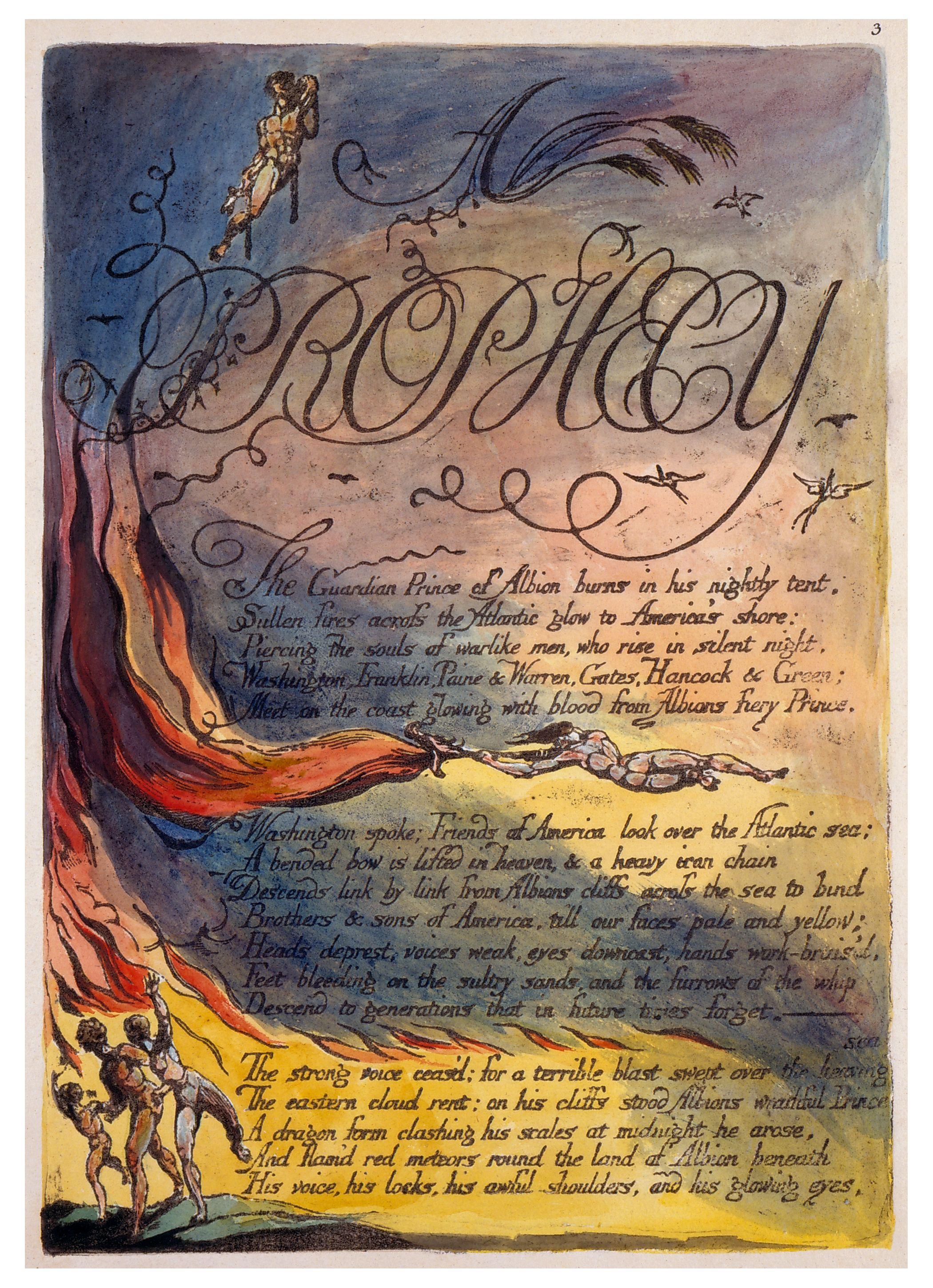
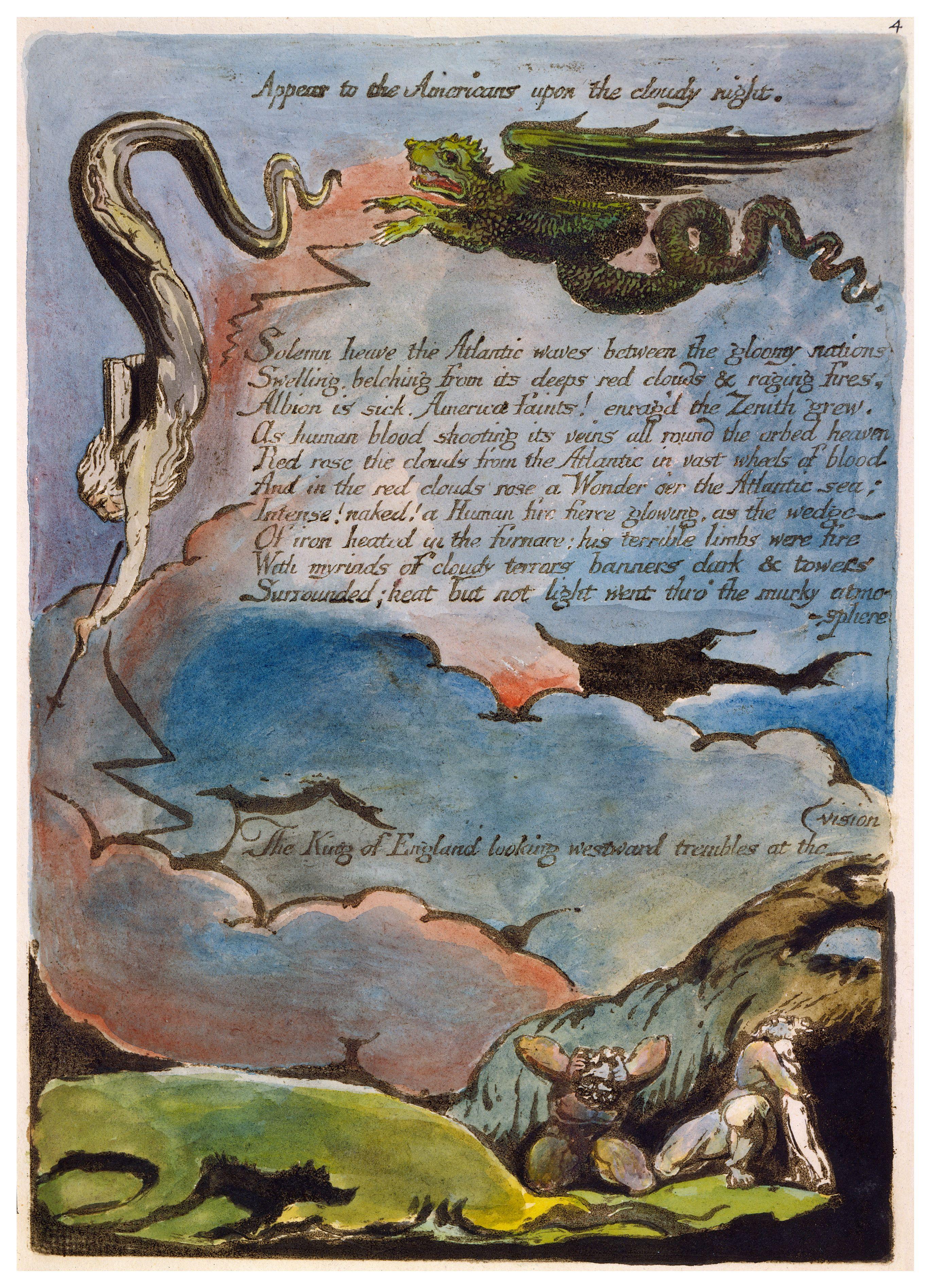
William Blake. America. A Prophecy [Public Domain].
In part 2, the birth of U.S.A. is examined against its Pluto themes outlined in part 1to demonstrate the nation’s character, values, and priorities. These are the factors that shape the nation’s destiny. With this understanding comes a new perspective and framework that could help us make sense and navigate through this complex and bewildering time. — Author
From the astrologer’s perspective, the quality of time and history is cyclical. It unfolds around a giant clock face with multiple converging forces traversing through different stages in the evolutionary cycle; the patterns and energies are distinctive. In order to understand how the U.S. historically handled and manifested its Pluto energy, I will review the crucial points of the U.S. Pluto cycle in part 2 and 3 of this series.
We start by exploring the themes and events surrounding the creation of U.S.A. For the sake of precision and clarity, I used a narrow 1-degree orb. It means that I only included events that took place when Pluto was within one degree of forming a major aspect (0, 60, 90, and 120 degrees) with the U.S. Pluto. Due to Capricorn’s slowness, some relevant events will inadvertently be omitted, since they occurred after the cut-off date.
First, a quick recap of the astrology of U.S. Pluto (detailed in part 1):
Capricorn second house: wealth equals status, prioritized conformity and social order, wealth acquisition, economic hardship, greed.
Pluto in Second house: Plutocracy and plutonomy (corruption, control, and consolidation), violation of personal freedom and property rights, currency manipulation, economic boom-and-bust.
Pluto in Capricorn: governmental and institutional surveillance, corruption, coercion, intimidation, violent struggle.
Pluto at 27th degree of Capricorn, potential solution in 27th degree of Cancer: discontent, abandoning the status quo, rebellion, exceptionalism, natural laws.
Scorpio 12th house and antiscion (2nd degree of Sagittarius) in 12th house: drug wars, prosecution of minority, slavery, surveillance, espionage, covert ops, geopolitical maneuvers, opaque and misleading foreign policy, diplomacy, foreign wars.
The founding of America
Active Periods:
April 2, 1775 – May 24, 1775
January 23, 1776 – August 17, 1776
November 26, 1776 – February 1, 1777
August 6, 1777- December 10, 1777
Themes:
Departure from the status quo
Separation from ineffectual peers
No middle ground
Appeal to natural law and common sense
Short-term conformity at the cost of long-term stability
Profits trump principles
Wealth consolidation and re-distribution
Last resort as the only option
Foreign entanglement with allies and saboteurs
National debt, currency devaluation, and hyperinflation
Trade war and financial warfare
On April 19, 1775, amidst mounting tension and state of rebellion in New England, the British force set out to preemptively confiscate the colonists’ weapon stockpiles and was met with well-coordinated resistance. During the stand-off, shots were fired by an unknown gunman, and the skirmish quickly escalated into a full-scale conflict, thus commenced the American Revolutionary War.
The fateful turn of events was perceived by the colonists as the testimony of Britain’s brutal oppression and solidified the colonists’ resolve against the British rule. The unavoidable war of independence had dawned. George Washington, upon hearing the news of the battle, wrote:
“Unhappy it is, though, to reflect that a brother’s sword has been sheathed in a brother’s breast and that the once-happy and peaceful plains of American are either to be drenched with blood or inhabited by a race of slaves. Sad Alternative! But can a virtuous man hesitate in his choice?”
In the aftermath, the colonies gathered and signed declarations and resolves to sever their ties with Britain. In January 1776, Thomas Paine published “Common Sense”, claiming that the polite discussions had been ineffectual:
“Volumes have been written on the subject of the struggle between England and America. Men of all ranks have embarked in the controversy, from different motives, and with various designs; but all have been ineffectual, and the period of debate is closed. Arms as the last resource decide the contest; the appeal was the choice of the King, and the Continent has accepted the challenge.”
Paine’s forceful argument aligned with the energy of Pluto. Piercing through the pacifists’ delusion, he called out Britain’s pretension and advocate a departure from the status quo and forging new alliances:
“As much hath been said of the advantages of reconciliation, which, like an agreeable dream, hath passed away and left us as we were,…We have boasted the protection of Great Britain, without considering, that her motive was INTEREST not ATTACHMENT; and that she did not protect us from OUR ENEMIES on OUR ACCOUNT; but from HER ENEMIES on HER OWN ACCOUNT, from those who had no quarrel with us on any OTHER ACCOUNT, and who will always be our enemies on the SAME ACCOUNT. Let Britain waive her pretensions to the Continent, or the Continent throw off the dependence, and we should be at peace with France and Spain, were they at war with Britain.”
Coincidentally, Paine foretold the U.S. Capricorn second house, i.e., wealth equals security:
“Besides, what have we to do with setting the world at defiance? Our plan is commerce, and that, well attended to, will secure us the peace and friendship of all Europe; because it is the interest of all Europe to have America a free port. Her trade will always be a protection, and her barrenness of gold and silver secure her from invaders.”
Paine’s rousing call to common sense appealed to the colonists’ inner knowing that they deserve to be free –a Cancerian principle. In the Pluto fashion, his words “had swept through the colonies like a firestorm, destroying any final vestige of loyalty to the British crown.” (Ellis, American Sphinx.)
“Whenever men become sufficiently dissatisfied with what is, with the existing regime of positive law and custom, they will be found reaching out beyond it for the rational basis of what they conceive ought to be. This is what the Americans did in their controversy with Great Britain. And this rational basis they found in that underlying preconception which shaped the thought of their age -the idea of natural law and natural rights.”
Becker, The Declaration of Independence
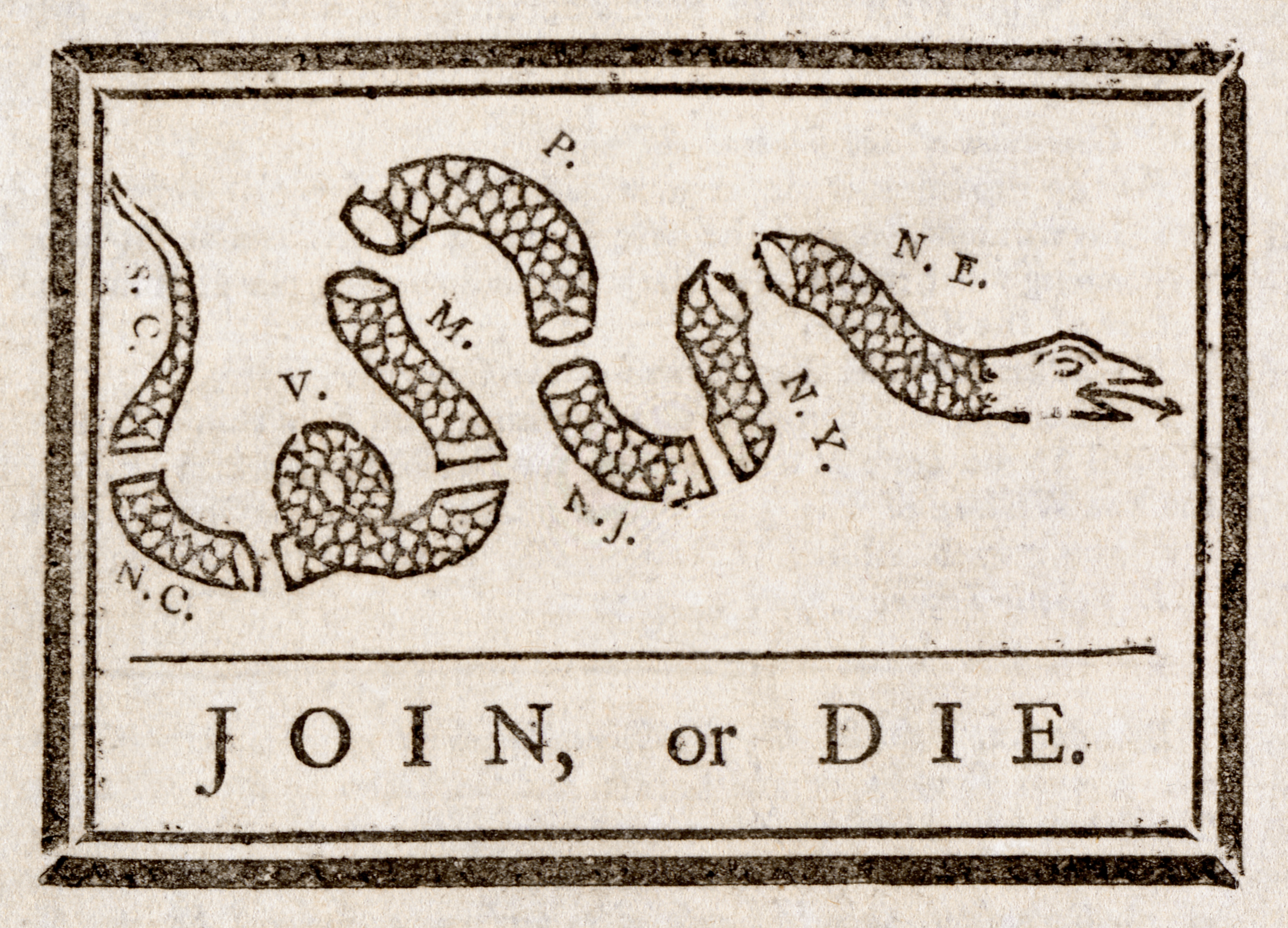
As the revolutionary war raged on and hostility escalated, the hope of reconciliation with Britain was all but lost. The southern colonists, fearing a slave insurrection, set aside their distrust and banded together with the northerners, heading for the only way out of the crisis perpetrated by Britain.
Benjamin Franklin, Join, or Die
Not all colonists were swept up in the revolutionary spirit, however. Three days before the formal declaration, South Carolina and Pennsylvania delegates voted against independence. New York declined to vote on the day of the formal Declaration and only waited until July 15 to formally join the rebellion.
The Declaration of Independence
The Declaration of Independence thrust the U.S. onto the world stage and marked the triumph of the Enlightenment and political radicalism.
The founding document listed 27 grievances, listing the deliberate and systematic abuse that drove the colonists to desperation [Pluto]. In their own words, to “resisting force by force… (and) be ready to sacrifice our livesand fortunes to secure her freedom and safety” (Liberty Point Resolves). The oppression and maltreatment represent the distinct characteristics of a dysfunctional and malicious Pluto in Capricorn Second-house placement, as well as the Scorpio 12th house influences:
Deliberate sabotage of the colonial legal system [Pluto in Capricorn, antiscion in Sagittarius]; burdensome bureaucracy and repressive martial law [Pluto in Capricorn]; hijacked local government [Pluto in Capricorn] and justice system [Pluto’s antiscion in Sagittarius]; restricted trades and revenue [Capricorn second house]; destroyed properties [Pluto in the second house]; and imposed taxes without consent [Pluto in the second house].
In addition, foreign soldiers from Germany (Sagittarius antiscion), American Indians [Capricorn] and slaves [Scorpio 12th house] were used as mercenaries. American armed vessels and their crews were forced into the British force to attack their own people [Pluto at the cusp of Aquarius].
By the same token, the colonists’ answers to such perils also confirmed the modus operandi of U.S. Pluto, as discussed in part 1:
Separation from ineffectual peers:
“… it becomes necessary for one people to dissolve the political bands which have connected them with another, and to assume …the separate and equal station” … a decent respect to the opinions of mankind requires that they should declare the causes which impel them to the separation.”
Departure from the status quo (out of moral obligation and necessity):
“…whenever any Form of Government becomes destructive of these ends, it is the Right of the People to alter or to abolish it, and to institute new Government”
“But when a long train of abuses and usurpations, pursuing invariably the same Object evinces a design to reduce them under absolute Despotism, it is their right, it is their duty, to throw off such Government, and to provide new Guards for their future security.”
“Such has been the patient sufferance of these Colonies; and such is now the necessity which constrains them to alter their former Systems of Government.”
“We must, therefore, acquiesce in the necessity, which denounces our Separation, and hold them, as we hold the rest of mankind, Enemies in War, in Peace Friends.”
Appeal to natural law and common sense:
“…to which the Laws of Nature and of Nature’s God entitle them, a decent respect to the opinions of mankind requires that they should declare the causes which impel them to the separation.”
“We hold these truths to be self-evident, that all men are created equal, that they are endowed by their Creator with certain unalienable Rights, that among these are Life, Liberty and the pursuit of Happiness.”
Safety and conformity as priorities:
“…laying its foundation on such principles and organizing its powers in such form, as to them shall seem most likely to effect their Safety and Happiness.”
In addition, on July 19, 1776, an added resolution inserted the word “unanimous” to the final official copy.
Commercial interest and short-term stability at the cost of moral principles and long-term prospects: This is demonstrated by the removal of the anti-slavery language to protect the business interests of the slave owners and traders.
National Interest Equals Business Interest
Thomas Jefferson’s “rough draught” of the declaration was thoroughly debated and suffered “mutilations” (in Jefferson’s own words) that betrayed and undermined the original founding principles and sow the seed of future discord. The glaring omissions include the anti-slavery passages and the accusation that the British Crown waged war on humanity by forcing the slave trade on the colony:
“He has waged cruel war against human nature itself, violating its most sacred rights of life and liberty in the persons of a distant people who never offended him, captivating & carrying them into slavery in another hemisphere or to incur miserable death in their transportation thither. This piratical warfare, the opprobrium of infidel powers, is the warfare of the Christian King of Great Britain. Determined to keep open a market where Men should be bought & sold, he has prostituted his negative for suppressing every legislative attempt to prohibit or restrain this execrable commerce. “
Jefferson called out his morally compromised peers:
“The pusillanimous idea that we had friends in England worth keeping terms with, still haunted the minds of many. For this reason those passages which conveyed censures on the people of England were struck out, lest they should give them offense. The clause too, reprobating the enslaving the inhabitants of Africa, was struck out in complaisance to South Carolina and Georgia, who had never attempted to restrain the importation of slaves, and who on the contrary still wished to continue it. Our Northern brethren also I believe felt a little tender under those censures; for tho’ their people have very few slaves themselves yet they had been pretty considerable carriers of them to others.”
Jefferson, The Writings of Thomas Jefferson: 1760-1775.
The hypocrisy also attracted criticism from contemporary observers:
“…only I could wish to ask the Delegates…, how their Constituents justify the depriving more than an hundred thousand Africans of their rights to liberty, and the pursuit of happiness, and in some degree to their lives, if these rights are so absolutely unalienable;…”
Hutchinson, Strictures upon the Declaration of Independence
The blaring omission of anti-slavery language in the nation’s founding document speaks volumes about U.S.’ priorities and values as a country, which has always been wealth for the few [Plutonomy]. In the pursuit of short-term profit and stability, we sacrifice fundamental principles, undermine long-term peace and prosperity, moralizing and justifying as we go.
Jefferson was haunted by this national moral lapse ever since and considered it the seed of the nation’s destruction. He wrote in 1820:
“…this momentous question, like a fire bell in the night, awakened and filled me with terror. I considered it at once as the knell of the Union. it is hushed indeed for the moment. but this is a reprieve only, not a final sentence. a geographical line, coinciding with a marked principle, moral and political, once concieved and held up to the angry passions of men, will never be obliterated; and every new irritation will mark it deeper and deeper.”
Thomas Jefferson to John Holmes
A World War, A Civil War, A Currency War, and A Trade War
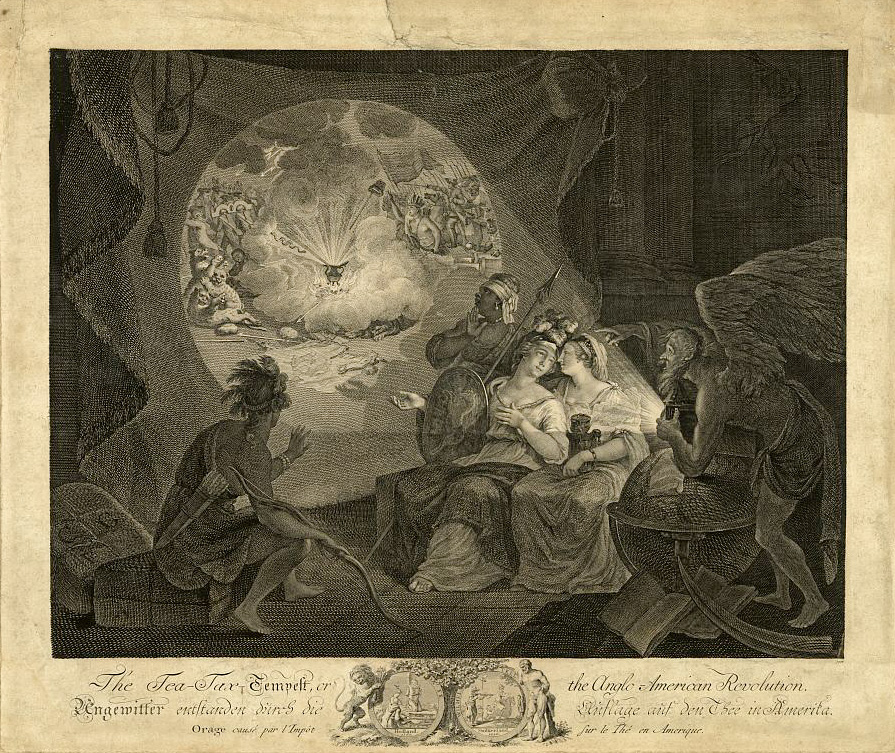
In essence, American Revolution was ignited by the tax burdens and trade restrictions implemented in the aftermath of the Seven Years’ War. Despite an overwhelming victory, the war doubled Britain’s national debt and brought about a postwar recession. The colonists’ protest of the revenue-generating measures was not only ignored by Britain but responded with more punitive policies. The animosity from both sides escalated to the point of no return, and a series of conflicts built up to a full-scale, multi-front war.
Young America immediately faced existential crisis. Conflicts between the patriots and loyalists marked the first civil war of the new country as the political divide shattered families and destroyed social fabric. Citizens who refused to swear oaths of loyalty were declared traitors and faced prosecution –there was no middle ground.
Economically, the country was also off to a rocky start. The Continental Army suffered from financial deprivation and was short on training, essential equipment, and sustenance. The soldiers were owed salary and would not re-enlist, leaving the Continental Army on the brink of dissolution.
“We are now as it were, upon the eve of another dissolution of our Army—the remembrance of the difficulties which happened upon that occasion last year . . . that unless some speedy and effectual measures are adopted by Congress; our cause will be lost.”
The Papers of George Washington
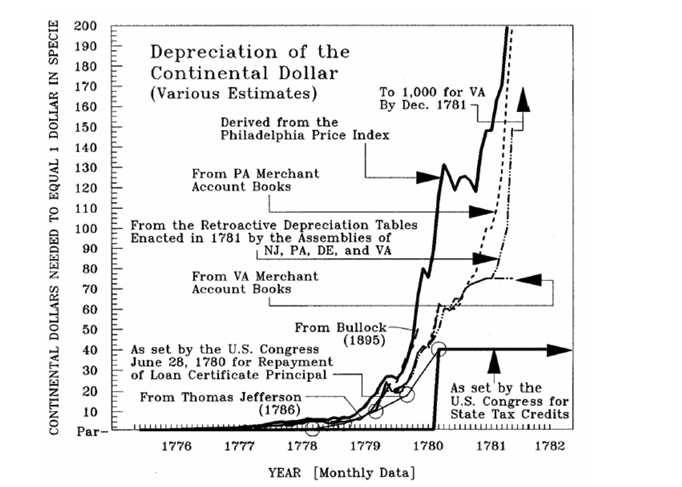
In 1775, Continental Congress issued Continental Dollars to finance the war. The new currency was backed by future revenue alone and its value fluctuated with the military’s triumphs and defeats. After a series of military routs and the resulting currency devaluation, the congress responded with massive issuance, which coincided with Britain’s devastating counterfeiting campaign. The loss of confidence lead to merchants’ refusal to accept the Continental as payments for military supplies as well as the immediate, severe erosion of the army salary. The vicious cycle in turn diminishes the army’s morale and battle readiness.
In 1777, 12 of the states passed confiscation legislation to seize and assumed control of loyalists’ land – amounted to millions of acres – to fund the war. Most of the prime properties were purchased by wealthy officers and politicians at a heavy discount, which contributed to the consolidation of wealth and political influence [Plutocracy]. The Patriot’s financial prosecution of their political opponents lasted well into the early 1800s, decades after the war was won.
An International Affair
From a global perspective, the American revolution was just one of the battlefronts in a world war – specifically, a century-long international conflict about empire-building and trade. Our major allies, French and Spain, sought to revenge for the bitter defeat by Britain during the previous war; supporting American Revolution happened to provide the long-awaited opportunity.
“We should be driven to the Necessity of Declaring ourselves independent States, and that We ought now to be employed in preparing a Plan of Conferation for the Colonies, and Treaties to be proposed to foreign Powers particularly to France and Spain, … That these three Measures, Independence, Confederation and Negotiations with foreign Powers, particularly France, ought to go hand in hand, and be adopted all together…. That foreign Powers … could not be expected to acknowledge Us, till We had acknowledged ourselves and taken our Station, among them as a sovereign Power, and Independent Nation. That now We were distressed for Want of Artillery, Arms, Ammunition, Cloathing and even for Flynts. That the People had no Marketts for their Produce, wanted Cloathing and many other things, which foreign Commerce alone could fully supply, and We could not expect Commerce till We were independent.”
Adams, John Adams autobiography, part 1, “John Adams,” through 1776
Foreign relation was among the top concerns for the colonists during the Revolution. Resolution of Independence, passed on July 2, 1776, was introduced because according to its author Richard Henry Lee: “I am clearly of opinion that unless we declare openly for Independency there is no chance for foreign aid. In another letter, he further declared “no state in Europe will either treat or trade with us so long as we consider ourselves subjects of Great Britain.” (Ferreiro, Brothers at Arms)
Without foreign aid – in particular, France’s material supply and amphibious military support – the Revolutionary cause would have been lost. This acknowledgment has largely faded from today’s collective consciousness, and we are now out of touch with our foreign policy and oblivious to U.S.’ military and intelligence covert operations overseas [Scorpio and Sagittarius 12th house]. U.S.’ attempt to maintain leadership and moral posture [Capricorn] jeopardized democracy at home and around the world, and kept the pursuit of ambiguous “national interest” out of the public eye and into the shadows of unaccountability and hypocrisy.
Business Overseas
The secrecy and our collective ignorance of our foreign policy and operations are the symptoms of the U.S. Pluto antiscion (2nd degree of Sagittarius) in the 12th house. The 12th house is the realm of self-undoing and ignorance, it’s our vice that we mistake for salvation. Mundane ventures rising from the 12th house are jeopardized by misinformation and sabotage from within and without.
For example, Battle of Quebec, an attempt to draw French-speaking Canadians’ support for the revolutionary cause, was U.S.’ first foreign war and the prototype of foreign policy blunders. The colonists failed to persuade the populace of their causes of democracy and equality, and suffered catastrophic failure, due to overestimation of strength and miscalculation.
In recent U.S. history, our two-faced foreign policies and opaque “national interests” have been hidden [twelfth house] from public scrutiny. Meaningful and open discussions were exiled from mainstream media; dissidents and skeptics are labeled unpatriotic and treasonous. Pluto’s business is deep, dark, and unsavory. However, ignorance is not an option, neither is isolationism –it is not in the stars. In order to plot the best course forward, it is crucial that we grasp U.S.’ role in global trade and finance, and the truth about our covert operations and standing in the world.
Plutocracy are Us
Our country is one born on the battlefront of a multi-front world war; violence and warfare have always been in our nation’s DNA. Even during peacetime, all forms of aggression are glorified and consumed in large doses as mass entertainment. We, collectively, delight in seeing things being blown up and enjoy picking sides in conflicts –we can’t help it. As the biggest exporter of violent imagery and weaponry in the world, we inherently see peace in any corner of the world as our detriment. This is the uncomfortable truth we must recognize and content with. Peace and virtue were not indicated in the birth chart of this nation.
The U.S. second house (house of resource) is truly unparalleled. The vast geography spans two immense oceans, providing natural barriers from hostile invaders even during the worst internal conflicts. Its territory contains abundant natural resources and massive arable land. A seemingly endless inflow of ambitious and brilliant talents, driven by overwhelming desires for success, propel innovation and enterprise [Pluto in Capricorn-Aquarius second house]. Our talents and gifts run deep and wide.
This unique geography and demography shaped our character: an amoral and naïve optimism that combines shortsightedness and willful arrogance. Pluto in the Capricorn second house indicates a desperate and unrelenting drive for power and wealth –to counter-productive extremes.
Through relentless drive for control, Pluto investigates, meddles, and corrupts any system it touches. It destroys and reshapes all that stands in its way until the ultimate consolidation is achieved. The result is a power so intense and concentrated that it either becomes a super weapon or collapses under its own weight. Either way, discord and disorder ensue, and in the messy dysfunction and deterioration, the process restarts.
We have a Plutocracy. The destructive and regenerative cycle of Pluto is most fittingly allegorized as a snake eating its tail. In the case of America, the destruction and rebirth play out in the social order [Capricorn] and financial [Second House] arena. In the background, it operates in the realm of deceit and ignorance [twelfth house], particularly when it comes to foreign relations, controlled substance (drugs and alcohol), and prosecuted minorities. This imprint has and will continue to unfold and manifest in ways we collectively respond as the recipient and the personification of this energy.
America was never about freedom and liberty, not since the founding moment. The principle of our country has always been and will always be “in profit we trust” –trading short-term profit for the few at the cost of long-term peace and prosperity of the general population. Implementing policies that promote superficial social cohesion while continue to drive power and profits to fewer and fewer hands. The process is legitimized by laws and (de)regulations, promoted domestically and around the world under the guise of national interests, American value, free-market economy, social and economic progress, freedom and democracy.
Under this scheme, we the people are considered as the state’s subjects — consumers of propaganda, participants in private and public revenue-generating, and supporters of the status quo –detracted, intimidated, overwhelmed by a web of predatory complexity and weaponized disinformation. Without recognizing this sobering fact, we cannot come up with a realistic solution for national and personal survival. Clarity and awareness is just the first step.
It’s an obvious choice. We can exhaust our resources to reinforce the failing status quo and delay the inevitable decay and disintegration. Or, we can detach from the current system – depart from our ineffective peers, and reclaim what we believe as universal, natural and true. We don’t need fact-checkers, experts, government officials, or virtue-signaling mobs to confirm the common sense.
In part 3 of this series, we’ll continue to examine the patterns of how U.S. Pluto manifests and interacts throughout history. (To be continued)
Further Reading:
Hugh Percy Duke of Northumberland. (1902). Letters of Hugh, Earl Percy, from Boston and New York, 1774-1776.
Fischer, David Hackett. Paul Revere’s Ride. Oxford University Press, USA, 1995.
Becker, Carl. The Declaration of Independence: A Study in the History of Political Ideas. Harcourt, Brace and Company, 1922.
Library of Congress. “Jefferson’s ‘Original Rough Draught’ of the Declaration of Independence – Declaring Independence: Drafting the Documents | Exhibitions – Library of Congress.” Accessed February 24, 2022. https://www.loc.gov/exhibits/declara/ruffdrft.html.
Ferreiro, Larrie D. Brothers at Arms. Vintage, 2017.
John Adams autobiography, part 1, “John Adams,” through 1776, sheet 22 of 53 [electronic edition]. Adams Family Papers: An Electronic Archive. Massachusetts Historical Society. http://www.masshist.org/digitaladams/.
“From George Washington to John Hancock, 25 September 1776,” Founders Online, National Archives, https://founders.archives.gov/documents/Washington/03-06-02-0305. [Original source: The Papers of George Washington, Revolutionary War Series, vol. 6, 13 August 1776 – 20 October 1776, ed. Philander D. Chase and Frank E. Grizzard, Jr. Charlottesville: University Press of Virginia, 1994, pp. 393–401.]
Milestones: 1750–1775 | Parliamentary Taxation of Colonies, International Trade, and the American Revolution, 1763–1775. Office of the Historian, Foreign Service Institute, United States Department of State, https://history.state.gov/milestones/1750-1775/parliamentary-taxation.
Grubb, Farley. “The Continental Dollar: How Much Was Really Issued?” The Journal of Economic History, vol. 68(01), Cambridge University Press, Mar. 2008, pp. 283–291.
William Blake. America. A Prophecy [Public Domain].
In this article, I will explain the astrology of the U.S. Pluto and the significance of the U.S. Pluto return. We will dive into the 27th degree of Capricorn, explore its hidden meanings through its antiscion degree, and discover possible solutions provided by the 27th degree of Cancer.
–Author
The long-awaited U.S. Pluto return is upon us. This is the period when Pluto completes a revolution around the sun and returns to the same zodiac degree in the nation’s birth chart. Based on the most commonly-used U.S. national birth chart, the exact U.S. Pluto return dates are February 19, 2022; July 12, 2022; and December 27, 2022. Using a narrow one-degree orb, the active period of this transit started in March 2021 and will stretch well into the end of 2023.
It is monumental because beside its rare occurrences (approximately once every 248 years), both participants of this event are equally powerful and unyielding. Natal Pluto symbolizes the entity’s survival instinct and nucleus of strength. Transiting Pluto, manifesting as external events, transforms everything it touches, destroying the frivolous and folly, mercilessly cutting down wastes and excess, and unifying the false dichotomy. Pluto transits force us to define and defend the crux of our existence, the spark of our souls. Failing that, we are zombies, lobotomized. We are a shell of our former selves. Our lights go out.
At the founding of the nation, the colonists presented the Declaration of Independence, stating:
“We hold these truths to be self-evident, that all men are created equal, that they are endowed by their Creator with certain unalienable Rights, that among these are Life, Liberty and the pursuit of Happiness.”
In reality, this credo has not held true. In this series, I will attempt to unpack the U.S. Pluto through astrology and history. Once we define our core strengths and our survival strategy, we have a better chance to find a clear path forward.
The astrology of U.S. Pluto
U.S. Birth Chart by Ebenezer Sibly
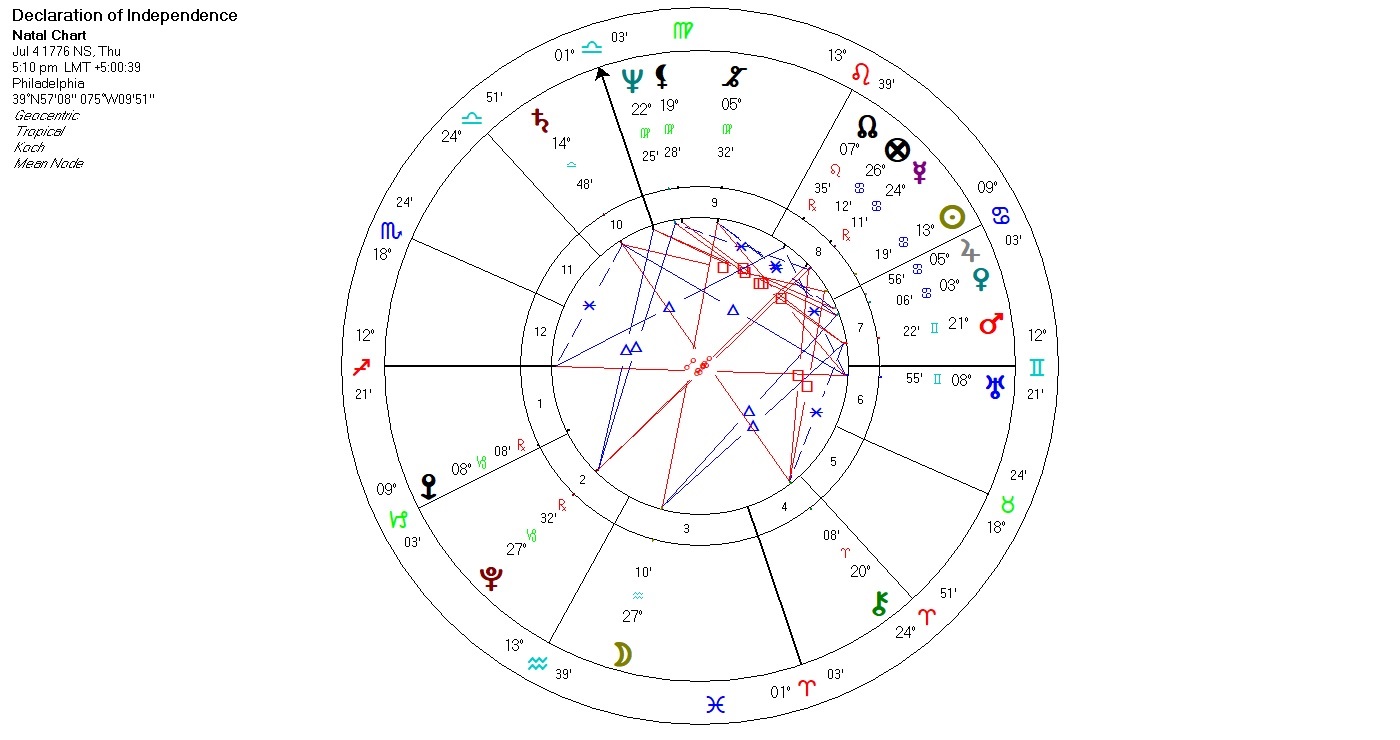
The most widely used U.S. Birth Chart was elected by British physician, astrologer, and occultist Ebenezer Sibly (1751-1799). Sibly’s chart placed the U.S. Pluto in the second house at Capricorn 27 degrees and 32 minutes. It is not the scope of this series to cover the U.S. birth chart in its entirety. Instead, I will focus on the astrology of U.S. Pluto and its cycle manifested in past and current events.
Meaning of the Second House
The second house of an astrology chart points to the resource at one’s disposal. Most commonly referred to as the house of money, it actually refers to value and resource in the broadest terms: judgment of worth, weighing of priorities (for deploying resources), money, time, energy, efforts, talents, personal properties, faculties, and freedom. Simply put, it is what we deem valuable and dedicate our resources to as a nation.
Meaning of U.S.’ Capricorn-Aquarius Second House
The second house in the U.S. birth chart spans from the 9th degree of Capricorn to the 13th degree of Aquarius. The Capricorn house cusp and the Pluto placement in Capricorn warrants heavy emphasis on Capricorn quality regarding the nation’s value and priorities.
The archetypal Capricorn is conscientious, responsible, insecure, and status-seeking. Driven by the underlining inferiority complex, Capricorn appeals to the authority and desires to present itself as the arbiter of reality. Predictably, Capricorn strives for stability and respectability, i.e. money and social status, and by extension, demands others to honor and conform to the social order it helps build, for it abhors the unpredictable and the deviant.
In short, Capricorn aspires to project success and order. Contrary to popular belief, Capricorn in the U.S. second house indicates that we as a nation value status and stability above all. Our collective pursue has always been wealth, power, and control.
The second part of the U.S. second house is in Aquarius. Innovation, revolutions, freedom, and Egalitarianism are also at our disposal. Pluto’s placement near the cusp of Aquarius hints at solutions that contain contradicting maneuvers, which I will discuss further.
Meaning of Pluto
Pluto in our natal chart represents the nucleus of our psychological and physical survival. It is what we cling to in our most perilous moments. It’s the part of us that digs deep and plays dirty for self-preservation.
Pluto is the fear of annihilation petrified into obsession, and the obsession eating its own tail. In the case of U.S. Pluto, our obsession with staying safe has turned a pent-up citizenry explosive. The interventions to stabilize domestic and international crises have destabilized the intended target in most cases. The need to control and manipulate our environment and relationships is sometimes so great that an off-the-rails Pluto will seek to alter the status quo by self-destruction. Despite its many negative manifestations, losing our Pluto, we lose the will to live and become frail facades.
Transiting Pluto shares the same quality and manifests through dramatic external events. During a Pluto return, the entity’s will to survive encounters the universal force to transform. Surviving and thriving during Pluto transits requires letting go of the status quo, –no exceptions. The more we try to stay the same, the more drastic the demolition. The only way through it is shedding all non-essential and pretense in every aspect of our lives. When we do, we’re indestructible.
Pluto in Capricorn
As these once-sacred institutions will simultaneously face the Plutonian purging and reform, seeking shelter from these establishment will be futile. Frauds exposed, credibility plummeted, the dismantling is unfolding right in front of our eyes. We share our fates with our nation, but that does not mean we face the same limited options as an overreaching and overstretched behemoth. It is worth mentioning that the U.S. Pluto placement also entails that the government and institutions will try the tools of control and oppression, even blatantly violate the social contract during their breakdown and transformation.
Pluto in the Second House, Ruling the Twelfth House
Pluto in the second house puts tremendous wealth and resources at U.S.’ disposal; it also clearly points to Plutocracy and Plutonomy. Destructive and weaponized Pluto signals dramatic rise and fall of fortune and unscrupulous policies that could rip the social fabric and undermine U.S.’ global standings. Pluto’s will to power and its manipulative, meddlesome approaches, in combination with misguided foreign entanglement and systemic corruption, could spell U.S.’ self-undoing.
Meaning of Capricorn 27th degree
The 27th degree of the zodiac is a degree of discontent and defiance; it is also a degree of exceptionalism. People under the influence of this degree acknowledge the deterioration of the institution and absurdity of the status quo. They also regard their peers as ineffectual when it comes to support and insights. To serve a higher calling, they depart from the social perimeter and blaze new trails.
The Sabian symbol for Capricorn 27th degree is “a large aviary”. We get the colorful image of chattering birds in confinement, but this hardly provides enough clues to flesh out our current predicament. My interpretation for this degree is twofold:
“Technocrats conspire with foreign agents to manage a discontent populace and disappointed international allies.”
“Disappointed truth seekers confront their peers who have resorted to underhanded maneuvers, and decide to remove themselves to take a higher ground.”
Lonsdale’s reading of this degree reminds us to rein in our follies:
“You need to drop the vast bulk of your voluminous self-indulgences in order to, after all, start to wake up and really remember purpose and the whole story.”
Capricorn 27 people are workaholics and truth-seekers who separate themselves from their peers to rise above groupthink and mediocrity. This degree reveals that the system has been corrupted and is breaking down. No help is coming from the establishment; they must break away from the consensus and convention to craft their exit plans. A small group of visionaries will propose solutions that seem impossible and unpopular, but soon will become the only viable option. At the founding moment, the energy of this degree was imprinted as the nation’s core strength and survival mechanism. We have come a long way and strayed far from the trailblazing business in many ways.
Another way to read a zodiac degree is to look for the hidden meaning derived from its shadow degree (antiscion). Antiscion is the zodiac degree that shares the same distance from solstice points as the degree in question, like a reflection in a mirror that stretches from the 0 degree of Cancer to the 0 degree of Capricorn. The Sabian symbol for Capricorn 27’s antiscion, Sagittarius 2, is “two men playing chess.” In uncanny synchronicity, Martin Goldsmith expanded the imagery and described:
“A young prince and his tutor concentrate on a game of chess. Around the board, an inlaid design depicts black and white dragons biting each other’s tails.”
The image brings in sharp focus inter-generational conflicts and geopolitical competition with China, frequently symbolized as dragons. Goldsmith further elaborates:
“Playing to win, no holds bars, vs. playing like a gentleman (dangerous opponents); making calculated moves; waiting for the right time to act, vs. rashly forging ahead; … bluffing by acting weak or bluffing by acting strong.”
This degree foretells coming geopolitical conflicts and inter-general competition for resources. Sagittarius 2 also hints at difficulty with international diplomacy, disagreements on beliefs and principles, and trusted elders turning on their young.
In the zodiac wheel, the opposite degrees are considered two sides of the same theme. Looking to Cancer 27 could propose a solution to our Capricorn 27th degree problems. The Sabian symbol for Cancer 27 is “a modern Pocahontas.” Later interpretations depict a Native American girl introducing her white boyfriend to the tribe. This degree points to breaking away from emotional dependency on one’s family, tribe, and race, and forging new connections outside one’s heritage and cultural identity.
Ellias Lonsdale, in is book “Inside Degrees” promised innate guidance to those involved with the 27th degree of Cancer:
“Inwardly knowing where to go, what to do, how to do it, and where it all leads. You have a special faculty for karmic clairvoyance or sensing the individual and collective destiny-territory that must be navigated through. Placed strategically in the molten core of world dilemma to remember how to get it right. Driven by a force of will that is overwhelming. You are guided to be in the right place at the right time for catching the drift of the tide we all are swimming toward. Unconsciously and superconsciously in touch and in tune with what is happening. Consciously, walking a tightrope between the heights and the depths, and never sure while being sure. Given an engraved destiny invitation to participate to the utmost in collective cycles of renewal and to stay within your place of power throughout. For you have gathered considerable awareness toward this time of decision, and this vertical attunement is a welcome ingredient–one vitally needed.”
ACall to Awareness
Throughout U.S. history, national crises unfolded around Pluto themes, and the same themes will be the focus again during the Pluto return. Regrettably, second-house matters such as national prosperity and personal freedom do not mix well with Pluto energies. Moreover, a Scorpio twelfth house subjects our national psyche to subversive and deceitful stratagems, as well as a predisposition to misuse the transformative and weaponized energy. Pluto principle underpins our national priorities and permeates our collective unconscious. Call it the original sin or collective karma, this is a burden we have to bear as a nation. The Pluto return is a period when we must take our own medicine and ride out this once-in-a-Plutonian-year storm. Think of it as a storm that flushes out the stale and the stifled, the outdated and the unsound. Whatever remains will be consolidated and stronger than before, like a newly acquired superpower. I speculate that by the time this transit is over, the current system and our endless, divisive bickering will reach a conclusion, and the opposing positions and their hotly contested issues will be irrelevant. (To be continued)
Author’s note: This article refers to 17 degrees Gemini (17-18 Gemini), not the 17th degree of Gemini (16-17 Gemini).
Mundane keywords: social misfits, cultural diversity, minority groups, multilingual, multiple ethnic and cultural identities, one who has difficulty assimilating, foreign languages or specialized languages/codes, China and the Chinese people, cultural ambassador, segregation.
Social and psychological keywords: being singled out for what one says or how one acts, determined to express oneself at the risk of being ostracized, being in and out of mainstream, juggling multiple cultural identities yet never quite at ease in one’s own skin, being a foreigner in one’s own country, the “you and me against the world” mind set, lost in translation, standing out from the crowd, speaking to an exclusive crowd, doubts and suspicion, xenophobia, elitist and inferiority complexes.
17 degrees Gemini locates in the Libra decanate and sits across the Sagittarius and Capricorn duads. It describes a mental and communication process (Gemini) concerning personal relations (Libra) in a foreign (Sagittarius) society (Capricorn). The number 8 (1+7=8) and 7 (degree 7 of the decanate) denotes the struggle (7) for power and wisdom (8).
We have two Chinese men speaking Chinese in western crowd. Being out of their native environment, they rely on each other for companionship and understanding. We don’t know if this is a chance meeting or a partnership, all we know is that they speak the same foreign language and they are naturally drawn to each other in such a setting. There might be a sense of comradery, a sort of “you and me against the world” mindset. Understandably, from the westerners’ point of view, the language barrier naturally arouses curiosity, mistrust and suspicion.
On the surface, this degree signifies one who is determined to drive home the point in a foreign, even hostile environment. For those living with this degree in their charts, to assimilate or not to assimilate is the question. Acutely aware of the shifting sands in a multicultural society, they hold on to their cultural traditions, abide with the mainstream as needed, and at the same time is mindful of the stark contrast between themselves and the norm. Nevertheless, they are compelled to speak out and are fully aware of the risks.
Martin Goldsmith went one step further and has the degree as “In a crowded Midwestern diner, two Chinese-Americans watch a television newscast, then argue about it in Chinese”. Here, against the all-American Midwest dinner backdrop, the social convention is conservative, commonsensical, and has a respectful distaste for outre behaviors. When the two Chinese-Americans watched the news and argue about it in Chinese, undoubtedly they would draw attention to themselves for their appearance and their foreign tongue, yet, their argued on. There is not only disagreement between the two, there is also glaring difference between the pair and their environment, with no compromise in sight. This degree points to conflict in the interpersonal relationships and one’s relation with the society as a whole.
The depiction of “two Chinese men” is interesting. If we were only to depict foreigners, there would be so many different nationality to choose from, why Chinese? Chinese culture is the longest consecutive major culture in the world. It is formidable in its depth and breadth; it is mysterious and exotic to outsiders yet its heritage directly influences roughly one quarter of the world population. The Chinese language is difficult for westerners for the enormous number of characters that are composites of meanings, pronunciations, and images. The Classical Chinese is often incomprehensible even to native speakers. Therefore, we can reasonably assume the symbol’s emphasis on cultural barrier to a colossal body of esoteric knowledge, at least to the western minds.
Incidentally, number 7 not only resonates with specialized knowledge and non-conformist tendencies, it also points to the path of mysticism. From a higher perspective, Dane Rudyar mentioned being “in” the world but not “of” the world. Ultimately, this symbols asks us to detach ourselves from what’s familiar and taken for granted, seek out the exotic, the esoteric, and a new approach that reconcile the contrasting polarities. Do we abide by the convention or risk the dirty looks? Do we eat at the same diner, or leave the comfort zone? Do we dare to suspend our ingrained prejudice and walk in others’ shoes? More than just choosing sides, we overcome the limitation of duality, and build a unified perspective –we become both the “two Chinese men” and the “western crowd,” at home with the world.
Some famous people and events that shares this degree are:
Barbara Bush (Sun): American First Lady and matriarch of the Bush political dynasty. After touring Houston Astrodome, one of the relief center in the horrific aftermath of Hurricane Katrina, she shared her observation of the refugees who have lost their homes and possessions, and were cramped into the crowded facility:
“Almost everyone I’ve talked to says, “We’re going to move to Houston.” What I’m hearing, which is sort of scary, is they all want to stay in Texas. Everyone is so overwhelmed by the hospitality. And so many of the people in the arena here, you know, were underprivileged anyway, so this, this is working very well for them”.
Jason Alexander (Moon): American actor famously known for his portrayal of George Costanza, a neurotic man suffering from low self-esteem and habitual lying, among many other personality flaws. He goes to great length to start and maintain romantic relationships but always falls short.
Jim Carrey (Moon): Canadian American actor and comedian. Famous for his maniacal brand of comedy, Carrey suffered from depression for significant period of his life and overcame it through spirituality.
Donald Trump (Uranus): American business man and presidential candidate. His has strong appeal to so called “angry (white) republicans,” and routinely offends various ethnic minorities during his presidential campaign. He is seen as xenophobic.
December 5, 1955 (South Node): Trial of Rosa Parks and the start of the Montgomery Bus Boycott. Parks was arrested for refusing to yield her seat in the colored section to white riders when the white section had filled up. The boycott was the first large-scale civil right protest in U.S. history. It was successful in removing the seating segregation on Montgomery buses.
June 3, 1946 (Uranus): The United States Supreme Court ruled in Morgan v. Virginia that a Virginia law requiring segregation of white and African-American bus passengers was illegal for interstate travel.






 Brave New Real